Voices of Influence
Perceptions of content creators on identity, market, and responsibility
About Redes Cordiais
Redes Cordiais is a Brazilian organization founded in 2018 with the commitment to strengthen the public sphere and promote a more
critical, pluralistic, safe, and reliable information culture. We work to support, raise awareness, and train communicators, journalists, educators, and communities, promoting the development of competencies and skills for a better networked life.
Learn more at: redescordiais.org.br
About Reglab
We are a private research center specialized in the media and technology sector, helping companies, associations, and policymakers make strategic decisions based on data and evidence.
Learn more at www.reglab.com.br.
Our special formats encompass customized content solutions for specific clients. This research report is an initiative developed in partnership between Reglab and Redes Cordiais. The study aims to collect empirical data with digital content creators and produce evidence for institutional dialogue. Through
in-depth qualitative interviews and focus groups with content creators, the research seeks to map perceptions, dilemmas, and ethical practices associated with the activity of digital content creation and identify empirical findings that contribute to the professional recognition of content creators.
This work is funded by YouTube Brazil. The authors maintain full professional independence and responsibility for the content and conclusions of this work.
Credits
Executive Directors: Pedro Henrique Ramos (Reglab) and Clara Becker (Redes Cordiais)
Research Director: Marina Gonçalves Garrote (Reglab) Project Director: Victor Vicente (Redes Cordiais)
Authors: Isabela Afonso Portas and Stephanie Mathias de Souza (Reglab) Researchers: Isabela Afonso Portas, Stephanie Mathias de Souza, Giulia Brombine, Vinícius Pimenta (Reglab) and Igor Waltz (Redes Cordiais) Final Layout: Larissa Camargo (Reglab)
Suggested citation: PORTAS, I. A.; DE SOUZA, S. M.. Voices of Influence: perceptions of digital creators on identity, market, and responsibility. São Paulo: Reglab/Redes Cordiais, 2026.
This study investigates how Brazilian digital content creators perceive the ethical, economic, and institutional challenges associated with their professional activity. Based on in-depth interviews and focus groups with 24 content creators, Reglab and Redes Cordiais, with support from YouTube Brazil, sought to incorporate empirical evidence into the debate about digital content creators. The research analyzes how these professionals understand their identity in the digital ecosystem, their communicational responsibilities, their relationships with brands, agencies, and platforms, as well as the structural challenges and possible pathways toward sector professionalization.
1. Main findings
The profession’s identity crisis: digital content creation is perceived as a professional activity in consolidation, marked by disputes over legitimacy and social framing. Many reject the term “influencer,” associated with stereotypes of superficiality and indiscriminate advertising, and prefer categories such as “content creator” or “communicator” to assert competence, responsibility, and public
value. This terminological dispute is not merely symbolic: it affects credibility with the audience, positioning in relation to brands and agencies, and the capacity to organize minimum parameters for professionalization and institutional recognition.
The influence market, ethical dilemmas, and the professionalization challenge: advertising is a significant source of income for content creators in general and is often crossed by ethical dilemmas and asymmetries in relationships with brands and agencies,
which manifests in non-transparent negotiations and extended payment deadlines. This commercial vulnerability is further aggravated by dependence on digital platforms — infrastructures considered essential, yet barely transparent and with limited support. In response, creators advocate for greater institutional organization of the sector, including minimum contractual parameters, commercial transparency, digital security, and legal formalization of the activity.
The cost of public exposure and its impact on mental health: managing public exposure imposes challenges that go beyond the professional sphere and directly impacts creators’ mental health. Participants report constant pressure for performance, dictated by engagement metrics that demand an uninterrupted presence on networks to avoid losing relevance. This scenario also features the toxicity of the digital environment, in which creators face negative comments and hate speech, often without adequate moderation support. As a result, professionals must develop comment moderation strategies, self-care practices, and community management techniques to preserve their mental health and career longevity.
III
INTRODUCTION
Contemporary media is undergoing one of its most profound transformations. The traditional broadcast model, characterized by few senders speaking to large masses, has given way to an ecosystem in which authority and attention are dispersed (Karhawi, 2023). At the center of this new logic are digital influencers — internet celebrities who, by intentionally cultivating their public image, seek to sustain their careers in the digital environment through the establishment of a bond of trust with the audience, which enables commercial and advertising partnerships (Abidin, Karhawi, 2021).
In Brazil, this phenomenon has been growing significantly. Recent estimates indicate that Brazil has more influencers than lawyers and doctors combined (HypeAuditor, ESPM, 2025). We are one of the nations that consume the most digital content in the world (HypeAuditor, ESPM, 2025), and the trust relationship established between creators and followers has significant mobilizing power: the influence market moves more than R$ 20 billion annually (HypeAuditor, ESPM, 2025). Nevertheless, its growth has not been matched at the same pace by mechanisms and policies that promote greater organization and security in these activities. On the contrary, recent legislative proposals
have generated a cycle of uncertainties that further strains the digital ecosystem (Ramos, Bizutti, 2026). For example, between 2015 and 2025, 88 legislative bills were submitted to regulate the activity in the National Congress, with an accelerated increase — driven by crisis triggers — starting in 2024. In general, the proposals reveal an ambiguous view from the legislature, which, while recognizing the content creator as a relevant actor in digital media, projects archetypes of delegitimization onto the influencing activity, frequently associating its practices with social risks, fraud, and exploitation (Ramos et al., 2025).
The relevance of digital content creators in the Brazilian and global landscape is not merely an online visibility phenomenon, but a reality that impacts
everything from individual financial decisions to the formation of public opinion on the most diverse topics. In this sense, the influencer acts as a trust mediator. According to Terra (2017), this is someone who publishes constant content and gains credibility because their audience recognizes them as a reliable source. From this perspective, trust is not a static attribute, but a process of building authority in which the individual comes to be understood as an
“autonomous media, a brand” (Karhawi, 2016, p. 42-43). This editorial and commercial autonomy allows the influencer to act as a reducer of uncertainty in the purchase decision process, converting social capital into economic capital. The data corroborate this discussion, since in Brazil, more than 3/4 of consumers have already bought products based on influencer recommendations (Statista, 2025). Beyond the commercial sphere, the relevance
extends to the social dimension: for example, influencers are perceived worldwide by audiences as useful sources of information on the most diverse topics:
PERCENTAGE OF CONSUMERS WHO BELIEVE INFLUENCERS ARE A USEFUL SOURCE OF INFORMATION ON SELECTED TOPICS (WORLDWIDE, MAY 2024)
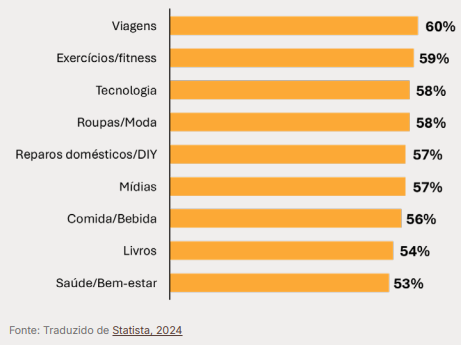
Source: Translated from Statista, 2024
We have already analyzed materializations of this dynamic in the publications “Teachtok and the New Learning Journeys” and “Booktok Brasil and the New Literary Experiences,” in which we explored how content creators promote reading and education on TikTok.
Thus, this research is born from the conviction that the active listening of content creators in regulatory discussions is not circumstantial; it is a necessary condition for creating effective mechanisms that balance the interests of the various agents operating in the influence market. Reglab, through the series: “From Feed to Floor” and “From Feed to Planalto,” sought to document
how the Brazilian government views digital influencers and, now, “Voices of Influence” adds another perspective. If before we analyzed how they are seen, now we seek to understand how they see themselves. With this in mind, this work documents a collective effort of listening and analysis.
Through interviews and focus groups, we sought to understand the perceptions, dilemmas, and routines experienced by content creators. By combining Reglab’s academic rigor, Redes Cordiais’s experience, and the direct voice of these individuals, the objective of this study is, ultimately, to provide empirical inputs that enrich
the national discussion and the dialogue with public authorities on self-regulation, regulation, and professional recognition of content creators.
What is presented in the following pages is an autonomous and preliminary research report. It constitutes a diagnostic foundation for future proposals to reflect the needs and dilemmas expressed by content creators.
METHODOLOGY
This study adopted a qualitative approach of an exploratory nature, designed to capture the complexity of perceptions, ethical dilemmas, and daily practices of Brazilian content creators.
This was made possible through the partnership with Redes Cordiais which, given its reach and history of articulation in the sector, was responsible for recruiting creators from its relationship network, while Reglab led the methodological design of the research and the technical conduct of in-depth interviews and focus groups.
The prioritization of narrative depth over statistical representativeness seeks to more thoroughly explore topics that are transversal to different experiences in the influence market. Thus, the data can support the construction of norms based on the reality of these agents.
The following were conducted:
11 2 focus groups
semi-structured qualitative interviews with content creators.
with content creators, totaling 13 participants.
To analyze the collected data, we used thematic analysis, a qualitative research method that identifies recurring patterns and themes in participants’ statements. The process works in three stages:
- We carefully read the transcripts and marked the most relevant excerpts. When necessary, we assigned each a code.
- We then grouped these codes by similarity, creating larger groups that function as categories.
- Finally, we organized these categories into themes, which represent the most important patterns found and structure the analysis, as can be seen in the chart below.
This method ensures that our conclusions are based on what those interviewed actually said. The complete methodology can be found in the annex of this report.
The interviews and focus groups reveal that suggestions and perceptions are diverse, a hallmark of the plurality inherent in the content creator activity. Among the 60 themes
identified in the statements, the 10 most frequently cited are:
- Defense strategies against hate and crisis management
- Exposure and online toxicity impact mental health
- Need for value alignment in advertising
- Attempts at humanization and dialogue in the activity
- Importance of admitting mistakes and correcting them
- Self-definition as creator, communicator, or artist
- Stigmas associated with the term “influencer”
- Lack of platform support for content creators
- Need for rigor and fact-checking in content creation
- Content creation process
RESULTS
From influencer to content creator: a question of identity
There is an evident tension in the way content creators identify themselves. The debate shows a conscious effort to avoid the term “influencer,” which frequently carries a pejorative connotation. The concern about the profession’s name reflects a desire to signal to the market and to the public the real scope and technical value of the activities performed. This happens because the term is associated with ideas such as superficiality, leading professionals to adopt words that prioritize technical competence and intellectual depth.
1.1. Self-designation as “creator,” “communicator,” or other activities
To combat stigmas and professionalize the content creator’s image, participants use different identity categories:
EMPHASIS ON CREATION AND ART
The preferred term is “content creator.” It shifts the focus from influence to the activity, and content becomes seen as an extension of the creator’s professionalism and artistic talent, seeking recognition for the substance of what is produced.
“
I feel that the word creator — because there’s also a lot of Americanization, with influencer, creator… — content creator has always warmed my heart more, because I saw that the influencer, perhaps, would compete more for attention, so anything goes. The content creator I see more in that place of genuinely creating, of there being an almost artistic process, of you transforming something into something that has your identity, your traits, speaking directly to your audience. I don’t know if it’s just a distinction my subconscious made so I could face it in the best way, but it’s something that brings me a great sense of relief to think about.
INFLUENCE AS A CONSEQUENCE
“
Participants seek to invert the logic of the term, asserting that influence is the consequence,
not the main objective of the work they do.
I much prefer the term content creator, because, well, that’s it, we will influence, we can’t, you know, pretend that this responsibility isn’t on us. We do influence. But I think that’s it: we’re influencing [as] a consequence of producing structured content, starting from a point, from something that truly adds value and not just influencing for the sake of it.”
“
Terms such as “communicator,” “writer,” “speaker,” and “entrepreneur” are used to anchor the digital activity in established
training or occupations in the market, making it easier for the public to understand content creation.
I have the biggest difficulty when someone asks me what I do, I say: ‘Do you have time?’ Because it’s difficult to explain, right? So, sometimes I say I’m a writer too, sometimes I say I’m a communicator.”
SOCIAL AND POLITICAL ROLE
There is a perception that content creators are the new opinion formers. They occupy spaces for claiming rights and public debate, elevating the function beyond advertising delivery.
We are also communicators. When people understand that we communicate, that we speak, that we can truly change things, holding authorities accountable, pressing deputies, senators to make changes — including within society — I see that it will be much better.”
“
The rejection of the “influencer” label (and also the “blogger” label) signals a search for professional legitimacy. By choosing new ways to name themselves, these professionals develop a way to communicate to the market and society the ethical and intellectual value of their production.
1.2. Primary vs. secondary career: the two faces of the profession
The practice of digital influencing is divided into two main models: a primary career with exclusive dedication, and a secondary one as a complementary activity. This choice directly shapes the professional’s relationship with risk, creativity, and time management, and choosing one model or the other depends on factors such as the creator’s maturity stage in the market.
INFLUENCE AS A PRIMARY CAREER
Exclusive dedication is motivated by high earning potential, but it comes with insecurities, especially financial ones.
- The advantages and motivations mentioned include, for example, high earnings potential, flexible hours, autonomy, and in some cases, the identity of a digital entrepreneur.
- The challenges and risks cited include financial instability, since income is directly tied to network performance and commercial partnerships. Additionally, there is constant pressure for engagement results,
as well as a perception of dependence on platforms and vulnerability in relation to changes in engagement logics, bans, or failures that can drastically affect the creator’s primary source of income and visibility.
“
Living off a profession that didn’t exist 15 years ago. So, when I stop to think about it, I feel it’s a privilege — I’m my own boss, I make my own schedule, I have my own ideas and I can apply my ideas. I think that’s something that, when analyzing the society we live in, the capitalist system we live in, very few people are able to truly work with what they love, you know?
INFLUENCE AS A SECONDARY CAREER
Some professionals maintain a more traditional career and use influencing as a supplemental income or “creative refuge.”
- The perceived advantages were less pressure in content creation — which exists because of the greater financial security provided by the other job — and greater creative freedom, given the lack of urgency for immediate commercial results.
- In general, the statements did not go very deep into the challenges and risks of influencing as a secondary activity, but reveal that, especially in the early stages of their journeys, overlapping roles requires sacrificing leisure hours
and rest, creating a physical and mental overload when balancing the two professional identities.
“
So, how did I create content? Before, when I had nobody, I would wake up at 4 in the morning to edit a video, it was just me, right? So, I would edit, work, wake up at 5 in the morning, take four buses, record with my phone, arrive home exhausted at 11 at night to work, and I was also in college.”
1.3. Negative perceptions of the term “influencer”
The “influencer” label faces significant resistance among the professionals themselves, being frequently associated with fragile ethical conduct and strictly commercial motivations. This stigma derives from the perception that influencers have their activity restricted to selling products, with a lack of technical depth in the content. However, this negative perception does not appear to be universal, since the term still has strong communication power and is quickly understood by the public. The main perceptions identified were:
AVERSION TO ADVERTISING AND DUBIOUS ETHICS
There is a stereotype that the influencer’s role is limited to stimulating consumption, without “producing actual content.”
This exclusive association with selling and advertising generates aversion, since many professionals believe that sales should be a consequence of content, not its only purpose.
But then when they call you an influencer, we’re like, no, hold on, I’m not in that group, I’m doing something here, you understand? I put in the effort, I write quality scripts, I deliver, I add value, right? You’re going to put me in the same box as the girl who was selling casino affiliate links, you understand?”
“
DECEPTIVE CONNOTATION AND LOW WORK LEGITIMACY
The term can also evoke the idea that the activity does not constitute real work, being seen as a way of generating financial gain without significant productive effort.
I think it’s a double-edged sword like that, because at the same time that many people dream of being an influencer, there are many people who massively tarnish the profession. Especially nowadays when people think of influencer, they think of people who are deceiving others, who are making money without working, without making an effort, you know?”
“
LACK OF GENUINE CONTENT
The image of the influencer is often linked to superficial lifestyle content. This creates a gap for professionals who seek to deliver “substantive content” and intellectual value.
They don’t effectively produce any content. They’re just there all day influencing you to buy what they put on their lips, on their hair, on their skin, the clothes they wear, the places they go, the restaurant they frequent.”
“
FEELING OF DEMERIT
Some professionals feel that the term “influencer” is used as a way to underestimate their technical, academic, or professional authority.
“
I much prefer to use the term content creator rather than influencer, because what I perceive is that when someone questions it, it’s very much in the sense of diminishing you. So, ‘oh, are you a blogger?’, ‘are you an influencer?’ — not out of curiosity, but truly to diminish.”
Counterpoint found: One interviewee in the Focus Group observed that, although the term “content creator” is the preferred one among professionals, in environments outside major centers like São Paulo, the word “influencer” seems to be more easily understood and viewed positively. This statement suggests that, although the term carries a negative stigma among professionals themselves — as will be discussed further — it has greater tangibility power for the general public or in specific regional contexts, being an already consolidated label for the activity.
1.4. The dream of being an influencer: social mobility and a career for youth
Content creators reported perceiving that this profession has reached the status of an aspired career by the new generation, equating — and in some cases surpassing — old dreams of success across various social realities. Some participants’ accounts position content creation as the new symbol of success in Brazilian society:
REPLACEMENT OF THE OLD IDEAL
The most powerful metaphor that emerged from the discussions points to a change in the pantheon of dream careers.
People used to dream of being soccer players. Today people want to be content creators, create their content at home, monetize, and do advertising.”
“
VISIBILITY AND RECOGNITION
In the perception of those interviewed, young people see the influencer career as a path to instant notoriety and fame — something that can attract far more interest than traditional careers with longer and less visible pathways.
Man, being an influencer is in a place that’s about the dream of changing your life. Like, I’m hungry, I’m going to make a video, I’m going to make money, I’m going to help my
“
mom, you know? Which is the same as in that environment of desperation — it’s the same as me looking to the side and saying: “those guys are there selling drugs with guns in hand, but they’re cool, I’ll deal too
because I’m hungry, right?” So, there’s the glamour, right? (…) this is a new fuel for desperation, like, man, influencing changes your life.”
These accounts show that, in different contexts, the influencer profession can be seen as a symbol of success and social ascent, symbolizing the hope for a better life.
The content creation process reveals best practices and points of tension
Discussions about the content creation process among professionals reveal great concern about the quality, accuracy, and social responsibility of the material that is published. Far from the image of improvisation and spontaneity, creators demonstrate a conscious effort to adopt best practices aimed at transparency and a positive impact on their audience, especially on topics of great public relevance.
Digital content production, for many professionals, is a structured process guided by the responsibility and accuracy of information. This movement is driven by creators’ desire to consolidate their credibility before a diverse audience, adopting fact-checking and transparency practices. However, this pursuit of accuracy constantly faces the challenge of platform speed, where the urgency for “hot topics” can compromise the quality of the information published.
“
It’s not that only formally trained people should give opinions, but I think you have to research very thoroughly and bring your sources for where you got that information.”
2.1. Credibility and democratization of language
Creators demonstrate a conscious effort to balance technical knowledge with accessibility. The strategies identified include:
ACCESSIBLE LANGUAGE
The simplification of complex topics is seen as a tool for democratizing knowledge. The goal
is to remove barriers to understanding and avoid jargon that alienates the lay public.
[My audience] became something much larger — people from very different places, with very different careers, repertoires, and backgrounds. So, there are
even some content pieces where I say: “Wow, I made a mistake, I was too technical.” There are people who follow me who don’t have that repertoire. So, I use terms that I need to explain; if I used English words, I need to immediately provide the translation. So, I have to keep monitoring myself: ‘wow, very different people follow me,’ so I need my content to be well-received and understood the way I’d like.”
“
CRITIQUES OF THE STRICTLY TECHNICAL SPEAKING POSITION
A minority of the statements warns that the requirement of formal education to create content on platforms can be elitist. Even so, the concern with information credibility remains, especially on sensitive topics.
Part of me looks and says: ‘Hold on, so only formally trained specialists can speak about things on the internet.’ Hmm, that sounds a bit elitist to me, you understand? That sounds right to me when I think of a doctor, but sounds a bit [wrong] when I think of perhaps other types of professionals. Do you understand? I don’t think it’s a simple matter.”
“
AUTHORITY AND CURATION
Although there is a concern that the requirement of academic training may be elitist, technical qualification is still valued as a trust seal for content.
Most content creators who genuinely create content are trained: that person who talks about biology is an actual biologist. That person who’s talking about business has a business, is trained in business administration.”
“
RIGOR, FACT-CHECKING, AND TRANSPARENCY
To compensate for the lack of formal expertise in specific areas, many professionals resort to hiring technical consultants to review scripts and validate data at different stages of content creation. Participants revealed having some self-regulation practices that seek to bring their content as close as possible to a responsible standard. This concern among creators with rigor and fact-checking of their sources is evident, reflecting a pursuit of transparency with their audience.
2.2. Admitting errors as best practice
Admitting mistakes and correcting information has been established as a best practice for maintaining trust with the audience. Instead of hiding errors, content creators use public correction as a reinforcement of honesty and as a pillar of credibility.
“
We always like to have a specialist, including to give their name and credentials at the start of the video so people feel comfortable with the information, because since I’m a host, I want people to feel comfortable and for us to have a name so that if anyone wants to contest any information, we have a professional here, with credentials, a well-known and highly respected person with a lot of knowledge, who will back this up.
STRENGTHENING TRUST
The act of publicly admitting and correcting an error is perceived by creators not as a failure, but as a reinforcement of honesty and the relationship with the community, since
“
Eventually you’ll make mistakes. I’m not afraid of making mistakes, I’m afraid of blinding myself to that mistake, and then you need to have a lot of maturity to understand what constitutes a mistake versus what is just a distorted view from someone who is speaking out of turn, right? (…) Mistakes will happen eventually, and they’ll continue to happen. When I have the chance, if it’s a very serious error that harms the information, then we replace the video, we swap it out, right. But we have today a verification stage with specialists that is quite thorough. It’s very difficult for something to slip through.
it demonstrates the valuing of truth and respect for the audience over the maintenance of a perfect image. On the other hand, creators’
accounts indicate that, many times, the reach of the corrected content ends up being lower than that of the original content.
STRATEGIC RECTIFICATION
“
There were accounts from creators who choose to keep the post with an error live for a
certain period, using the comments section to flag the mistake before permanently deleting it. This strategy reflects reputational concern in the face of errors, and avoids sudden deletion generating information vacuums or unfounded rumors.
When I publish something incorrect, I usually leave it up for a little while and respond to comments, because I think it’s important for people to see that it’s wrong. Then I go there, delete it, and say something in my stories, because I think it’s also important to have that moment of ‘oh, this is wrong,’ not just delete it and pretend nothing happened.”
Influence goes beyond consumer and entertainment topics. The concern with topics of public interest demonstrates the responsibility that many creators take on as communicators.
EDUCATION AND PUBLIC UTILITY
The educational role is heightened in sensitive topics, such as public health. Creators say they use their reach to promote validated and fact-checked information, emphasizing the importance of disseminating scientific data and consulting specialists to ensure the quality and safety of information. Also regarding health content creators, accounts centered on content published on networks during the COVID-19 pandemic. By focusing on topics of
social and public interest, content creators reinforce the association between influence, education, and public debate.
“
We protected ourselves by staying on the side of the scientific evidence that was available at that time, right? And years of work also ensured that we had a roster of consultants we trust and whose qualifications we know. So, we would take refuge there, saying: “Look, we’re here, this came out in this study, this person said so, they have this position,” right? So, we did defend ourselves.”
A point of tension is the conflict between the rush to participate in current debates and the risk of propagating disinformation.
“
At the beginning of my career as a creator, I had a period where I thought that spreading reports was something positive, but in that race to spread reports, sometimes you pass along wrong information. (…) Then you take the video down, make a story apologizing, right? But the thing is, you have no control over the algorithm, so sometimes the report reaches somewhere and the correction doesn’t, you know? So I stopped reporting things because I said: yeah, let the journalists fact-check the information, let them do their job — sometimes we’re pressured to help and end up making things worse.
Participants’ statements indicate that the attempt to “help” with social reports, without proper fact-checking, can cause irreparable or hard-to-resolve damage. Experiences such as these have led to a change in posture: one content creator reported having chosen to change the direction of their content, stepping back from hot topics, to avoid sharing incorrect information:
Interaction dynamics: community management and mental health
The relationship between the content creator and their audience is a fundamental aspect of the profession, but also represents a major vulnerability, since professionals must balance openness to dialogue with an exposure that is frequently toxic. To remain on the networks, creators seek to establish strategies and boundaries that protect their integrity without breaking the bond of closeness and trust with the community.
3.1. Between dialogue and exposure
Continuous interaction in the digital environment carries a significant psychological cost that affects everything from the direction to the sustainability of the content creator’s career:
EXPOSURE AND TOXICITY
The existence of harassment, hate, and destructive comments is a constant. This exposure requires the professional to develop resilience mechanisms.
“
You realize there’s a constant hatred in people. They’re always waiting for you to slip on a banana peel so they can say: ‘See, you did that.’ People seem to always be ready to show whatever bad thing you do. And then there comes a moment in life when you no longer have the emotional strength for that, right?
SELF-CENSORSHIP ON CONTROVERSIAL TOPICS
The practice of self-censorship emerges as a strategy for emotional survival and career preservation in the face of digital toxicity. The fear of
attacks and the negative impact on mental health leads many creators to avoid taking positions on sensitive topics. This strategy ends up limiting the creator’s authenticity, who begins to filter their content not only by editorial criteria, but also out of fear of
retaliation and negative career impacts, including financial ones.
Has there ever been a situation where I thought it was better not to speak about a topic? Every single day, basically. (…) I ended up doing a lot of work to filter which situations I’ll speak about, topics I’m truly willing to face.”
The people who follow me know my political stance, know what I believe in, know what I talk about and so on. The times I avoid speaking are because I know the other side will come at me with full force, and I’m not someone who can handle that right now. I’m not someone who can handle a scenario of, I don’t know, ‘bots and all that taking down my profile,’ which is my source of income.”
“
“
PRESSURE FOR ENGAGEMENT
The use of metrics like likes, shares, and views to evaluate work performance creates pressure for uninterrupted productivity. The value of work comes to be measured by numbers considered volatile,
“
This, for me, profoundly harms our communication, because it prevents people from being able to receive what they clicked to receive, you know? It’s an illusion. So, the algorithm profoundly harms my content creation, completely drains my desire to create, and I wish people could receive what they clicked to receive. When I create content, today I don’t create just thinking about the message — I have to think about how I’m going to package that message to stand out in a sea of pollution, of AI slop, you know? Of brain rot…
which contributes to states of mental exhaustion.
SUPPORT STRATEGIES
The search for professional psychological support and the formation of support communities — whether fans or people close in personal life — are
mitigation strategies mentioned. The exchange of experiences with other professionals serves as a refuge and validation, but occurs less frequently than many content creators would like.
“
When people send me very kind messages, I take a screenshot and save them in a little folder in my drive of happy comments like: ‘Oh, I got a scholarship you shared,’ ‘Oh, I found my career path because of something you shared,’ and so on — positive things where I say: man, that’s why I create content.”
THERAPY
“
I’m someone who really likes talking, speaking, exchanging with people, but I have to say that the content creator career is sometimes very lonely, because it’s difficult to find those connections. I have friends I made on the internet who work on similar topics to mine, others on completely different things, and I try to bring this a bit closer, because sometimes we’re left wondering, not knowing if it’s just us, if it’s our content. Anyway, I think exchanging is always good, always very important.
Several accounts point to therapy as a habit that helped creators deal with hate speech on the networks, ranging from comments on posts to messages in DMs (direct messages).
I started therapy in 2020 partly because of that, because I didn’t know how to deal with everyone commenting that they love you, and also people saying they hate you for no reason — because the hate comes whether you’re doing good work or not, but largely because you’re standing out in some way. So, for me it was something very difficult to deal with, because I thought: ‘How can you think I’m horrible? You don’t even know who I am, you don’t know me, you don’t know my family.'”
“
3.2. Protection and moderation mechanisms
Faced with high exposure to criticism and hate speech, creators develop protective tactics for themselves and their communities.
FILTERING AND MUTING
The use of platform native tools, such as
keyword filtering and muting users, is the most
frequently mentioned way of dealing with hate. These are resources that aim to protect the
interaction space between users and prevent the content creator and their community from being surrounded
by negativity.
BLOCKING AND DELETION
“
One thing I’d recommend to any content creator you interview is: “Never block the hater — mute them.” So, what do I do? When a hater comes to insult me or offend me, I don’t delete the comment. On Instagram we delete depending on the offense, but most of the time what I do is mute the person. There’s a very interesting tool on Instagram where the person is responding and commenting on your post, but they don’t know that it’s not reaching people. It’s as if they’re talking to themselves.
Especially in serious cases, such as racism or threats, blocking users and deleting comments are used as security measures.
At the same time that it’s not my responsibility to educate people, sometimes what I choose is to not let it stand. A crime is not an opinion, so some things I delete saying: ‘Sorry, you’re not.’ And sometimes I respond and say: ‘You’re not going to say that here.’ I say: ‘You’re in my space, this profile is mine, I don’t want that kind of thing here.'”
“
REACTION AND POSITIONING
Although muting is the general rule, taking a public stance against attacks also happens, even if less frequently, especially in moments of tension or stress.
“
Sometimes I get more mouthy, sometimes I’m running low on ideas, I go there and write a long response, or I say something dumb, or I go to the person’s profile and write terrible things on their photos too, just like they did on mine. I love doing that when I’m out of patience. It gives me a sense of ‘here, take your embarrassment back,’ you know? (…) But generally I just block or delete, block the person, or that’s it — I don’t spend much time reading everyone’s comments.
3.3. Attempts at humanization and dialogue
Although toxicity requires building barriers, the essence of content creation work lies in the ability to build an authentic dialogue relationship with the audience.
Humanization attempts seek to bring creators and followers closer in cases where the audience is suffering negative comments from third parties.
It’s already happened that a follower defended me. And there were people there insulting and offending… I’ve sent messages, especially to those people, because I’m already used to the volume of people liking and commenting. That person, sometimes, has two followers, has been following me, and suddenly has 50 people talking at the same time. So I send them a direct message. But, in my opinion, it’s also very much the platform’s fault. The platform needs to bear responsibility for the things people post.”
“
SELECTIVE DIALOGUE
Content creators prioritize interactions that generate value, such as healthy debates, constructive feedback, and clarification of doubts, strengthening authority and closeness with followers.
If the person said: ‘hold on, you said this, but actually it’s this and this’ and provides an argument, there I do have some reason to interact with that comment. But just expressions of hatred and revulsion on the networks — no. You learn that you really don’t need to and it’s part of the game, you know? You can’t get worked up about it.”
“
I don’t always comment, but I do take a position when I need to. Whoever doesn’t take a position on anything, whoever stays neutral — I’m not like that. For me, neutral is just soap, people. There’s no such thing as neutrality, especially when we’re talking about certain topics.
“
CONTENT CREATION FROM HATE MESSAGES
Some content creators adopt the tactic of converting negative messages into new content, as an opportunity to pass on new information and interact with the audience.
I do this curation of the messages I’m going to screenshot, post in my stories, and we’ll follow up with a productive debate. And what I’ll leave alone — that I won’t screenshot, won’t share, and nobody will know existed, except the person who sent it. So, I can have that control.”
“
FROM HATE TO DIALOGUE IN THE DMs
“
Sometimes the person thinks I won’t see the message and sends something super ‘rabid dog.’ So I respond and say: “Hi [name], I didn’t quite understand what you meant, could you explain further?” And the person completely changes their tone and says: “No, sorry, that wasn’t what I meant, I just wanted to say this and this.” And I say: “Oh, I didn’t understand.” But do you get my point? And we have a great conversation, we find common ground.
In specific cases of messages in the comments or DMs, dialogue is used to defuse conflicts and create a possibility of exchange with the hater themselves.
WELCOMING PEOPLE IN THE DMs
Some creators reported that there are cases of followers in vulnerable situations who seek support from the creator through private messages. In these cases, creators indicated that the general conduct has been to redirect the follower to authorities or organizations that can provide specialized assistance.
That was heavier — I received both very negative messages and messages from people who needed to be supported.
“
People started using my inbox to vent and ask for help: ‘I’m going through what you went through, help me.’ And then it’s about having this awareness — I always responded: ‘It’s not me who will help you.’ (…) In general I ask the person to seek care at the local health center, ask the person to contact Cras [Social Assistance Reference Center], things like that.
“
I think it’s two weights like that, because you also have to deal with welcoming other people you don’t know, situations that you end up going through too and that
person ends up going through too.”
The relationship with brands and advertising is, in many cases, the core of monetization of the influencing activity for professionals who work with creation full-time, but can also be a source of ethical dilemmas and conflicts of interest for creators. Perceptions about “sponsored content” reveal that the professional is a curator of proposals, applying integrity criteria to protect their credibility and the relationship with the audience.
4.1. The need for value alignment in advertising
An effective advertising partnership is understood as an organic extension of already-produced content, not as an interruption. Therefore, it must be aligned with the creator’s brand identity and the values of their community.
This content needs to be as close as possible to any other of ours — if not identical.”
“
To ensure this integration, creators adopt the following criteria:
THE AUTHENTICITY FILTER
There is a consensus that a promoted product or service must be aligned with the professional’s values. The refusal of proposals that diverge from the creator’s principles or the lifestyle shared with the community is seen as a necessary brand preservation practice, since
the focus is on ensuring that the commercial message does not compromise the content creator’s personal narrative.
The first thing is for me to believe in the product. If I don’t believe in it, I can’t bring myself to talk about and recommend something to my audience that I don’t believe in.”
I can produce the content, but it has to have my face — I can’t lie to my audience in any way.”
“
“
PRODUCT TESTING BY THE CONTENT CREATOR
Prior testing of the products or services being advertised is seen as the ideal conduct standard. When direct testing is made unfeasible by logistical issues, the professional resorts to analyzing the brand’s reputation and market consolidation to mitigate risks.
Something I use personally is even better, but sometimes, you know… a computer brand came along that isn’t
“
exactly the one I use. But I know it’s a great computer, so I think: ‘Okay, but how can I fit it into my routine?’ People don’t say ‘Oh, but she doesn’t use it.’ I say: ‘Okay, but I’m giving other possibilities.’ Sometimes what I use also doesn’t fit people’s budget, so this one, why is this one good and might fit…”
There are products I’ve never consumed, but when the brand comes to me, I say: ‘Oh, I’ll try the product
and see if I like it, right?’ So, for me there’s no problem if a product I’ve never tried comes along, because I can try it and tell my audience what I thought, right? So, that’s not a problem for me, but I do try to create something honest, something that will please the brand, something that will please the audience, right?”
“
DIFFICULTIES IN TESTING PRODUCTS
Short deadlines and the sending of products only after contract signing are identified by content creators as obstacles to the ideal of product testing, pressuring the creator to make decisions even without the possibility of in-depth product knowledge.
I think maybe creators who are bigger, they say: ‘Great, you want to work with me, I’m going to spend a month, or at least a week, testing this product before.’ And the brand sometimes ends up allowing it. But the deadlines are normally things that are extremely absurd. So, many times… no, I think never once was I able to test calmly before signing
“
the contract, before accepting. It’s like, ‘we’ll only send it to your place when everything is all wrapped up,’ so you end up accepting risks.”
REFUSAL OF UNETHICAL ADVERTISING
Content creators said they are totally opposed to promoting products they consider harmful or whose promotion is seen as unethical given their professional context. The main example cited was online gambling (betting) platforms, but also alcoholic beverages and, in the case of health and beauty, medications and cosmetic treatments.
I’ve never done betting ads in my life. I’ve been offered more than a million to do betting ads — something that would change my reality, would solve a million of my problems. But I won’t do it, because I don’t think it’s right, you understand? Everyone does
“
what they think is right, you understand? Everyone manages their own image, their own management, their own things. I have my principles and I believe that from the moment I violate those principles, I lose credibility with my audience.”
Alcoholic beverages I can’t do. I can’t do it, I talk about health, you know?”
‘Do you do betting ads?’ Man, I don’t do betting ads. ‘There’s an alcoholic beverage commercial.’ Man, cool, but I don’t drink beer, I’m not going to do a beer ad. So, I don’t do anything I don’t consume. I don’t do anything that destroys people’s lives.”
“
“
“
We don’t advertise treatments. We’ll never say… actually, we very much avoid using commercial names for medications.”
4.2. Other concerns in advertising
An important point of discomfort addressed by content creators is the perception that certain brands try to use the professional’s credibility and respected image before their audience as an opportunity to cover up questionable internal practices and get around image crises.
REPUTATION AND LEGITIMACY
Creators show sensitivity to the idea of being used as a tool for brand image crisis management. Promoting a brand whose track record does not reflect the values of transparency, diversity, or sustainability of the creator’s community is seen as a high-risk damage to reputation. This concern requires the creator to research the history and culture of the partner company before closing contracts.
“
Brands have already come to me with an advertising proposal. And when my agency went to research, they discovered that it was crisis management — they wanted to associate themselves with my image to clean up some cancellation the brand had gone through. And then we say: “God save us,” right? So, personal values — I think that’s something very important, right? Brands that are aligned with my values, not brands that [had some reputational crisis] and are wanting to suck up my values to clean their image.
Despite the need for value alignment and reputational concern being the main aspects mentioned as essential to advertising, content creators also reported that
“
Sometimes, I see some people who do something hidden, [where the ad label] is only at the very end, and the reach is much higher, but I don’t think it’s right in the end. So, mine stays there very prominently. I think a lot of people skip it because it’s advertising, but at least I feel at peace.
there is an effort to engage in transparent advertising, in a pursuit of mitigating the legal risks of the activity.
4.3. Relationships and conflicts in the influence chain
The relationship between creators, agencies, and brands, analyzed based on the interviewees’ previous experiences, reveals a structure of interdependence that, while professionalizing the sector, generates friction and lack of transparency.
Influencer agencies act as positive organizational filters for the legal and commercial aspects of the influencing activity, but the fragmentation of the process across multiple parties frequently results in communication failures and deadlines considered abusive.
PROFESSIONALIZATION AND CURATION
For many creators, the agency is an arm that ensures legal security, pricing support, and contract intermediation. This closeness allows the professional to focus on creation, while the agency works on prospecting brands aligned with the creator’s profile.
I was with an agency, I spent 4 years with an agency when I started. It was very important for me to understand the market.
“
You can’t complain about that. I learned a lot about how to price my work correctly so as not to be
exploited. But there are many other agencies that come along and start manipulating the creator, thinking they’ll never be able to do things on their own.”
We have a very good experience [with the agency], with a team that knows you, that already knows… All the legal and contractual work, and even the prospecting, is done based on that relationship. So, we have our group chats with the people, we talk every day, we know the team, we know what’s happening, we have access to emails, for example — we know
everything that’s going on. So, it’s a very positive experience and in this arrangement we feel very comfortable.”
“
LACK OF TRANSPARENCY
In contrast, a lack of clarity in negotiations is a critical point. Reports of absence of access to important emails, contracts, and negotiation flows generate insecurity and financial instability, preventing the creator from having real control over their career.
“
And regarding the agency, I didn’t have one, but the PR firm already caused a very big conflict. It was the biggest conflict in 5 years, and it was about lack of clarity. I didn’t have access to emails, I didn’t have access to how negotiations were going, I didn’t have access to contracts — this made me very insecure. And I was closing deals, there were good things being closed, but one month a good amount was closed, another month nothing was closed, and then nothing again, but ‘we’re working on it, we’re working on it’… and I wasn’t seeing these emails. So, it was a very difficult process for me.
CONFLICTS OF INTEREST IN RELATIONSHIPS AND CONTENT
“
Look, I think all work ends up being a bit tumultuous, because I feel that, in the vast majority of cases, there are four parties acting, right? So, me, my agency helping me, the agency helping the brand, and the brand. So, sometimes I get feedback and I think: ‘Okay, but was that from the agency or from the brand?’ And the deadlines are crazy — sometimes the briefs don’t come very complete, the deadlines are always super crazy too. So, it often becomes a game of telephone.
A common challenge is the imposition by brands or agencies of rigid briefings that don’t connect with the audience. The creator resists being treated as a “face” for the delivery of ready-made messages defined by third parties.
I’ve never done anything like that, handing it over to an agency to produce. And I would be very afraid, to tell the truth — not for anything, but because I think the interests are different and the work is different.”
“
Sometimes, they’re companies I think are great, I say: “Man, really great.” But then when I start putting down 1000 rules, like, I want to have the right to speak, I’m going to choose how the content is… ‘Ah, no, but we’ll create the content.’ Okay, but I want to approve it first, so… and so on. Then it ends up not working out.”
“
I think they have a very narrow view of the audience, so they come to me for the numbers and then want to teach me how to speak to my audience.
And many times they come with a briefing where I say: ‘Loves, this here isn’t going to connect with anyone who follows me. This has nothing to do with it,’ but ‘No, but we thought it this way…’. But aren’t you paying for my voice? Then let me speak. That’s why I do so few sponsored posts, actually — because I stand my ground and say: No, I won’t. You’re not just going to use my pretty face. That’s it. That’s not how it works!”
“
FEELING OF OBJECTIFICATION
“
I’ve also been managed by an agency, it wasn’t a good experience. (…) It’s not always a great thing, especially when you have exclusivity. It’s not great, because the agency will never be interested in selling you. They’re interested in selling any of the people they have in their roster.
Some content creators criticized the logic of agencies that focus on selling “character options”
from catalogues, rather than developing individual careers, reducing content creators’ bargaining power.
ABUSIVE PAYMENT CONDITIONS
Abusive payment practices — especially by large companies that impose 60, 90, 120-day or longer deadlines on smaller suppliers — constitute a structural problem that stifles the cash flow of many content creators.
“
Another thing I’ve also experienced when I closed advertising deals with agencies is this thing of 60 to 90 days to pay. You do the work and spend 3 months to receive payment. And like, I have people I know who work at agencies, acquaintances, who say: ‘No, the money is in the agency’s account.’ You understand? And like, why 90 days to pay the influencer, you know? So, I think people take advantage of influencers, take advantage of the platform, of people who work with this, and don’t value them.
EXCESSIVELY SHORT CREATION DEADLINES
“
Things normally arrive very rushed to us, very without a timeline. The person says ‘I want to run this campaign next year.’ Then they spend 10 months deciding whether to do anything at all, sends it to us, it arrives already delayed, and it’s our fault for not delivering by the day they asked. (..) So, I think there’s a bit of disrespect from them toward us, as if only we needed them and not the other way around, you know?
According to the accounts, the imposition of excessively short deadlines by brands and agencies
compromises important stages of the content creation process. This commercial urgency ends up forcing the professional to choose between the financial viability of the partnership and technical rigor, harming the deliverable.
POWER ASYMMETRY
Creators who have influencing as their exclusive career feel more pressured to accept abusive conditions or controversial conduct to guarantee their monthly income. This risk seems to be lower for professionals who maintain other sources of revenue, giving them greater freedom to refuse partnerships.
But I feel that sometimes creators who are on their own — man, standing up to the client is very complicated when it comes to the brand, right? Sometimes they’re very insistent, and you think: ‘man, but I don’t want to lose this work’ or ‘I don’t want to create tension with the brand’… So
“
you end up accepting things that at first you wouldn’t accept.”
So, having my bills paid by my other job gives me the security to produce content the way I want, at the pace I want. And that’s a privilege that makes all the difference. If I were being forced to produce content for any brand that
approached me, even if there was an ethical conflict and I was super uncomfortable… I turn down brands all the time, because I’m not comfortable doing it that way, no.”
“
Platforms are an essential infrastructure for digital work. At the same time, participants frequently perceive them as a source of operational insecurity. The management of these ecosystems is considered barely
transparent, especially regarding content moderation criteria and the limitation of direct dialogue channels with the responsible companies.
“
Wow, I think the platforms are extremely insecure. I think accounts should be linked to CPF [Brazilian taxpayer ID]. We need to have some traceability. I find them super super unstable, insecure. I feel very insecure. Any person, any hacker, can access an account, hack an account, take down an account. Thiago Chavoso — Chavoso from USP has had his account taken down for the third time because people keep hacking and taking it down, because he speaks against the system. So, I feel very insecure with social networks, because they give me no type of security support. Even when I report something, their analysis is that nothing happened.
5.1. Moderation of harmful content
The main criticism from content creators is directed at the inefficiency or selectiveness of platform moderation systems. In general, participants state that companies apply their own guidelines inconsistently.
MODERATION INCONSISTENCY
Creators point to a significant disparity between what is quickly removed and what is allowed. In their perceptions, relatively harmless content can be removed quickly, while harmful content, hate speech, racism, or disinformation remains available for long periods.
I’ve already reported a million absurd things I’ve seen — not about me, but in general — and nobody took them down, right? They say: ‘No, no, it doesn’t violate
“
our guidelines.’ Then there’s a woman breastfeeding, that violates the guidelines. But anyway.”
I see some content, for example, that to me is racist, you know? And then I report it, man, but that content won’t come down, I know that. I report it because I need to report it, but I know that content won’t come down; an excuse will come: ‘oh, this content doesn’t violate any rights’, but I’m seeing that it does violate and many other people are seeing it.”
“
NON-TRANSPARENT ENGAGEMENT LOGICS
Another recurring concern relates to the perception of ‘randomness’ in platform engagement logics. The
creators report not knowing the criteria that determine the reach and distribution of their content, which makes strategic work planning difficult. This opacity is perceived as a harmful force that further deteriorates the relationship between platforms and creators.
The person enters this content creation world without knowing what to do. They throw content onto the platform, it’s
Russian roulette, see what takes off, we’re completely lost, there’s no guidance, nobody knows how the algorithm works, the algorithm changes every week, someone’s always coming along saying: “The algorithm changed, before it was 15 seconds, now they want longer videos, before it was without editing, now we want content that seems authentic, right? And it needs to have retention, now it doesn’t anymore.” So, it creates instability in us.”
“
5.2. Debate on civil liability
In line with discussions about Article 19 of the Internet Civil Rights Framework, creators present distinct views on the burden of responsibility. In general, the statements call for greater accountability from creators for the content they publish; when the subject is third-party comments on posts, there is considerable divergence:
OWN CONTENT
Among those interviewed, there is a consensus about the need for content creators to be
responsible for their publications. In identifying themselves as authors and curators, they agree that there is a duty to publish truthful posts,
condemning the pursuit of engagement through harmful content.
I think people have to be held accountable for what they say on the internet. We’re living through an epidemic of disinformation on all social networks, because that’s it: once it generates money, we create a very worrying dynamic, because if money is directly linked to the number of views, what happens when the person realizes that being sensationalist,
spreading disinformation generates many more views?”
“
THIRD-PARTY INTERACTIONS
Divergences arise when the subject is comment management. Some content creators defend that responsibility lies solely with the message’s author:
“
I think that, first and foremost, responsibility lies with the individual. If you have a reach… not that large, like I have. I’m far from being big, but I’m big enough that it is, humanly, very difficult for me to be there watching all the comments happening on the post. So, I really don’t feel responsible for them.”
“
I have nothing to do with that. [The responsibility] is either the platform’s or theirs [whoever commented], you understand? I, no, I already have too much demand to worry about that. You guys who are fighting among yourselves, I have nothing to do with that.”
On the other hand, some participants understand that the platform should take a more active role in filtering illegal or offensive content:
“
Wow, the finger for banning people moves very fast here. I see no problem at all with going around blocking people, because depending on what’s said, I say: ‘I don’t want that kind of thing inside my profile.’ So, it’s complicated because I keep thinking: the person writes something, and I say: ‘How did the platform let this be written?'”
“
I think that many times yes, the platform does bear responsibility for what people post. You can’t create a social network and not want to be responsible for what people post inside your house. It makes no sense to leave everyone to fend for themselves. (…) When someone insults you, offends you, commits acts where a person might harm themselves — how can you not give access to who that person is to a judge? How can you not take responsibility for what people are posting inside your house?
There are also intermediate positions, which point to a shared responsibility between creators and platforms in dealing with abusive behavior:
“
First, yes, there is creator responsibility, because there are creators who operate solely on hate. So, if you take the followers of people who grew up only insulting others, who create nothing, who only make videos insulting others, the followers of that person, if you look, will be people who are in that energy, especially with the creator encouraging it.”
“
I think we have a shared responsibility. I’m not responsible for what that person says. And the platform isn’t either, but we are responsible for how we will deal with what that person says and how they are acting. So, on my network, if I notice that, that person will be blocked. They won’t be allowed to offend another person on my network. But I can only block them on my network. I can’t stop them from going to Direct. I can’t stop them from creating a character, a new fake profile to talk, I don’t have that power. And that’s where the network comes in. So, it’s a path that needs to be walked hand in hand by many of us.”
5.3. Lack of technical support and service disparity
Another central criticism is the lack of an effective communication channel to resolve problems that directly affect creators’ work.
NON-EXISTENT OR LOW-QUALITY SUPPORT
Support is described as non-existent, excessively automated, or unpredictable. In critical cases, such as undue bans or account hacking, professionals feel helpless due to the absence of human resolution channels.
Support isn’t the right word, because the relationship is very one-sided. When they need something, there are little meetings, coffee chats, headquarters visits. It’s wonderful. When we need something, they disappear.”
“
I know other influencers who have had their networks taken down for no apparent reason, months went by and the person stopped monetizing. Sometimes it’s their only job, right? And there’s no support either. So, I think at some moments the creator feels alone like that, dealing almost with another machine, right? Instead of a platform that could offer some type of support.”
“
People get hacked, suffer SIM swap attacks, lose their Instagram and can’t recover it. And this anxiety,
this worry of ‘I can lose my account at any moment’ and if I lose it, the whole thing stays there locked up and you’re just done — and since it’s our source of income, this is very serious! It’s like, you know, ripping a company out of our hands!”
“
HUMAN SERVICE IS ESSENTIAL
There is a perception that real support from platforms depends on close contacts with company employees, and content creators who had account managers or internal contacts reported greater ease in resolving problems.
“
Look, I already start from the assumption that the platform itself won’t help me much with many things. So, I think whoever has received help in that sense is because they knew someone who worked at the company and was then able to speed things up in some way.
“
Having those contacts is extremely important indeed. Whenever we need something, we try to internally contact someone to resolve the issues. But it’s very important, really, I think. To have a healthy work life you need to have that other end helping you out internally, you know?
Participants’ accounts suggest that some companies have more mature account management models, while others are perceived as negligent in serving creators. While some platforms offer
dedicated account managers, in others creators feel completely abandoned and receive automated responses instead of human service. The accounts expose how a close relationship with companies facilitates the resolution of serious problems, such as inability to access an account, and this inconsistency in service across different platforms creates a scenario where creators must deal with very different levels of support, making daily work even more difficult.
SERVICE DISPARITY BY CONTENT CREATOR SIZE
There is a perception that the level of support is unequal among content creators. While influencers with millions of followers tend to
receive better service, the vast majority of creators receive little support or are ignored.
I think that if it were Casimiro, in all those cases, the platform would respond in 1 day. So that’s why I say, it depends on performance, right? There’s this gatekeeper, right? The person there can either allow or not allow you to get something.”
“
“
Okay, a tiny account, a person wanting the best support… it becomes somewhat unviable, perhaps, logistically. But those of us who have accounts with many thousands of followers, hundreds of thousands, should have more support if we go through a situation like that.”
It’s very easy to get support when you’re already big. For those who are small, it’s very difficult. When I was small, I didn’t have much support from these platforms. They only pay attention to the big ones. And I think everyone starts with a little. I think it’s great to focus on the small ones.”
I went four days without using my network. Someone tried to invade my account, the platform blocked it, but I
“
“
also couldn’t prove that I was me. I only managed to resolve it because someone inside the company helped me resolve it, but it wasn’t because there was a channel I entered… no, nothing like that! It was someone who worked there and who already followed me, who loves my work, who said: ‘Hold on, let’s, let’s try to resolve this here, let me see how we can work this out.’
And even that person had difficulty inside figuring out who they should speak with.”
Finally, content creators criticize how platforms operate, arguing that the online environment favors not only harmful content but also creates a dynamic that damages creators’ self-esteem:
Regulatory Horizons
“
I feel it’s a mechanism, a massive psychological manipulative engineering that I resist enormously. I feel it’s a social network that has negative effects on our self-esteem, especially when you have a profile as a representation of yourself, and the exchange between the audience and the influencer based on this emotional currency called the like. It seems that your worth, your self-esteem, is equivalent to the performance of your last piece of content. So, I feel that this ends up bringing us… you know, when you have that additional hazard pay that companies have to provide — because I had to go through a lot of therapy to deal with the effects of these social networks.
The future of the content creator profession is intrinsically linked to its regulation. The discussions revealed that content creators are not oblivious to this debate, but approach it with a mix of fear that the law may limit the freedom of the internet and hope that it will bring the recognition and professional security the activity lacks.
PERCEPTION OF ABSENT OR INEFFECTIVE REGULATION
We have rules within the artistic sphere, the sports sphere, that allow children to work, but on the internet it’s complete chaos. Children are there doing sponsored content with absurd content, right? Being part of sponsored content for who knows what — cigarettes, alcoholic beverages, betting apps — and the child is in the middle of all that and nobody regulates it. So, if the rules that apply to the real world were applied to the internet, we’d already have a great improvement, right?
“
Because they’re not being applied.”
6.1. Concerns about regulation
The main fear creators have regarding regulation is the loss of autonomy and the curtailment of the freedom that defines the internet.
State
CENSORSHIP AND SILENCING
The fear of censorship is the most sensitive point. The experience with inconsistent platform moderation, already discussed earlier, leads creators to fear that state regulation will replicate or worsen this problem. They fear that new laws will be used to silence critical voices or to impose
“
People can say whatever they want, nothing happens, spread disinformation, be intellectually dishonest and nothing happens. But, also, if it goes too far the other way, who’s going to regulate that? Who’s going to decide? Who’s going to, you know? What kind of credentials do you need to have to be able to speak? What type of field? I think this is a discussion we need to have as a society. We urgently need to have this discussion, but I don’t think it will be an easy discussion.
excessive control over content that is, by nature, experimental and dynamic.
TAX ASPECTS AND IMPACT ON CREATORS’ FINANCES
Several content creators fear that regulation may negatively impact the finances of their businesses, with the creation of taxes that fall upon the activities they carry out. It is worth noting that not only taxation itself is a concern, but also taxation that violates the principle of contributive capacity.
“
I think they need to look at the small ones, because it’s very easy to charge taxes for those who are really making 10 million a month from advertising. But those who aren’t making that much will pay the same as the big players? It’s just a matter, I think, of looking at the small ones from a tax perspective, understanding within the law the tax situation of these people who create content, because if you put everyone in the same basket, you’re being unfair.
| Content creator Agencies |
6.2. Opportunities for constructive regulation |
| Content creator Agencies |
Despite the concerns, creators see regulation as a chance to resolve structural problems in the profession, with the opportunity to foster greater professionalism, security, and transparency. The main ideas and demands raised by those interviewed include:
CREATION OF A PROFESSIONAL STATUTE |
| Content creator Agencies |
The demand for a unification of the rights and duties of content creators, such as a professional statute, reflects the search for greater security in the profession
and basic labor rights. This would help mitigate the current career instability and normalize the activity as legitimate work.
” There should be, I don’t know, I don’t know how to explain it — something like a SEBRAE [Brazilian SME support service] for influencers, there should be a school, a place where we knew
what our responsibilities are, what our rights are, so that everything works in the right way. So, it’s no use one person having the information and the other not having it, it should be something unified. So, I think that as much as
we’re losing today on the CLT [formal employment] side — when everyone was CLT, we knew what the rights were. So, you knew you were hired, that you signed a contract, that you had hours to come in and hours to leave, you knew you had 13th salary, paid vacation, everyone knew how work worked, and now nobody knows how things work, because everyone does it differently. So there should be a way for it to be the same for everyone.”
MINIMUM PARAMETERS AND BEST PRACTICE GUIDES |
| Content creator Agencies |
Creators support the creation of minimum parameters and best practice guides for the profession that act not as punitive laws, but as references to professionalize the market. This includes:
Better materializing expectations and guarantees: defining in law what constitutes a fair contract, payment deadlines (avoiding “90 business days”), and what is
the creator’s responsibility versus what is the brand’s/agency’s responsibility. |
Back to summary 49
“
If there were a law that said: ‘the payment to any content creator — the brand must pay within up to 50 days. Beyond that, there are interest charges and fines.’ Even if they don’t comply, as some won’t, but it’s in the law. We’d be able to have that protection in law. I think that’s one point that really bothers me.
- Standardization of advertising: establishing clear and uniform rules on the identification of paid content, combating hidden advertising and protecting both the consumer and the creator.
I see that first it would be important to have this transparency for followers. CONAR [Brazilian advertising self-regulation body] already states that everyone must disclose and label advertising, but many don’t follow this, they put that very small ‘ad’ label on the side, right?”
“
For the profession to develop sustainably, regulation must address crucial issues of formalization and legal framing:
OWN CNAE AND TAX ISSUES
Formalizing the activity requires creating a specific CNAE [National Classification of Economic Activities] that accurately reflects the work of the
State
content creator. Currently, the lack of a specific code leads to inadequate classifications, such as those for audiovisual activities, which generate complex tax issues and legal uncertainty, especially regarding tax rates and access to credit lines.
We don’t have a profession within the Simples Nacional [simplified tax regime] where it says ‘content creator.’ So, we pay a tax burden that can be more or less, depending. We put there
digital production as if it were ‘cinema,’ right? As if we worked with
“
cinema, but it’s not. So, we may perhaps be paying a higher tax burden now simply because we’re in the wrong category.”
IDENTIFICATION AND ACCOUNTABILITY METHODS
Regulation is seen as an opportunity to define
the creator’s legal responsibility in relation to the content they endorse versus the platform’s responsibility to moderate toxicity and illegality from third parties. This would bring greater clarity about the ethical and legal boundaries of the work.
I think it needs to become clearer to the people who use [the platforms] that it’s not a lawless land, that behind every computer, every profile, there’s a CPF [taxpayer ID]. And if you do something wrong, say something wrong, you will be held accountable.
I think people still have this notion that ‘here I can do anything, here I’m protected, nobody will know this, nobody will reach me, I can say whatever,’ right?”
“
From Evidence to Best Practices
The results presented throughout this report demonstrate that digital content creation constitutes a complex professional activity, traversed by structural tensions, ethical dilemmas, and institutional asymmetries. Research participants reject the reduction of their work to the stigmatized figure of the “influencer,” when that figure is associated with superficiality, indiscriminate advertising, and absence of communicational responsibility.
This symbolic dispute over professional identity is not merely terminological: it reveals a search for legitimacy, responsibility, and adequate institutional framing.
The qualitative analysis made it possible to identify a recurring set of tensions:
- Monetization ↔︎ ethics and compliance;
- Informational speed ↔︎ rigor and fact-checking;
- Creative autonomy ↔︎ engagement logics;
- Freedom of expression ↔︎ civil liability;
- Professionalization ↔︎ structural informality;
- Public visibility ↔︎ mental health.
Given this scenario, we have systematized here a set of reflections and possibilities, grounded in the empirical evidence collected. This is not a recommendation work with a definitive propositional character. The central objective of this chapter is to offer a qualified analysis of the research findings and, based on it, explore paths, indications, and ideas that may serve as a starting point for a broader dialogue with the influence market community.
7.1. Communicational responsibility
| Guiding principle |
The greater the reach and trust a content creator has, the greater their responsibility for what they communicate. |
| Empirical basis |
Participants reported practices of fact-checking, consulting specialists, and publicly correcting errors, especially in
content involving health, finance, and sensitive social topics. |
| Structural tension |
Engagement logics may prioritize speed and emotional intensity, which can compromise informational rigor. |
RECOMMENDATIONS AND BEST PRACTICES
- Clarifying when something is a personal opinion and when it is a fact;
- Indicating verifiable sources in content of public interest;
- Providing for mechanisms of public correction and retraction when necessary;
- Valuing informational responsibility as a criterion of professionalism.
7.2. Transparency and integrity in advertising
| Guiding principle |
Transparency constitutes a central foundation of trust between creator and audience. |
| Empirical basis |
Those interviewed clearly rejected hidden advertising, recounted refusing to endorse certain products that did not align with their values, and showed concern for maintaining their credibility. |
| Structural tension |
Financial dependence on commercial partnerships and the power asymmetry between creators and brands can pressure ethical decisions. |
RECOMMENDATIONS AND BEST PRACTICES
- Clear identification of when content is sponsored;
- Establishment of guidelines for situations where there is a conflict of interest;
- Recognition of the right to refuse partnerships;
- Valuing creative autonomy in campaign execution;
- Stipulation of stricter rules for products harmful to society.
7.3. Community management and responsible moderation
| Guiding principle |
Content creation happens in an interactive space, requiring moderation guidelines that preserve dignity and public debate. |
| Empirical basis |
Participants diverge on the degree of responsibility for third-party comments, but agree on the need to address hate speech and harassment. |
| Structural tension |
Digital environments can reproduce symbolic violence or encourage harmful behaviors. |
RECOMMENDATIONS AND BEST PRACTICES
- Accountability: the person who wrote the offensive message is primarily responsible for it;
- Definition of what is expected of the content creator when moderating comments;
- Encouraging the use of tools to filter and block inappropriate messages;
- Understanding that responsibility is shared between creators, platforms, and users.
7.4. Working conditions, mental health, and digital security
| Guiding principle |
For this profession to function fairly and sustainably, it is necessary to recognize the working conditions and the impact on creators’ mental health. |
| Empirical basis |
Recurring accounts of anxiety, pressure from metrics, exposure to coordinated attacks, and insecurity about hacking and account blocks indicate structural vulnerability. |
| Structural tension |
Economic dependence on platforms coexists with technical support channels that don’t always work and poorly transparent structures. |
RECOMMENDATIONS AND BEST PRACTICES
- Recognition of mental health as a relevant dimension of the activity;
- Creation of channels or communities aimed at experience-sharing among content creators;
- Establishment of minimum guidelines on account security and recovery protocols;
- Creation and necessity of adequate support channels for professional accounts;
- Inclusion in contracts of mechanisms to mitigate problems caused by platform instability or failure.
7.5. Contracts and asymmetries in the influence market
| Guiding principle |
Professionalization of the activity demands reduction of asymmetries in contractual relationships with brands and agencies. |
| Empirical basis |
Abusive payment deadlines, excessive exclusivity clauses, and lack of transparency in negotiations were reported. |
| Structural tension |
Power difference between creators — especially those who financially depend on this activity — and large brands or agencies. |
RECOMMENDATIONS AND BEST PRACTICES
- Establishment of minimum parameters for payment deadlines;
- Guarantee of full access to contracts;
- Recognition of creative autonomy as a legitimate contractual element;
- Encouragement of transparency in relationships between creators, agencies, and brands.
| Guiding principle |
Ethical recognition of the profession demands adequate legal framing. |
| Empirical basis |
Participants reported uncertainty regarding tax classification and the absence of a specific CNAE for the activity. |
| Structural tension |
Inadequate framing of the activity within existing economic categories can generate legal uncertainty and disproportionate taxation. |
RECOMMENDATIONS AND BEST PRACTICES
- Creation of a specific CNAE for digital content creators;
- Making clearer what the legal responsibilities of each creator are, taking into account the size of their audience and the potential impact of their content;
- Evaluation of professional statute models or bill of rights;
- Alignment of the tax burden with contributive capacity.
CONCLUSION
We investigated how Brazilian digital content creators perceive the challenges, responsibilities, and dynamics that structure their professional activity on digital platforms. Based on interviews with content creators working in different segments and audience scales, we sought to understand how these professionals interpret their responsibilities in relation to their audience,
brands, platforms, and society, as well as their perceptions about regulation, sector professionalization, and ethical practices in content production.
The study was guided by the objective of collecting empirical evidence that allows incorporating content creators’ perspectives into the discussion of best practices and into the institutional dialogue about the role of creators in the digital ecosystem.
And what did we find?
The interviews and focus groups show that digital content creation is seen as a profession in consolidation, with opportunities for visibility and autonomy, but also structural challenges linked to informality, absence of clear parameters, and dependence on actors in the digital ecosystem.
A first finding relates to creators’ perception of responsibility. Many recognize the impact of their publications, highlighting the importance of fact-checking, commercial transparency, and trust with the audience.
Another axis addresses professional relationships in the influence market, especially with brands and agencies. The accounts indicate power asymmetries and unfavorable patterns, such as long payment deadlines, rigid briefings, and broad image rights. These factors reinforce that the sector lacks standardization and transparency.
Creators also highlight the centrality of digital platforms as work infrastructure, along with the challenges of this dependence.
Inconsistent moderation, absence of effective support, and frequent rule changes are sources of instability, especially for those who financially depend on online presence.
Finally, there emerges the perception that the activity lacks greater institutional recognition and professionalization. Many mention the need for parameters for commercial relationships, advertising transparency, better tax framing, and best practice initiatives.
Together, these findings indicate that, although the digital influence market has consolidated as an important segment of the creative economy, it
still presents institutional and normative gaps that impact creators’ professional experience.
And why does this matter?
By listening directly to digital content creators, this study enriches the public debate about the role of content creators in the contemporary informational ecosystem. As creators perform increasingly relevant functions
in the circulation of information, cultural mediation, and public opinion formation, understanding their perceptions and experiences is fundamental to formulating informed and realistic policies, guidelines, and self-regulation instruments.
Moreover, the study points to the importance of broadening the dialogue between creators, digital platforms, brands, researchers, and public policy makers. Building an empirical base on the practices and perceptions of these professionals can contribute to the development of more balanced regulatory and institutional strategies, capable of promoting innovation, responsibility, and sustainability in the digital ecosystem.
DIRECTIONS FOR FUTURE STUDIES
This exploratory qualitative study brought together 24 digital content creators to understand their perceptions about ethics, professional responsibilities, and institutional challenges associated with the influencing activity on platforms. The central objective was, in a context of growing social and economic relevance of digital content creation, to promote a space for qualified listening and reflection on pathways toward sector professionalization.
Although the interviews and focus groups identified relevant trends, consensuses, and tensions, the results do not exhaust the debate. There is room for future studies to deepen the understanding of the digital influence ecosystem, its economic, social, and informational dynamics.
Among the possible directions for future studies, the following stand out:
Audience perspectives on creators and digital content
This study focused on the perceptions of creators themselves, without including the perspective of their followers or the general public. Future research can investigate how different audiences perceive the credibility, responsibility, and social role of content creators, exploring expectations regarding advertising transparency, the reliability of shared information, and the impact of this content on behaviors and opinions.
Analysis of self-perception and vocabularies associated with the activity
The accounts showed that there is great dissent regarding the terminology that defines the activity of influencing and content creation. These terminological disputes may not be explained solely by ethical values or professionalization strategies,
but may also be associated with territorial markers, as some creators suggest. Thus, future studies could test this hypothesis through comparative investigations between regions and audiences, verifying whether there are differences in perceptions and expectations of legitimacy in each label, in each place.
Impacts of digital work on creators’ mental health
Future studies can investigate working conditions in digital content creation, including the “digital hazardousness” mentioned by participants. This field can analyze how performance metrics, public judgment, platform instability, and the pressure for continuous production affect creators’ mental health and constitute occupational risks of digital work.
Contractual relationships and power asymmetries in the influence market
Future studies could analyze contractual relationships between creators, brands, and intermediaries, investigating power asymmetries and harmful practices such as long payment deadlines, broad image rights assignments, and lack of transparency in negotiations.
Tax regimes and framing of the content creator activity
Future studies can analyze the tax regimes applicable to content creators in Brazil, investigating difficulties in classification within existing economic categories and the impacts of the absence of a clear professional category on tax collection, tax compliance, and legal certainty.
Future research can examine professional training in digital content creation comprehensively. Creators face diverse challenges — from managing digital businesses, legal aspects, and contractual relationships, to issues of advanced digital literacy regarding the functioning of internet tools and mechanisms. Studies can investigate the need for educational programs targeted at the influence market, addressing digital entrepreneurship, applied law, career management, and technical and critical skills related to digital infrastructure, enabling creators to better understand the environments in which they operate and make more informed decisions about their content strategies.
REFERENCES
ABIDIN, Crystal. Influenciadores digitais, celebridades da internet e “blogueirinhas”: uma entrevista
com Crystal Abidin. [Interview given to] Issaaf Karhawi. Revista Intercom – RBCC, São Paulo, v. 44, n. 1, p.289-301, Jan./Apr. 2021. Available at: https://revistas.intercom.org.br/index.php/revistaintercom/ pt_BR/article/view/3883/2526. Accessed: Mar. 10, 2026.
HYPEAUDITOR; ESPM. State of Influencer Marketing, 2025. HypeAuditor, 2025. Available at: https://hypeauditor.com/pt/resources/whitepapers/estado-de-marketing-de-influencia-2025-completo/. Accessed: Mar. 10, 2026.
KARHAWI, Issaaf. Influencers, creators e posts: proposição de categorias dos conteúdos publicados por influenciadores digitais. Revista do centro de pesquisa e formação, n. 17, Dec. 2023. Available at: https://www.sescsp.org.br/wp-content/uploads/2023/12/Influencers-creators-e-posts-Proposicao-de- categorias-dos-conteudos-publicas-por-influenciadores-digitais.pdf. Accessed: Mar. 10, 2026.
KARWAHI, I. Influenciadores digitais: o eu como mercadoria. In: SAAD CORRÊA, E. N. E SILVEIRA, S. C. Tendências em Comunicação Digital. São Paulo: ECA/USP, 2016. P. 38-58. Available at: https://www. researchgate.net/publication/315114355_Influenciadores_digitais_o_Eu_como_mercadoria. Accessed: Mar. 30, 2026.
RAMOS, P.H.S.; BIZUTTI; A. Insegurança jurídica na era da influência. Temas Essenciais da Regulação Digital. Vol 1. São Paulo: Reglab, 2026. Available at: https://reglab.com.br/ebook-temas-essenciais- regulacao-digital/. Accessed: Mar. 10, 2026.
RAMOS, P.H.S.; GARROTE, M.; BROMBINE, E.; SOUZA, S. Do Feed ao Plenário: o debate sobre regulamentação de influenciadores Digitais no Congresso Nacional. Radar Reglab. n. 2. São Paulo: Reglab, 2025. Available at: https://reglab.com.br/feed-ao-plenario/. Accessed: Mar. 10, 2026.
STATISTA. Percentage of consumers who have already bought a product after seeing a digital influencer or creator recommending it on social media in Brazil as of June 2025, 2025. Available at: https://www.statista. com/statistics/1623205/consumers-buying-influencer-recommendation-brazil/. Accessed: Mar. 10, 2026.
STATISTA. Share of consumers who believed influencers were a useful source of information on selected topics worldwide as of May 2024, 2024. Available at: https://www.statista.com/statistics/1478548/ usefulness-influencers/. Accessed: Mar. 10, 2026.
TERRA, Carolina. Do broadcast ao socialcast: apontamentos sobre a cauda longa da influência digital, os microinfluenciadores. Revista Communicare, v. 17, p. 80 – 101, 2017. Available at: https://www.leme.uerj.
br/wp-content/uploads/2020/03/carolina-do-broadcast-ao-socialcast.pdf. Accessed: Mar. 30, 2026.
METHODOLOGY ANNEX
Title
Voices of Influence: perceptions of digital creators on identity, market, and responsibility
Research question
How do digital content creators interpret the ethical dilemmas, professional responsibilities, and institutional relationships that structure their activity?
Methodology summary
This study adopted a qualitative approach to map perceptions, dilemmas, and ethical practices associated with the activity of digital content creation. The research investigated the production of educational content, engagement, and platform visibility. Data collection was structured in two stages: (1) semi-structured in-depth interviews with 11 digital influencers; (2) 2 focus groups with a total of 13 influencers. Data analysis was carried out through content analysis with thematic categorization of interviews and focus groups from their transcripts.
Data collection
As part of the project scope in partnership, the mapping, initial contact, and selection of content creators for the interviews and focus groups was carried out exclusively by Redes Cordiais from its existing network of contacts with content creators (convenience sample). Following participant confirmation, Reglab conducted the activities in the period between January 27 and March 2, 2026, in an online format, with an average duration of 1 hour for interviews and 3 hours for focus groups. Both dynamic models were conducted based on semi-structured scripts, which covered topics related to professional context and practice, best practices in content production, advertising and transparency, sociability, self-regulation, and ethical issues of the profession. The dynamics were conducted by Reglab’s research team and recorded with the express authorization of participants through a free and informed consent form. The recordings were fully transcribed and stored.
Data analysis
In this study, we adopted content analysis with thematic categorization of interviews and focus groups, a qualitative research method that helps identify patterns and themes that appear frequently in participants’ statements. The process works as follows:
We carefully read the transcripts and marked the most important excerpts and, as appropriate, assigned each a descriptive label — words or short phrases that summarized what was being said. We call these codes.
We then grouped these codes by similarity, creating larger groups that function as categories. This method ensures that our conclusions are always based on what those interviewed actually said, and not on assumptions. The full transcripts of the interviews were coded in Atlas.ti software, and the codes were reviewed by the two researchers responsible for the research — a process that ensured interpretive consistency and reliability, guaranteeing adherence to the original empirical corpus.
The analysis stage was conducted between February 9, 2026 and March 5, 2026. The codes used in each category are presented below, according to their frequency:
Category 1: Definitions of the activity
Self-definition as creator, communicator, or artist Self-definition as influencer
Influence as a consequence Influence as primary career Influence as secondary career
Stigmas associated with the term “influencer” Category 2: Best practices of content creators Content creation process
Need for rigor and fact-checking in content creation
Need for creator accountability for their content Place of responsibility and transparency with the audience Importance of admitting mistakes and correcting them Concern with public interest topics Concern with accessible language Category 3: Basic aspects of advertising Refusal of advertising for harmful products Need for value alignment in advertising Concern with transparent advertising Reputational concern in advertising Concern with legal risks in advertising Minimum product knowledge for advertising Perception of engagement drop in advertising Category 4: Perceptions of intermediaries and their market practices Agencies as first filter Occurrence of conflicts of interest Lack of transparency from intermediaries and brands Abusive payment conditions Excessively short deadlines Criticism of the “me-as-product” logic Category 5: Accountability for third-party content Responsibility for third-party actions lies with platforms Responsibility for third-party actions lies with the content creator Responsibility for third-party actions lies with the individual themselves Category 6: Freedom of expression and its limits Defense of the technical speaking position Defense of the non-technical speaking position Self-censorship on controversial topics Category 7: Interactions between creators and platform users Defense strategies against hate and crisis management Attempts at humanization and dialogue in the activity Dialogue between content creators happens less than ideal Category 8: Impacts on mental health Exposure and online toxicity impact mental health Fatigue from the relentless pursuit of engagement Use of support communities to deal with online exposure
Category 9: Best practices by platforms Promotion of meetings or events Existence of support and account managers Category 10: Criticisms of platforms Engagement logics enable harmful content and disinformation, difficult to remove Criticism of opaque platform rules Lack of platform support for content creators Perception of service disparity between platforms Content creation as unpaid work for platforms Lack of digital sovereignty Category 11: Concerns about regulation Perception of absent or insufficient regulation Fear of ineffective regulation Fear of regulation with excessive bureaucracy Fear of financial and tax aspects of regulation Risk of regulation favoring ideological biases or censorship Category 12: Essential points of regulation Need to regulate intermediaries Need to regulate platforms Need for real accountability for harmful content Defense of civil identification methods on platforms Need to regulate AI content Need to regulate image rights Need to create minimum parameters Need for a new tax category Need to value the small content creator
Bias reduction procedures
Consolidated theoretical-methodological references: the data collection and analysis techniques adopted in this study followed practices recognized in academic literature. The methodological approach was discussed internally before and after conducting the interviews, allowing the incorporation of critiques and suggestions into the final research design, before the start of the analysis process. Method triangulation: in the analysis and commentary section, empirical findings were contrasted with documentary analysis of secondary sources, with the objective of comparing, validating, and reinforcing the consistency of interpretations built from the interviews. These references, when used, were expressly cited throughout the text.
Independent double analysis: two researchers reviewed the set of codes and themes in a cross-referenced manner, reducing individual biases. The final definition of themes was approved by two other researchers from the Reglab team, ensuring multiple perspectives and control of individual biases in data interpretation. Recording and methodological transparency: all stages of the analytical process were documented, including successive versions of the drafting files. This practice allows the traceability of the methodological path, in accordance with Reglab’s guidelines for transparency and replicability.
Other methodological limitations
Intermediate character of the research: this research did not aim to be a final and definitive report on the regulation and professional recognition of digital content creators, being a report with empirical findings for the development of future initiatives on the topic.
Dependence on external tools: part of the analytical process depended on the use and performance of proprietary software, which may limit replicability in different contexts. Qualitative scope and exploratory character: the findings of this study derive from the perceptions of 24 Brazilian content creators. The narratives offer analytical depth and interpretive richness, but do not claim statistical representativeness.
Reduced and convenience-based sample: The small research sample size may have introduced biases, since content creators who declined to participate in the research, as well as those who had no contact with the Redes Cordiais organization, may have distinct perspectives, experiences, and motivations from those who made themselves available for the interviews.
Absence of primary data triangulation: the study relied exclusively on interviews and focus groups, without complementary analysis of the content created by the digital influencers, direct observation of content creation practices, or consultation with other primary data sources that could enrich or validate the collected accounts. Dependence on self-reports: data were obtained through creators’ own narratives about their practices, perceptions, and experiences, without direct observation of the work or analysis of the actual engagement of followers with the content produced. This dependence may have introduced social desirability or memory biases.
Time frame: data were collected between January 2026 and March 2026, in a specific context of the digital influence market. Given the rapid transformation of digital platform dynamics and technology-mediated content creation practices, the findings reflect the scenario at that time, which may limit their temporal validity in future analyses.
Software used
The software used in the development of this study were: Adobe Creative Suite for layout and finalization of graphics and illustrations; Atlas.ti for organization, coding, and analysis of qualitative data; Gemini for audio transcription of interview and focus group dynamics into text, brainstorming, information systematization, grammatical review (spelling, grammar, and synonym search), language adaptation, adaptation to the Reglab Writing Manual, image and illustration generation. Notion AI for text editing, research organization, and schedule structuring.
Ethical guidelines
Research partnership and funding: This research is an initiative developed in partnership between Reglab and Redes Cordiais, with funding from YouTube Brazil. Although it is a commissioned study, Reglab maintained full editorial and methodological control over the project, with autonomous definition of methodology, analysis of results, and writing of this findings report. The authors preserved full professional independence and assume full responsibility for the content and conclusions presented.
Personal data handling: the research involved the handling of personal data only in the collection and analysis stages, in a limited and proportionate manner to the objectives of the study, in compliance with Law 13,709/2018 (LGPD — Brazil’s General Data Protection Law).
Legal basis: all participants formally authorized their participation by signing a consent form, with awareness of the research objectives and the use of data. Purpose and adequacy: data were used exclusively for the purposes of this research, in accordance with the consent obtained, and were not used for other purposes.
Minimization and anonymization: personally identifiable information that was not relevant to the study objectives was anonymized in the transcripts and excluded from the active database.
Confidentiality and secrecy: in presenting the results, data were kept confidential and quotations were adjusted, when necessary, to preserve source confidentiality. Only a restricted number of Reglab and Redes Cordiais researchers directly involved in the project had access to personal data and original documents.
Record and information security: files were stored under password-controlled access and in compliance with Reglab’s internal information security policies.
Retention and disposal: data will be stored for up to 12 months, exclusively for methodological auditing and possible replication purposes, and will subsequently be deleted.
Responsible use of public data: although some analyzed data are public, their use was carried out in a responsible and ethical manner, with the exclusive objective of independent research. Methodological transparency: the research methodology was described in detail to ensure transparency and replicability, contributing to scientific integrity and enabling independent validation of results. Non-discrimination and respect for diversity: the research was conducted in a manner that respects diversity and avoids any form of discrimination.
[IMAGE 5 — replace with the corresponding image from the PDF]
www.reglab.com.br | Instagram | LinkedIn