Executive summary
- MSMEs matter to the Brazilian economy and are already using generative AI in their operations: micro, small, and medium-sized enterprises account for roughly 27% of Brazil’s GDP; national surveys indicate growing AI adoption to achieve productivity gains (automation, marketing, HR, customer service) and improve work quality.
- The quality of AI models depends on data: LLMs learn from a large volume, diversity, and quality of data; copyright restrictions that reduce this input tend to affect the accuracy and quality of available models.
- Restrictive regulatory scenario: Brazilian copyright law does not provide exceptions for data mining, an essential practice for training AI models. Bill No. 2,338/2023, the proposed AI regulatory framework, suggests a limited exception alongside mechanisms that are technically unfeasible to implement in practice. This may disincentivize the use of national data in training these systems and negatively impact the quality perceived by end users.
- Distributional risk for MSMEs: because they rely on commercially available AI models (rather than training their own), MSMEs may be the first to experience the impact of quality drops, eroding productivity gains and competitiveness.
Introduction
The regulatory debate on artificial intelligence (AI) and copyright has largely been driven by the perspective of big technology companies, which develop the models, and the creative industry, concerned with the use and remuneration of their works in training these systems.
This is a legitimate perspective – after all, the leading developers of large language models (LLMs) are also major global corporations. However, this narrative risks overshadowing other relevant stakeholders: micro, small, and medium-sized enterprises (MSMEs).
MSMEs play a strategic role in the Brazilian economy, accounting for approximately 27% of national GDP (Agência Sebrae, 2025). Despite this, they remain in a vulnerable position regarding technological innovation, with fewer resources to invest in proprietary infrastructure or cutting-edge solutions (Brito, 2025).
In recent years, Brazilian companies, including MSMEs, have been incorporating artificial intelligence tools into their routines to innovate, automate processes, and gain productivity (Cetic.br, 2025).
However, this digital transformation movement could be compromised by stricter copyright rules that limit the use of data, which is essential for training AI systems. In this exploratory essay, we present data to understand (i) how AI works and the role of data in application quality, (ii) the regulatory landscape in Brazil, and (iii) the potential impacts on MSMEs.
- How AI works and why data matters for its quality
To understand the impacts of more restrictive copyright regulation, it is necessary to comprehend how generative AI (GenAI) works and why the data used in its training is decisive for the quality of its outputs.
The layers of generative AI
The GenAI economy can be understood as an ecosystem of complementary layers (Ramos; Barreto; Garrote, 2025):
- Infrastructure: chip manufacturers and high-performance data centers that provide the processing foundation.
- Models: companies that develop and train large language models (LLMs), neural networks with billions of parameters fine-tuned from vast datasets.
- Applications: solutions built on top of these models and delivered to end users, such as chatbots, code copilots, marketing tools, and customer service systems.
While these three layers interlock, it is at the model layer that the role of data becomes decisive. To understand why access to quality data matters, one must look at how these models “learn”.
The logic of model learning
LLMs can be thought of as a “super student”. Rather than learning from a few books, they need to process billions of texts, images, or sounds to recognize patterns, grasp vocabulary, styles, and contexts. The larger and more diverse the material studied, the greater this “student’s” ability to respond effectively to different questions and scenarios.
The Reglab study (Ramos; Barreto; Garrote, 2025), based on interviews with science, technology, engineering, and mathematics (STEM) technical professionals, highlights three factors as central to model performance:
- Quality: data containing errors or gaps compromises the model’s inferences, leading to the replication of distortions or omissions;
- Diversity: a variety of languages, styles, and contexts is essential for inclusive and generalizable answers;
- Quantity: in neural models, “the more data, the better” – however, quantity without diversity creates redundancy and limitations.
A reduction in the data available for training was identified as a direct risk to model quality. The smaller the dataset, the more limited the universe the system can represent, resulting in less accurate responses that are less adapted to different contexts (Ramos; Barreto; Garrote, 2025).
Data, quality, and biases
International studies reinforce this rationale. The OECD report (2023) notes that “language models trained on small volumes of data perform worse than those trained on large volumes.” Another study (Naveed et al., 2024) confirms that LLM performance increases predictably as model size, data volume, data diversity, and available compute capacity grow.
In addition to reduced accuracy, data scarcity intensifies biases. When training focuses on specific groups or cultures, the learned patterns reflect these asymmetries. Buolamwini and Gebru (2018) showed that commercial gender classification systems exhibited significantly higher error rates for darker-skinned individuals and women due to a lack of representative examples. Similar effects occur in language models: less data leads to the “hallucination” of responses, increased reproduction of stereotypes, and a reduced capacity to handle cultural or linguistic variations (Marwala, 2023).
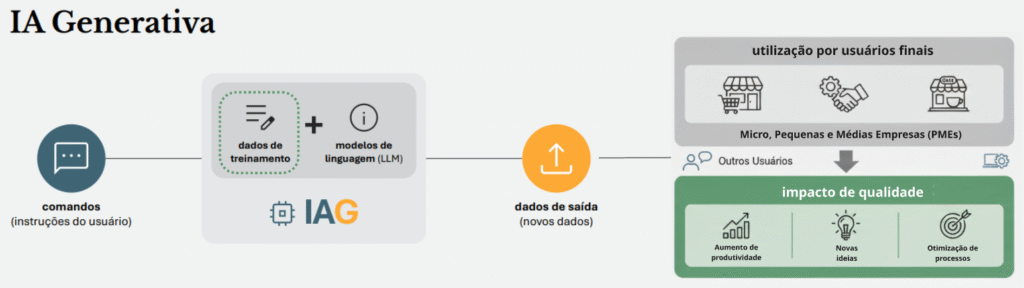
LLMs therefore act as a digital infrastructure: they form the foundation upon which various applications are built. At the surface of this ecosystem are the users of these commercially available models – ranging from individuals to businesses of various sizes. Within this group, micro, small, and medium-sized enterprises (MSMEs) occupy a key position, as they have fewer technical and financial resources to train their own proprietary models and ultimately turn to these off-the-shelf solutions to sustain their competitiveness. Any decline in LLM quality would tend to impact most immediately those companies that rely directly on these models to innovate and grow.
Figure 1. Operational flow of GenAI models: impact of training data on the value generated for end users.
- The regulatory landscape in Brazil
Discussions on copyright and AI regulation can directly influence how generative AI models are developed. We observe how these laws and proposals are taking shape in Brazil, as their design can impact both the quality of available models and the possibilities for application across different economic sectors.
Like most Latin America countries, Brazil has a more restrictive copyright law (Schirru et al., 2024), lacking exceptions that permit data mining practices (Flynn et al., 2022), which are foundational for training generative AI models. This absence creates a restrictive environment for technical, scientific, and commercial uses of data.
In contrast, countries such as the United States rely on the fair use doctrine, which has enabled data mining practices, while Japan and Singapore have introduced exceptions for data mining, including for commercial purposes (Ribeiro; Garrote, 2025). Meanwhile, the European Union, through Directive 2019/790, established specific TDM exceptions, albeit subject to limitations and opt-out mechanisms for authors (European Union, 2019).
In Brazil, the most recent debate revolves around Bill No. 2,338/2023, which proposes an AI regulatory framework (Brazil, 2023). The text suggests a narrow exception: it allows data mining exclusively for scientific and educational institutions, museums, archives, and libraries, subject to rightsholders’ opt-out rights. Outside this context, rightsholders could veto the use of their works for AI training, including retroactively – that is, even after the content has already been used in the learning process.
Furthermore, the current text of the Bill proposes the possibility of proportional remuneration per work used in data mining. In practice, this poses a major technical challenge: according to STEM professionals, monitoring and proportionally remunerating each individual use within massive data mining processes is not yet technically feasible (Ramos; Barreto; Garrote, 2025). By analogy, it would be like trying to measure, upon slicing a cake, the exact proportion of each constituent ingredient. In AI models, which extract patterns from billions of examples, such proportional calculation becomes unworkable.
This regulatory design raises two central concerns. First, given the technical unfeasibility, developers may choose not to train models on Brazilian data, leaving systems less adapted to the local context. Second, the proposed exception for data mining covers only academic and cultural institutions, excluding most of the research and development (R&D) conducted in the country. In 2023, for instance, the private sector accounted for nearly half of national R&D expenditure (Brazil, 2025), yet it would be left out of this authorization.
As a result, Brazil falls into the category of countries with low regulatory permissiveness regarding data mining. In practical terms, downstream effects could mean lower-quality GenAI tools available in the Brazilian market and a direct negative impact on organizations and end users.
- The impact on small and medium-sized enterprises
The regulatory debate on artificial intelligence spans multiple economic sectors and directly affects corporate productivity and competitiveness across various fields. ECOA’s Economic Report (Almeida et al., 2025) demonstrated that artificial intelligence can serve as a significant lever for productivity gains in creative, industrial, and service activities. The technology makes it possible to automate processes, reduce costs, scale up content production, and enable more precise decision-making. These effects represent a concrete opportunity for economic growth.
At the same time, the study points out that regulation restricting access to training data could lower the quality of AI models available in Brazil, thereby compromising part of those productivity gains. This finding suggests that, regardless of business size, there is both an opportunity for growth and a risk of loss if regulatory restrictions diminish the quality of models available in Brazil.
Brazilian micro, small, and medium-sized enterprises (MSMEs) have also turned to generative AI tools to gain productivity and enhance their competitiveness. Recent surveys confirm this trend:
- 47% of MSMEs in Brazil already use or plan to use AI in their processes (Serasa Experian, 2024).
- Among those that have adopted it, results are proving positive: 91% reported an improvement in work quality, with an average 48% boost in productivity (Microsoft Brasil, 2024, p. 24).
- The most common AI applications in businesses include workflow automation in marketing or sales, cybersecurity, HR support, recruitment, and general management (Cetic.br, 2025, p. 105).
Despite this potential, benefits are not yet evenly distributed. While 67% of large Brazilian enterprises report positive results with AI, this percentage drops to 52% among medium-sized businesses and below 45% among micro and small enterprises (Edelman, 2024, p. 11).
According to the ICT Enterprises survey (Cetic.br, 2025, p. 76), this discrepancy is tied to investment capacity: large companies expand infrastructure and teams, whereas smaller ones face high implementation costs and a shortage of specialized talent. Unsurprisingly, among businesses that do not yet use AI, one of the most cited hurdles is the perception of high costs (Cetic.br, 2025, p. 82).
International studies help expand this picture. In the United States, 36% of MSMEs state that AI helped them compete with larger enterprises, and those adopting the technology saw a 12-percentage-point increase in the likelihood of profit growth compared to non-adopters (U.S. Chamber of Commerce Technology, 2023).
An economic study conducted in China (Mao et al., 2025) identified a positive correlation between generative AI usage, innovation, and economic growth in MSMEs: innovation appears as a partial mediator, indicating that economic gains stem, in part, from the ability to generate new products, processes, and organizational models. In Latin America, Microsoft LATAM highlighted that the democratization of AI grants MSMEs access to capabilities previously limited to large corporations, strengthening their competitiveness and efficiency (Microsoft Source Latam, 2025).
This body of evidence suggests that, despite cost and skills barriers, MSMEs may be among the segments with the most to gain from adopting generative AI in their operations – both through opportunities for productivity gains and the ability to compete on a more level playing field with large corporations.
On the other hand, they may also be the most vulnerable under restrictive regulatory scenarios. Unlike large corporations, which can train or customize proprietary models, MSMEs rely more heavily on “off-the-shelf” tools, often in affordable or free versions. Should more restrictive copyright laws reduce the diversity and quality of available models, smaller enterprises could be the first to feel the impact.
Conclusion
Given this scenario, it is worth questioning whether a more restrictive regulation on the use of data for training generative AI systems would truly impact only large developers or the remuneration of the creative sector. By limiting the available dataset, such rules could lead to GenAI models that are less accurate, less creative, and less adapted to the needs of the local market.
For MSMEs, which rely on affordable and often free solutions because they lack the capacity to develop or license high-performance proprietary models, the effects of a potential drop in quality would be felt most immediately. It is therefore worth considering whether restrictive and technically challenging rules would widen technological inequalities, curbing the competitiveness of the businesses that sustain a large portion of the Brazilian economy.
References
ABREU, Carlos. De GPS a Chat GPT: maioria dos pequenos negócios abraça a inteligência artificial para aumentar resultados. Agência Sebrae, jun. 2025. Available at: https://agenciasebrae.com.br/inovacao-e-tecnologia/de-gps-a-chat-gpt-maioria-dos-pequenos-negocios-abraca-a-inteligencia-artificial-para-aumentar-resultados/#:~:text=O Sebrae identificou ainda o,20.
AGÊNCIA SEBRAE. PIB demonstra aceleração econômica. Pequenos negócios fazem parte do resultado positivo. 30 mai. 2025. Available at: https://agenciasebrae.com.br/economia-e-politica/pib-demonstra-aceleracao-economica-pequenos-negocios-fazem-parte-do-resultado-positivo/.
ALMEIDA, Silvia F. de; TAKAHASHI, Gabriel S.; MOREIRA, Miguel S.; OLIVEIRA, Lara de. Impactos do PL 2338/2023: mensuração da redução de ganhos de produtividade decorrente da remuneração de direitos autorais proposta sobre o uso de IA. Observatório de Direitos Autorais e Tecnologia, 2025. Available at: https://observatorio.cc/pl-de-ia-pode-gerar-perda-de-r-218-bilhoes-ao-pib-brasileiro-em-10-anos/
BRASIL. Câmara dos Deputados. Projeto de Lei n. 2.338, de 2023. Dispõe sobre o desenvolvimento, o fomento e o uso ético e responsável da inteligência artificial com base na centralidade da pessoa humana. Brasília, DF, 2023. Available at: https://www.camara.leg.br/proposicoesWeb/prop_mostrarintegra?codteor=2868197&filename=PL 2338/2023.
BRASIL. Ministério da Ciência, Tecnologia e Inovação. Brasil: dispêndio nacional em pesquisa e desenvolvimento (P&D) em relação ao total de P&D e ao produto interno bruto (PIB), por setor institucional, 2000-2023. In: Indicadores Nacionais de Ciência, Tecnologia e Inovação – Recursos aplicados: indicadores consolidados. Brasília, DF: Governo Federal, 30 jul. 2025. Available at: https://www.gov.br/mcti/pt-br/acompanhe-o-mcti/indicadores/paginas/recursos-aplicados/indicadores-consolidados/2-1-3-brasil-dispendio-nacional-em-pesquisa-e-desenvolvimento-em-relacao-pd-e-produto-interno-bruto-por-setor-institucional.
BRICS BRASIL. New Industrial Revolution. Luciana Mancini: “Micro and small enterprises are the backbone of the BRICS economy”. 8 maio 2025. Available at: https://brics.br/en/news/luciana-mancini-micro-and-small-enterprises-are-the-backbone-of-the-brics-economy.
BRITO, Carina. Apenas 10% das pequenas empresas utilizam inteligência artificial nos negócios, diz pesquisa. Revista Pequenas Empresas & Grandes Negócios, 13 maio 2025. Available at: https://revistapegn.globo.com/gestao/noticia/2025/05/apenas-11percent-das-pequenas-empresas-utilizam-inteligencia-artificial-nos-negocios-diz-pesquisa.ghtml.
BUOLAMWINI, J; GEBRU, T. Gender shades: intersectional accuracy disparities in commercial gender classification. In: Conference on Fairness, Accountability, and Transparency, 2018. Proceedings of Machine Learning Research, v. 81, p. 1-15, 2018. Available at: https://proceedings.mlr.press/v81/buolamwini18a/buolamwini18a.pdf.
CETIC.br. TIC Empresas: pesquisa sobre o uso das tecnologias de informação e comunicação nas empresas brasileiras – 2024. São Paulo: CETIC.br, 2025. Available at: https://cetic.br/media/docs/publicacoes/2/20250512122204/tic_empresas_2024_livro_eletronico.pdf.
EDELMAN. Artificial intelligence in the corporate world – regional report. jan. 2025. Available at: https://news.sap.com/latinamerica/files/2025/06/05/Regional-IA-in-the-corporate-world-External.pdf.
FIIL-FLYNN, Sean; et al. Legal reform to enhance global text and data mining research. Science, v. 378, p. 951-953, 2022. Available at: https://doi.org/10.1126/science.add6124.
MAO, Ningning; WEI, Jianxiu; ZHU, Xuanliang. Generative artificial intelligence and SMEs innovation: a driver of economic growth. International Journal of Economics, Business and Management Research, v. 9, n. 4, 2025. ISSN 2456-7760. DOI: https://doi.org/10.51505/IJEBMR.2025.9404.
MARWALA, Tshilidzi. Algorithm bias — synthetic data should be option of last resort when training AI systems. United Nations University (UNU), 28 jul. 2023. Available at: https://unu.edu/article/algorithm-bias-synthetic-data-should-be-option-last-resort-when-training-ai-systems.
MICROSOFT (Source Latam). IA continúa impactando positivamente las pequeñas y medianas empresas en Puerto Rico. News Center Microsoft Latinoamérica, 2 maio 2025. Available at: https://news.microsoft.com/es-xl/ia-continua-impactando-positivamente-las-pequenas-y-medianas-empresas-en-puerto-rico/#:~:text=“En esta nueva era de,haciéndolas más competitivas y eficientes”.
MICROSOFT (Source Latam). 75% das PMEs no Brasil estão otimistas sobre o impacto da inteligência artificial em seus negócios, aponta estudo da Microsoft. Microsoft, 7 maio 2025. Available at: https://news.microsoft.com/source/latam/features/noticias-da-microsoft/75-das-mpmes-no-brasil-estao-otimistas-sobre-o-impacto-da-inteligencia-artificial-em-seus-negocios-aponta-estudo-da-microsoft/?lang=pt-br.
MICROSOFT; EDELMAN. IA em micro, pequenas e médias empresas: tendências, desafios e oportunidades. Brasil, fev. 2024. Available at: https://msftstories.thesourcemediaassets.com/sites/42/2024/03/Microsoft_Edelman_PMEs_2023_Imprensa-Brasil-VF.pdf.
NAVEED, Humza et al. A comprehensive overview of large language models. out. 2024. Available at: https://arxiv.org/abs/2307.06435.
OCDE. AI language models: technological, socio-economic and policy considerations. (OECD Digital Economy Papers, n. 352). Paris: OECD Publishing, abr. 2023. Available at: https://www.oecd.org/content/dam/oecd/en/publications/reports/2023/04/ai-language-models_46d9d9b4/13d38f92-en.pdf.
RAMOS, P. H.; BARRETO, J.; GARROTE, M. Remuneração por Direitos Autorais em IA: Limites e Desafios de Implementação. Policy Briefs Reglab, n. 3. São Paulo: Reglab, 2025. Available at: https://reglab.com.br/remuneracao-por-direitos-autorais-em-ia-limites-e-desafios-de-implementacao/.
RIBEIRO, N.; GARROTE, M. Mapeamento Global de Leis de Direitos Autorais e Exceções para Mineração de Dados. Contexto Reglab. n. 1. Reglab, 2025. Available at: https://observatorio.cc/mapeamento-global-de-leis-de-direitos-autorais-e-excecoes-para-mineracao-de-dados/.
SCHIRRU, Luca; SOUZA, André Rocha de; VALENTE, Mariana G.; et al. Text and data mining exceptions in Latin America. International Review of Intellectual Property and Competition Law – IIC, v. 55, p. 1624-1653, jul. 2024. Available at: https://doi.org/10.1007/s40319-024-01511-2.
SERASA EXPERIAN. Quase metade das PMEs brasileiras usa ou pretende usar inteligência artificial (IA) em seu dia a dia, de acordo com pesquisa realizada pela Serasa Experian. 27 nov. 2024. Available at: https://www.serasaexperian.com.br/sala-de-imprensa/pmes/quase-metade-das-pmes-brasileiras-usa-ou-pretende-usar-inteligencia-artificial-ia-em-seu-dia-a-dia-de-acordo-com-pesquisa-realizada-pela-serasa-experian/.
U.S. CHAMBER OF COMMERCE TECHNOLOGY. Empowering small business: the impact of technology on U.S. small business. 2. ed. Washington, DC: U.S. Chamber of Commerce, 2023. Available at: https://www.uschamber.com/assets/documents/The-Impact-of-Technology-on-Small-Business-Report-2023-Edition.pdf.