About Reglab
We are a private research center specializing in the media and technology sector, supporting companies, associations, and policymakers in making strategic decisions based on data and evidence.
Learn more at: www.reglab.com.br.
About the Fellowship on Innovation and Copyright series
The Fellowship on Innovation and Copyright series features articles by invited authors who explore topics in digital governance, synthesizing research, presenting empirical evidence, or contributing new information to the debate. The articles follow Reglab’s standards of methodological transparency, and their content is the sole responsibility of the authors.
Acknowledgements
Executive Director: Pedro Henrique Ramos
Research Director: Marina Gonçalves Garrote
Author: Camila Santos
Researcher: Camila Santos
Final layout: Larissa Camargo
Suggested Citation: SANTOS, C. Who profits when marginalized communities create? Copyright, digital platforms and the creative economy. São Paulo: Reglab, 2026.
Executive Summary
This study is guided by the following question: how do creators from urban peripheries and marginalized communities experience income generation from their works in digital environments?
To address this question, in-depth interviews were conducted with artists and producers working in digital contexts. The objective was not to calculate values or compare earnings, but to understand, based on reported experiences, how monetization, copyright, and relationships with platforms and intermediaries operate in practice. The study considers both streaming platforms, where remuneration may occur through the use of works, such as Spotify and YouTube, and platforms primarily oriented toward distribution and visibility, such as Instagram and TikTok. In addition, the value chain involves actors such as aggregators, distributors, record labels, production companies, and managers.
The accounts reveal a recurring pattern. The main source of income for participants is linked to direct and continuous labor, such as live performances, services, advertising, or commissioned production. This income depends on the creator’s ongoing activity.
By contrast, income associated with the catalog of works, such as royalties and revenue shares from content use, appears unstable and irregular. According to interviewees, the circulation of works does not consistently translate into recurring revenue.
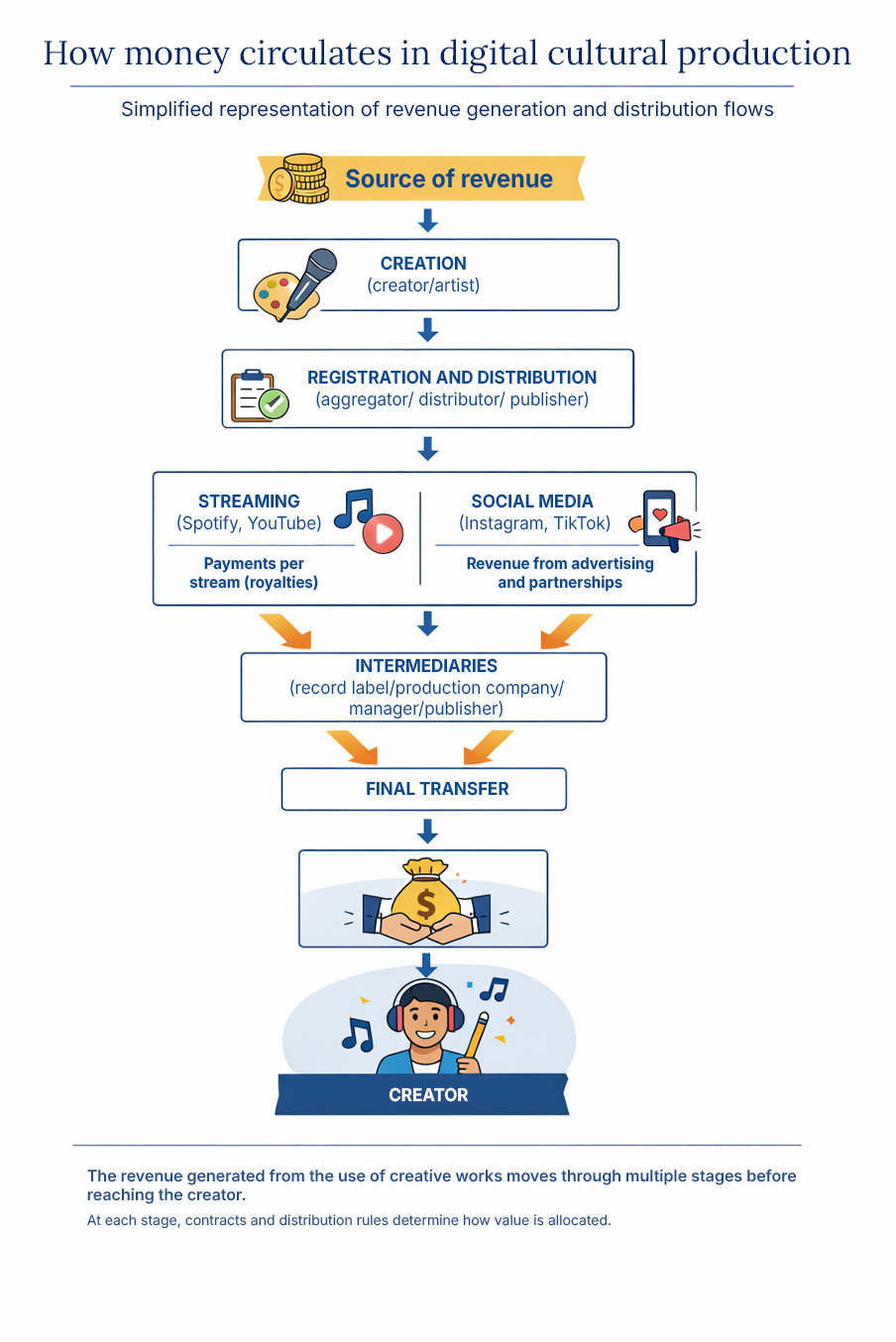
The research also highlights barriers to accessing information. Some participants report not clearly understanding how values are calculated, which criteria guide payments, or how to contest discrepancies. In some cases, there is no formal documentation or usable documentation that allows creators to track the economic exploitation of their works. The value generated tends to pass through multiple stages and actors along the chain, while the creator remains at the final stage of this process.
These findings suggest that broadly designed policies for the creative economy or copyright protection may produce different effects across the value chain. In addition, the data indicate that measures related to transparency, access to information, and contractual formalization may be particularly relevant for those who depend directly on creative work as a source of income.
1. Introduction
Since the mid-2000s, digital services such as YouTube, Instagram, Spotify, and TikTok have come to organize a large share of the circulation of music and audiovisual content. These platforms have expanded access to distribution and reduced technical barriers that previously limited the publication and dissemination of works. With the rise of streaming, the idea gained traction that it would be possible to reach large audiences even outside traditional structures such as established record labels and production companies.
In public debate, this shift is often associated with the democratization of cultural creation. The expansion of visibility and reach is frequently interpreted as a sign of economic inclusion. However, the experiences reported by many creators suggest that increased circulation does not, in itself, guarantee financial stability or recurring income. Visibility may coexist with instability, dependence on continuous labor, and difficulties in long-term planning.
The literature on the creative economy and digital services also points out that expanding access to circulation does not necessarily imply a more equitable redistribution of the value generated by creative works. These environments structure rules of exposure, monetization criteria, and revenue-sharing mechanisms that are not always transparent to creators. In addition, remuneration tends to involve multiple stages and intermediaries along the value chain.
Although the circulation of works produced in urban peripheries is often celebrated as a sign of cultural inclusion, there is still limited discussion about how the economic value generated by this circulation is distributed. Available data and debates suggest that visibility may increase without being matched by stable income for creators.
Cultural Creation as Labor
Urban peripheries have increasingly been recognized as spaces of intense cultural production and innovation. In this context, cultural creation operates simultaneously as a form of symbolic expression and as a means of income generation.
Music, audiovisual production, and other forms of artistic creation are marked by informality, instability, and multiple sources of work. For creators with limited financial resources, authorial production is often combined with service provision, side activities, and intermittent work that extend beyond artistic creation itself.
In this context, it is important to distinguish between active income and asset-based income. Active income results from continuous work and the creator’s direct involvement, such as live performances, technical services, or commissioned production. Asset-based income, in turn, is linked to the ongoing exploitation of creative works through royalties, copyright, licensing, or publishing. It refers to income that can be generated when a song is streamed or a work is licensed, even without the creator’s direct involvement at that moment.
The circulation of contemporary cultural production takes place through a range of digital services and intermediary actors. Platforms such as Spotify and YouTube organize distribution and may provide remuneration based on the use of works. Platforms like Instagram and TikTok operate primarily in terms of visibility and audience-building, with more indirect forms of monetization. Beyond these platforms, the value chain also includes aggregators, distributors, record labels, production companies, publishers, and, in some cases, managers and agents.
These different actors structure the various stages of circulation and value transfer. Each performs specific functions, such as registering works, distributing content to platforms, negotiating contracts, or acting as commercial intermediaries. When a song is streamed or a video is monetized, the revenue generated typically flows through this chain before reaching the creator.
In digital platform environments, copyright is operationalized through automated systems for content identification and management. In practice, this occurs through mechanisms such as claims, strikes, and blocks or revenue redirection, which directly affect the circulation and monetization of works.
Although these mechanisms are intended to protect rights ownership, their day-to-day functioning is not always perceived as transparent by the creators interviewed. Some report difficulties in understanding enforcement criteria, revenue calculations, and dispute procedures.
Against this backdrop, this study is guided by the following question: how do creators from urban peripheries experience income generation from their works in digital environments?
To guide the analysis, the article also considers: (i) how the relationship between active income and asset-based income is structured; (ii) how disputes and automated copyright mechanisms (claims, strikes, blocks) affect circulation and revenue distribution; and (iii) how barriers related to information and documentation emerge not only on platforms but across the value chain, particularly affecting the measurement and understanding of asset-based income, such as copyright-related revenues.
2. Methodology
This research adopts a qualitative and exploratory approach. The study was not intended to estimate financial values or produce statistical generalizations. Instead, it sought to identify recurring patterns in the reported experiences.
The methodological strategy combined in-depth interviews with six creators working in the fields of music, audiovisual production, and digital cultural production, alongside desk research. This approach made it possible to connect individual narratives with the observable functioning of the digital environments in which these works circulate.
In-depth interviews
The primary data collection method consisted of semi-structured, in-depth interviews with six creators active in music, audiovisual, and digital cultural production.
The participants come from different urban peripheries in the state of São Paulo and are at different stages of their careers, ranging from early-stage to professionally established, as shown in the table below. The interviews lasted approximately 60 minutes on average and were conducted using a structured interview guide organized around five key dimensions: trajectory and territorial context; modes of circulation and sources of income; experiences with copyright and claims systems; barriers to the consolidation of asset-based income; and perceptions of intermediation and access to information.
Participant profile
| Participant |
Field of activity |
Age |
Gender |
Region |
Career stage |
| P1 |
Artistic producer |
25 |
Male |
São Paulo – SP |
Early-stage |
| P2 |
DJ and music producer |
30 |
Male |
Bauru – SP |
Emerging |
| P3 |
Multidisciplinary artist (DJ, visual artist, and audiovisual director) |
25 |
Male |
Barueri – SP |
Emerging |
| P4 |
Rapper and songwriter |
25 |
Female |
Santos – SP |
Emerging |
| P5 |
R&B singer and songwriter |
28 |
Female |
São Paulo – SP |
Established |
| P6 |
Sertanejo singer and songwriter |
31 |
Female |
Manduri – SP |
Established |
Data analysis
The analysis was conducted using thematic analysis, with a focus on identifying recurring patterns in the narratives. The procedure involved:
- Data pre-analysis: full reading of the interview transcripts.
- Pattern identification: organization into analytical categories related to monetization, copyright, access to information, and intermediation.
- Cross-referencing of information: interview data were analyzed in dialogue with desk research on digital platforms, with the aim of contextualizing the accounts and understanding how practices of distribution and public performance manifest in digital environments.
Exploratory observation
As a complementary strategy, a non-participant exploratory observation was conducted, consisting of desk research on the public profiles of interviewees and creators with similar characteristics on platforms relevant to cultural circulation, particularly Instagram, YouTube, and Spotify. Only publicly accessible information was analyzed, with no direct interaction or access to private data.
3. Results
The centrality of active income
Given the difficulty of converting the circulation of works into stable asset-based income, the data indicate that active income plays a central role in the economic sustainability of creators from urban peripheries. Live performances, gigs, technical services, freelance work, workshops, commissioned production, and side jobs emerge as the main, and in many cases the only, sources of continuous income.
Among participants, income directly associated with their creative catalog was described as uncertain, irregular, or insufficient to ensure financial stability. In contrast, activities that require constant presence, time availability, and sustained effort were identified as essential for maintaining material livelihoods. Creation, therefore, generates recurring work, but rarely generates assets.
As one interviewee summarized: “Today, if I don’t perform or provide services, I don’t earn anything. The work alone doesn’t pay the bills.” (P1)
For P5, a singer and songwriter in an emerging stage of her career, with works available on major digital platforms and revenue distributed via a distributor, monetization was described as residual: “I do have it, but it’s minimal monetization.”
At another point, when asked about her main source of income, she stated directly: “No, music is not my main source of income.” She further explained that, after a period in which she was able to sustain herself through performances and projects, her primary income shifted to another professional activity: “Over the past two years, my main source has mostly come from my work as a communicator.”
This pattern appears across different career stages. Early-stage creators reported the need to combine authorial production with multiple activities to sustain themselves. More visible creators, in turn, described routines shaped by intense work schedules, in which income from performances, partnerships, and services compensates for the fragility of digital monetization. As another participant noted: “Income comes from the daily hustle. You can’t rely on digital as something stable.” (P4)
The centrality of active income is also reflected in how participants structure their trajectories. Rather than planning their careers around the consolidation of an authorial catalog, many reported making decisions driven by immediate work demands, prioritizing short-term opportunities over long-term asset-building strategies.
In this sense, active income does not appear as a complementary strategy, but as the structural axis of economic survival. The work gains traction and expands the creator’s visibility, but financial sustainability depends on continuous labor. This recurring pattern among participants helps explain a broader phenomenon identified in the research: professional advancement that does not necessarily translate into asset accumulation.
Professional advancement without asset accumulation
One of the central findings of the research is the dissociation between professional advancement and asset consolidation among creators from urban peripheries. Increased visibility, circulation, and public recognition do not automatically translate into recurring income derived from the catalog.
Most participants reported audience growth, expanded geographic reach, and greater integration into the cultural scene. However, income structured around their body of work – income that would continue to generate returns even without ongoing labor – remained residual or nonexistent.
As P5 summarizes: “My work reached a lot of people, but that doesn’t mean I make money from it. Visibility increased, but the money didn’t follow.”
The same dynamic appears concretely in P4’s account when referring to her first platform payment: “This was the first year I received money from PayPal… I got 21 dollars. Wow, 21 dollars. It sounds like nothing, but at that moment it felt like good money to me.”
The amount, accumulated over approximately a year and a half, was described as symbolic. The participant herself acknowledges the structural difficulty: “It’s very hard for money to come in. People have to listen a lot, repeatedly.” (P4)
The expectation that the catalog will eventually generate recurring income exists, but it is framed in terms of needing to “work better,” “promote more,” or “release more.” There is little clarity regarding the structural mechanisms that determine financial returns.
Another participant, a producer responsible for distributing independent artists, describes the same dynamic: “I’ve made some money… like two dollars.” (P1)
When explaining how the system works, he points out that many artists do not even understand basic registration mechanisms: “If you mention what UBC is, they don’t know.” He adds: “If the distributor generates the ISRC, they hold the phonogram rights. No one tells you that.” (P1)
These accounts suggest that the issue goes beyond an abstract “concentration” of income and involves at least three layers:
- First, there is a dilution of income along the production chain. Between platforms, distributors, publishers, and production companies, the work passes through multiple intermediaries. Creators often lack control over contractual terms and revenue flows. As the interviewed producer explains: “You start playing the game without knowing the rules.” (P1)
- Second, there is a deficit in technical and legal literacy. Access to information about registration, rights allocation, ISRC codes, public performance, and contracts is not straightforward. Even when available, it requires familiarity with technical language and specialized mediation. One participant acknowledges: “I never really paid attention to that… I only learned later.” (P4)
- Third, there is a lack of institutional structure. Several interviewees report that, despite having talent and circulation, they do not have access to production companies, legal teams, or specialized advisory support. As P2 states: “If I had better structure, I know I’d be somewhere else.”
This point is decisive. Asset accumulation requires not only creation, but also the active management of rights, contracts, and disputes. When this structure is absent, increased visibility expands exposure but does not ensure economic autonomy.
In some cases, growing visibility is accompanied by greater risk. Rights disputes, claims, and conflicts between distributors were mentioned as frequent situations, especially in collaborations between artists linked to different aggregators. In these contexts, monetization may be suspended or redirected to third parties, requiring technical or legal intervention to be contested.
The result is a recurring paradox: the more a work circulates, the more value it generates within the digital ecosystem, yet this value does not necessarily return to the creator in proportional terms.
This dynamic is captured in the words of one participant: “You see your music circulating, but you don’t see any return.” (P6)
The findings therefore indicate that the difficulty of converting creation into assets is not limited to early career stages. It persists even after territorial recognition or entry into relevant circuits.
This finding challenges a widely disseminated narrative in platform discourse, in the promises of the “digital creative economy,” and in the very structure of copyright law. Empirical evidence suggests that visibility and monetization operate under distinct logics, and that the democratization of access to circulation does not, in itself, guarantee economic inclusion.
Advancement occurs. Asset accumulation, not necessarily.
The data indicate that informational asymmetry is one of the central factors limiting the conversion of cultural circulation into asset-based income. Among the participants interviewed, there is a recurring perception that information related to monetization, calculation criteria, and rights ownership is not fully accessible.
One participant summarizes this difficulty: “I receive the payment, but I don’t know exactly where it comes from. I don’t know which song generated it or how it was calculated.” (P3)
Another reports: “There are months when money comes in, but I don’t know why. I have no way of verifying it.” (P5)
In the accounts, this asymmetry appears across different points in the value chain. In the case of streaming platforms that pay for copyright usage, participants mention difficulties in understanding reports, revenue splits, and distribution criteria: “The report is packed with numbers, but I don’t understand how that turns into what I receive.” (P2)
On social media platforms oriented toward content circulation, monetization is described as unstable and dependent on unclear rules: “We post, it goes viral, but that doesn’t mean there will be any return. The algorithm changes and you don’t even know what happened.” (P6)
Beyond platforms, some accounts suggest that asymmetry may also involve intermediaries within the music and entertainment industries. As one participant notes: “I depend on what they pass on to me. I don’t have direct access to the information.” (P4)
The practical consequences of this asymmetry are made explicit by the participants themselves. As one interviewee states: “I can earn from shows, from direct work. But the money from the music itself, I don’t know how to manage.” (P1)
The data therefore suggest that informational asymmetry operates as a structural mechanism within the digital monetization chain, reinforcing the centrality of active income and hindering the consolidation of recurring income associated with the creative catalog.
Lack of documentation as a structural pattern
Throughout the research, a consistent difficulty in accessing clear documentation regarding rights ownership, monetization criteria, and payment flows emerged. More than the complete absence of records, the accounts point to the lack of documentation that is understandable and operationalizable by creators themselves.
As one participant summarizes: “I never really understood how they calculate this. The number just shows up.” (P1)
The difficulty in interpreting reports reinforces the informational asymmetry previously described and limits the ability to verify or contest the amounts received.
In addition, access to key information appears to depend on the presence of specialized support. As one participant states: “Those who have a lawyer or someone who understands it can sort things out. Those who don’t, lose.” (P3)
This dependency highlights that formalization and contractual understanding are not evenly distributed across the ecosystem analyzed.
Finally, learning about rights and monetization is described as an informal and reactive process: “I learned everything by making mistakes. There’s no manual for those on the margins.” (P4)
The data therefore suggest that the lack of accessible and intelligible documentation is not an individual failure, but a structural feature of the monetization chain in the digital music industry, reinforcing creators’ vulnerability in managing their rights.
4. Discussion of results
The findings of this study contribute to understanding how economic inequalities are produced and reproduced within the digital ecosystem of the creative economy. The data indicate that the difficulty of converting the circulation of works into asset-based income does not stem from a lack of talent, production, or visibility, but from the way monetization, intermediation, and information mechanisms are structured.
Visibility, hope labor, and the limits of economic conversion
The findings engage with the literature on hope labor (Gill, 2010; Duffy, 2017), which describes forms of cultural labor sustained by expectations of future returns associated with visibility. In the case analyzed, the promise of converting circulation into asset-based income appears structurally unlikely, rather than merely delayed.
Professional advancement increases the circulation of works, but does not alter the creator’s position within the value chain. Continued engagement in creative work is sustained by expectations of future economic inclusion, while actual returns from royalties, for example, remain unstable. Visibility, although central to platform dynamics, does not automatically translate into economic autonomy.
The centrality of active income observed in the data indicates that creating does not equate to accumulating assets. Performances, services, and ongoing work become the primary sources of livelihood, while asset-based income associated with the catalog remains residual or unpredictable.
This configuration resonates with analyses of inequality and accumulation (Piketty, 2014), in which exclusive dependence on labor constrains the capacity to accumulate wealth over time. In the ecosystem analyzed, the presence of extensive intermediation chains, comprising platforms, aggregators, record labels, and distributors, widens the gap between creation and remuneration.
Intermediation does not eliminate risk, but redistributes it along the chain, often preserving more stable and accumulable gains within intermediary layers and infrastructure-owning actors. Creators remain dependent on continuous labor, with limited capacity for asset consolidation.
Informational asymmetry emerges as a cross-cutting mechanism that helps explain the persistence of this dynamic. The knowledge required to operate within the music industry value chain, including contract management, copyright, and monetization flows, is unevenly distributed, often concentrated among intermediaries and actors with greater institutional capital.
This dynamic aligns with analyses that understand platforms and intermediaries both as private regulatory agents (Gillespie, 2018) and as central infrastructures for organizing and extracting value in digital capitalism (Srnicek, 2017). In the field of cultural production, this asymmetry limits creators’ capacity for planning, contestation, and asset organization. Even when professional advancement occurs, full access to information does not materialize; what changes, in many cases, is only the ability to absorb the costs arising from informational opacity.
The findings therefore indicate that the observed inequality cannot be resolved through individual professionalization or increased public exposure alone, but is rooted in the informational and economic architecture that structures the music industry in its contemporary context.
5. Conclusion
This article examined how monetization mechanisms, copyright, and value intermediation operate in the experiences of creators from urban peripheries working on digital platforms such as Spotify, YouTube, Instagram, and TikTok.
Based on in-depth interviews, three recurring patterns were identified: the centrality of active income, the dissociation between visibility and asset accumulation, and the presence of informational asymmetry throughout the monetization chain.
The accounts suggest that the circulation of works expands reach and recognition, but does not, in itself, guarantee stable asset-based income or control over value flows. Economic survival remains strongly tied to continuous labor, while income associated with the catalog appears irregular, residual, or difficult to audit.
In dialogue with the literature on hope labor, the data indicate that expectations of future returns sustain continued engagement in creative work despite present instability. The promise of converting visibility into income coexists with the concrete experience of dependence on active income and difficulties in understanding monetization mechanisms.
The findings do not allow for statistical generalization, but they point to structural mechanisms that warrant regulatory attention. Policies focused solely on expanding access to platforms do not necessarily address informational, contractual, and intermediation barriers that limit the consolidation of asset-based income. Similarly, the findings suggest that expansive copyright policies do not necessarily benefit creators from urban peripheries, who are likely to remain marginalized from this type of income.
By shifting the focus from visibility to value flows and access to information, this study contributes to a more precise understanding of inequalities in the digital creative economy.
6. Direction for future studies
The findings of this study highlight the need to deepen the investigation into the mechanisms of value generation and distribution in the digital creative economy.
A first relevant research agenda involves quantitative studies on financial flows between platforms, intermediaries, and creators. Systematic analyses of monetization data and contractual arrangements could more precisely assess how revenue is distributed along the value chain.
Another promising direction lies in comparative research across different regulatory contexts. Examining how distinct copyright regimes and intermediation models affect the ability to convert circulation into asset-based income may provide valuable insights for public policy design.
Studies incorporating racial and gender perspectives are also essential. Given that Brazil’s urban peripheries are shaped by historical inequalities, intersectional analyses can shed light on how these dimensions influence access to information, exposure to copyright disputes, and dependence on active income.
Another relevant avenue concerns generational analysis. Comparing the trajectories of creators who began their careers before the consolidation of digital platforms with those who depend entirely on these infrastructures may help clarify transformations in the relationship between creation, circulation, and income.
In addition, research in other territories, including different regions of Brazil and countries in the Global South, can help assess the extent to which the patterns identified in this study are replicated or take on distinct configurations.
Finally, future research may examine alternative models of authorship organization and value distribution, such as cooperative arrangements, hybrid models, or community-based platforms. Exploring these initiatives can expand the debate beyond diagnosing inequalities, opening space for more balanced forms of institutional reorganization.
By advancing along these lines, academic research can contribute to a more informed debate on the political economy of digital cultural production and on possible pathways to strengthen the economic sustainability of creators.
References
BRAUN, Virginia; CLARKE, Victoria. Using thematic analysis in psychology. Qualitative Research in Psychology, v. 3, n. 2, p. 77–101, 2006.
DUFFY, Brooke Erin. (Not) getting paid to do what you love: gender, social media, and aspirational work. New Haven: Yale University Press, 2017.
GILLESPIE, Tarleton. Custodians of the internet: platforms, content moderation, and the hidden decisions that shape social media. New Haven: Yale University Press, 2018.
GILL, Rosalind. Life is a pitch: managing the self in new media work. Work, Employment and Society, v. 26, n. 3, p. 428–446, 2012.
PIKETTY, Thomas. O capital no século XXI. Rio de Janeiro: Intrínseca, 2014.
SRNICEK, Nick. Platform capitalism. Cambridge: Polity Press, 2017.
Reglab Methodology Annex
Title: Who profits when marginalized communities create? Copyright, digital platforms, and the creative economy
Research Question: How do monetization mechanisms, copyright frameworks, and value intermediation processes operated by digital platforms influence the ability of creators from urban peripheries to convert circulation into asset-based income and economic autonomy?
Methodology summary
This research adopts a qualitative and exploratory approach, aiming to understand how creators from urban peripheries experience, in practice, the monetization of their works on digital platforms.
The study was not intended to measure financial values or estimate income concentration. Instead, it sought to identify recurring patterns related to income generation, asset formation, intermediation, and access to information, based on participants’ reported experiences.
The methodological strategy combined in-depth interviews, desk research on digital platforms, and a specialized literature review.
Data analysis was conducted using thematic analysis, identifying recurring patterns in the narratives. The procedure involved a full reading of transcripts, initial coding of relevant excerpts, and subsequent organization into analytical categories related to monetization, copyright, access to information, and intermediation.
Data collection
Six semi-structured interviews were conducted with creators working in the fields of music, audiovisual production, and digital cultural production.
Participants reside in different regions of the state of São Paulo and are at different stages of their careers (early-stage, emerging, and established).
The interviews were conducted via Google Meet, lasted approximately 60 minutes, and followed a structured guide organized around five dimensions: trajectory and territorial context; modes of circulation and sources of income; experiences with copyright and claims systems; barriers to asset-based income consolidation; and perceptions of intermediation and access to information.
All interviews were conducted with informed consent, recorded, and transcribed. The research adopted anonymization procedures and identity protection measures as requested by participants.
As a complementary strategy, desk research was conducted on digital platforms relevant to cultural circulation, particularly Spotify, YouTube, and Instagram. The analysis focused exclusively on publicly accessible information, such as profile descriptions, view counts, and the presence (or absence) of visible authorship credits. No access was made to private data, contracts, or internal platform reports.
The lack of organized documentation among participants, such as formalized contracts or detailed royalty reports, was considered a relevant empirical finding of the study.
Data analysis
The analysis was conducted through thematic analysis, identifying recurring patterns in the narratives (Braun & Clarke, 2006).
The procedure involved full reading of transcripts, initial coding of relevant excerpts, and subsequent organization into analytical categories related to monetization, copyright, access to information, and intermediation.
Coding was carried out using ATLAS.ti software, ensuring organization and traceability of analytical decisions. Final categories emerged inductively and were later articulated with the literature on the creative economy, platform capitalism, and hope labor.
Interview data were analyzed in dialogue with desk research on digital platforms, aiming to contextualize the accounts and understand how circulation and public presentation practices manifest in digital environments.
Bias Reduction Procedures
Established theoretical-methodological references: Data collection and analysis techniques followed recognized academic practices. The methodological approach was discussed internally before and after the interviews, allowing for the incorporation of feedback and refinements prior to the analysis phase.
Trajectory contrast: Comparisons between participants with different trajectories were used to identify points of convergence and divergence. This comparative approach strengthens the robustness and scope of the conclusions.
Inductive coding: An inductive coding strategy was adopted, allowing themes and patterns to emerge from raw data rather than being predefined, thus reducing the risk of confirmation bias.
Methodological transparency and documentation: All stages of the analytical process were documented, including successive versions of drafts. This ensures traceability of the methodological pathway, in line with Reglab’s standards for transparency and replicability.
Other Methodological Limitations
Limited number of participants and lack of statistical generalizability: The narratives provide analytical depth and interpretive richness but are not statistically representative.
Lack of access to internal platform financial data: The research relied on publicly available data or information provided by participants. This limitation may introduce inaccuracies or omissions.
Absence of in-depth contractual document analysis: The lack of formal documentation among participants, such as contracts or monetization reports, limited deeper documentary analysis. This absence was treated as an empirical finding in itself.
Software use
The following software tools were used in the development of this study:
Adobe CC Suite: layout design and finalization of graphics and illustrations
Google Meet: interview conduction and recording
Gemini: Transcription support and image generation for layout design
Google Suite (Docs, Sheets): data organization and document management
ATLAS.ti: coding, thematic analysis, and qualitative data organization
ChatGPT: editorial support, text standardization and translation
Ethical Guidelines
Personal data processing: The research involved the processing of personal data only during data collection and analysis stages, in a limited and proportionate manner, in compliance with Brazilian Law No. 13,709/2018 (LGPD).
Legal basis: All participants formally consented to participate by signing an informed consent form, acknowledging the objectives of the research and the use of their data.
Purpose limitation: Data were used exclusively for the purposes of this research and not for any other use.
Minimization and anonymization: The study followed core ethical principles. Participants’ identities were preserved through anonymization, and no sensitive data were collected or disclosed.
Confidentiality: Data were treated confidentially in the presentation of results, and quotations were adjusted when necessary to preserve source anonymity. Only the researcher directly involved in the project had access to personal data and original documents.
Responsible use of public data: Although some data analyzed were publicly available, their use followed ethical standards and was limited to independent research purposes.
Methodological transparency: The research methodology was described in detail to ensure transparency and replicability, supporting scientific integrity and enabling independent validation of the findings.
Non-discrimination and respect for diversity: The research was conducted in a manner that respects diversity and avoids any form of discrimination. |