The Impact of Digital Financial Institutions on the Brazilian Economy
What is a decade of digital transformation in the Brazilian financial system worth in economic activity? Reglab Policy Brief no. 8, produced by the Applied Economics Unit with support from Zetta, measures the differential in economic activity associated with the expansion of digital financial institutions (DFIs) between 2016 and 2026.
The study estimates a cumulative differential of BRL 1.6 trillion in Brazilian GDP — comparable to the annual GDP of countries such as Chile or Colombia. Within that total, BRL 982 billion corresponds to consumption and BRL 371 billion to investment.
The finding with the most direct effect on household budgets, however, is a different one: households and businesses saved BRL 47 billion in cumulative banking fees over the period. Those savings came from two sources — the lower fees charged by DFIs themselves and, above all, the competitive pressure these institutions placed on incumbent banks, forcing them to reduce margins in a historically concentrated system. As a result, the benefit reached even customers who never opened a digital account.
What you’ll find in this study:
How the expansion of digital financial institutions translates into consumption and investment in the Brazilian economy;
Why the BRL 47 billion in fee savings reached even customers who never opened a digital account;
What the competitive pressure on incumbent banks reveals about the historical concentration of the Brazilian financial system.
Download the full study for the complete analysis.
COSTA FILHO, J. R.; PALANCA, T. O impacto das instituições financeiras digitais na economia brasileira. Policy Briefs Reglab, n. 8. São Paulo: Reglab, 2026.
Costa Filho, J. R., & Palanca, T. (2026). O impacto das instituições financeiras digitais na economia brasileira (Policy Briefs Reglab n.º 8). Reglab.
Costa Filho, J. R., e T. Palanca. "O impacto das instituições financeiras digitais na economia brasileira." Policy Briefs Reglab, n. 8. São Paulo: Reglab, 2026.
Autores
João Ricardo Costa Filho
Thais Palanca
Tags
Applied Economics Center, Policy Brief
POLICY BRIEF
The Impact of Digital Financial Institutions on the Brazilian Economy
About Reglab
We are a private research center specializing in the media and technology sector, helping companies, associations, and policymakers make strategic, data- and evidence-based decisions.
The Policy Briefs Series comprises studies that assess trends, existing public policies, or proposed legislation, using qualitative and quantitative data to inform and guide decision-making.
Credits
Executive Director: Pedro Henrique Ramos
Director of Research: Marina Gonçalves Garrote
Authors: João Ricardo Costa Filho and Thais Palanca
Final Layout: Larissa Camargo
Suggested Citation: COSTA FILHO, J. R.; PALANCA, T. The impact of digital financial institutions on the Brazilian economy. Reglab Policy Briefs, no. 8. São Paulo: Reglab, 2026.
Executive Summary
This study, produced by Reglab, quantifies the macroeconomic impact of the expansion of Digital Financial Institutions (DFIs) in Brazil between 2016 and the first quarter of 2026. The measurement is carried out using a Dynamic Stochastic General Equilibrium (DSGE) model, estimated with Brazilian data, and counterfactual exercises that compare the economy's observed trajectory with an alternative trajectory in which this expansion had not occurred.
The central finding is that, following the model, DFIs were responsible for a cumulative differential of at least R$1.6 trillion in Brazilian GDP (at 2026 prices) between 2016 and 2026, equivalent to the annual GDP of countries such as Chile or Colombia. Without these institutions, GDP in the first quarter of 2026 would have been approximately 2.2% lower in real terms.
The main components of this differential:
Household consumption: R$982 billion in cumulative differential;
Aggregate investment: approximately R$371 billion lower in the scenario without DFIs;
Savings on interest in non-earmarked credit: R$102 billion accumulated over the period;
Savings on banking fees: R$47 billion accumulated, benefiting even customers who never migrated to a DFI;
1. Introduction
1.1. Financial markets, economic growth, and digital transformation
The financial system plays an important role in how the economy functions. When it operates efficiently, it channels resources from savers to households and firms that need financing, enabling investment, consumption, and the expansion of economic activity. This requires institutions capable of assessing risk, selecting projects, and reducing transaction costs. For this reason, the economic literature frequently links more developed financial systems to higher levels of economic growth (King and Levine, 1993). The magnitude of this effect varies not only with institutional quality, financial system structure, countries' income levels, and the empirical methods used (Levine, 1999; Iwasaki and Kočenda, 2023), but this relationship can also be non-linear (Arcand et al., 2015; Deidda and Fattouh, 2002) — that is, greater financial market development does not always translate into higher economic growth.
When the effects are positive, this occurs through mechanisms that reduce information and transaction frictions, thereby improving the allocation of savings, investment, and innovation (Levine, 1999). Empirical evidence indicates that both bank credit and capital markets play a relevant role; moreover, some studies find that these segments are complements rather than substitutes, although credit often shows the largest long-run contribution in panel-data estimates (Durusu-Ciftci et al., 2017; Botev et al., 2019).
Although the expansion of Digital Financial Institutions (DFIs) has structurally transformed the Brazilian credit market over the past decade, its aggregate impact on GDP remains little explored in the Brazilian empirical literature. This is a gap that this study aims to narrow.
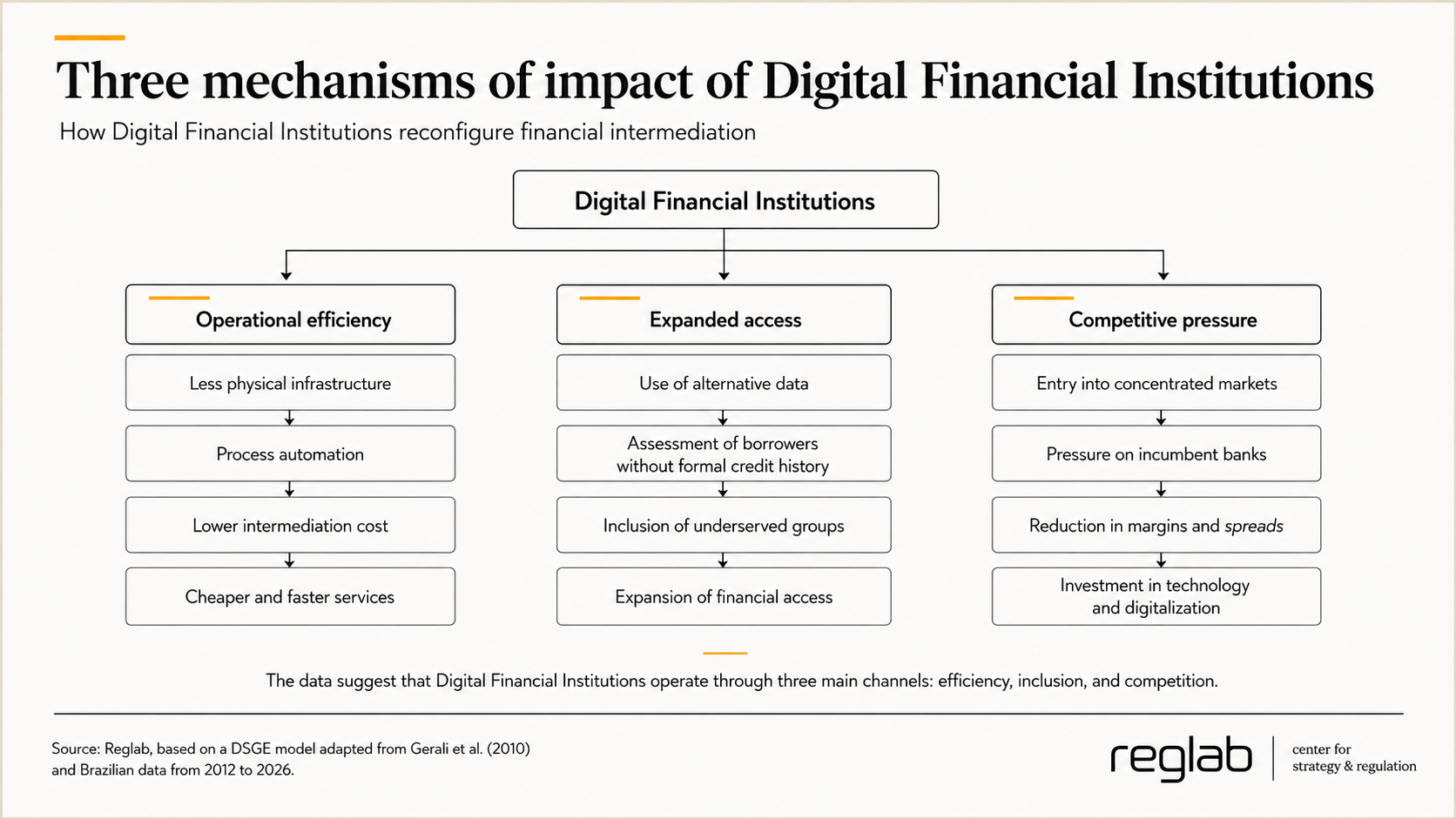
The digital financial services enabled by DFIs can help overcome obstacles frequently cited in access to traditional financial services, such as costs, geographic barriers, and information asymmetry (Khera et al., 2021). Three main mechanisms explain their potential to reshape financial intermediation:
Operational efficiency: by eliminating fixed spending on physical infrastructure and automating processes, DFIs operate with a significantly lower cost structure than incumbent banks, which translates into services offered at lower prices (Philippon, 2016) and with greater agility than the traditional system (Fuster et al., 2019). This lower cost structure makes it economically viable to incorporate population segments previously excluded from the financial system, whose inclusion was not profitable under the traditional banks' business model.
Broader access: the use of alternative data, such as digital usage patterns and transaction history, makes it possible to assess borrowers without a formal credit history, extending financial services to segments of the population traditionally excluded from the system (Berg et al., 2020; Jagtiani and Lemieux, 2018), including in municipalities historically without physical bank branches.
Competitive pressure: the entry of DFIs into markets with few competitors (as was the case in Brazil) can force traditional banks to reduce margins, compress spreads (the difference between lending and deposit rates), and invest in their own technology and digitalization (Cornelli et al., 2023; Hodula, 2023). The resulting reduction in rates charged to end borrowers, combined with greater digitalization of services, helps lower barriers to accessing the financial system.
These mechanisms generate significant economic effects. Khera et al. (2021) document that higher digital financial inclusion indices are associated with higher growth rates in emerging economies. Yang and Zhang (2022) argue that DFIs are market forces that contribute to financial inclusion, expanding household consumption in China and reshaping household financial management, with more pronounced effects among households that traditionally consumed less, encouraging banking uptake through incentives and reducing inequality. Liu and Zhang (2020) find that advances in digital financial inclusion contribute to the sustainable growth of small and micro enterprises, especially in competitive markets and high-technology private sectors.
The magnitude of this transformation is systematically captured by official international statistics. According to the IMF's Financial Access Survey (IMF, 2025), the average number of digital transactions per adult in emerging and developing economies jumped from 55 in 2017 to 251 in 2024 — Brazil, notably, is one of five countries that took part in the pilot collection of new DFI indicators. Segments such as buy now, pay later moved US$350 billion in 2024, and DFI financing directed at micro and small enterprises in Sub-Saharan Africa rose from 13% to 88% of total DFI funding between 2020 and 2023.
DFIs are also directly linked to corporate innovation (Ding et al., 2022) and job creation at financially constrained firms. Shi and Zhou (2025), analyzing 3,277 listed Chinese companies between 2011 and 2019, show that firms facing greater financing constraints hire significantly more in cities with more advanced DFI development, as measured by Beijing University's Digital Financial Inclusion Index (PKU-DFIIC, in their acronym), which combines coverage area, depth of use, and the level of digitalization of services by city. A 1% increase in the local DFI index is associated with an additional 0.51% increase in employment at these firms. The channel identified is intensified bank competition: DFIs pressure traditional banks to expand credit, which eases financing constraints and enables investment in labor, technology, and R&D. By easing financing constraints and reducing information asymmetries, DFIs improve total factor productivity — that is, how much more an economy can produce with the same resources.
Figure 1: How DFIs reshape financial intermediation.
RISKS AND CAVEATS
The benefits of DFIs coexist with the risks that the recent literature has been mapping. The evidence on these risks is heterogeneous and depends on the institutional context, the specific financial product, and the analytical horizon. We discuss four relevant dimensions here, seeking to record both the findings that point to risks and the evidence pointing in the opposite direction. Credit quality: the ease of access to digital credit has been associated, in contexts such as the U.S. market, with a greater propensity toward default and over-indebtedness. Di Maggio and Yao (2021) document that borrowers from DFIs in the United States were more likely to default than comparable borrowers from traditional banks. In the buy now, pay later segment, deHaan (2024), drawing on banking data for 10.6 million consumers, shows signs consistent with financial distress following use of the product. The Brazilian evidence, however, points in the opposite direction: Martins et al. (2025), using credit microdata from the Central Bank of Brazil, find that the probability of default at a DFI is roughly 20% lower than that observed at traditional banks for the same borrower. The discrepancy between the international and the Brazilian evidence suggests that the indebtedness risk associated with DFIs is not intrinsic to the digital model, but rather depends on product design, credit-granting criteria, and the regulatory environment. Discrimination in credit models: automated models that use machine learning for credit assessment can improve risk evaluation, but they can also inherit biases from the data used to train them, reproducing pre-existing inequalities. When a group has a thinner banking history, the system may classify it as riskier simply because there is less information available, and not because these individuals are in fact more likely to default. Bartlett et al. (2022) show that, in the U.S. mortgage market, racial minorities pay higher rates even with risk profiles similar to those of non-minorities, although this gap is smaller on digital platforms. Similar findings appear in Blattner and Nelson (2021) and Fuster et al. (2022). Effects on financial stability: the competitive pressure that DFIs exert on incumbent banks tends to benefit consumers. Classic theoretical arguments, originally formulated by Keeley (1990) and Matutes and Vives (2000), and applied to the digital context by Vives (2019), suggest that the erosion of incumbents' charter value could, in principle, give them an incentive to take on more risk in order to preserve profitability. The empirical evidence on this channel, however, is mixed and has not converged on a consensus: Cevik (2023), in a panel of 198 countries, finds an association between the expansion of digital credit and a deterioration in stability indicators, especially in developing economies; Daud et al. (2022), by contrast, using data from 63 countries, find evidence that DFIs may strengthen the stability of the financial system. For the Brazilian case specifically, the evidence tends to temper this concern. Xu (2026), the only study with causal identification available for Brazil, finds an effect which is statistically zero for the exposure to DFI competition on the risk-taking indicators of the banks analyzed. In addition, the IMF's 2026 Financial Sector Assessment Program (FSAP) for Brazil concludes that the financial sector remains resilient, with systemic risks contained and banks well capitalized, even after years of rapid DFI expansion (International Monetary Fund, 2026). The speed of bank runs in digital environments: instant payments and banking apps make it possible to withdraw deposits in seconds, which alters the classic dynamics of a bank run. The collapse of Silicon Valley Bank in 2023 is the most studied example: Cipriani, Eisenbach, and Kovner (2024) identify 22 U.S. banks that experienced runs coordinated via social media during that episode, although only two failed. It is worth noting, however, that digitalization also produces opposite effects on aggregate financial resilience: Suri and Jack (2016) show, for Kenya, that access to mobile money causally increased households' capacity to absorb income shocks — a distinct and potentially offsetting mechanism relative to run risk on the liability side of banks. Taken together, this evidence suggests that financial digitalization is neither uniformly beneficial nor uniformly risky. The net impact depends decisively on the quality of regulatory design, the financial product under consideration, and the macroeconomic environment. Rules that preserve competition and promote sound innovation practices, combined with continuous monitoring of indebtedness, bias in automated decisions, and systemic stability, are a precondition for the benefits estimated in this study to be sustained over the long run.
1.2. Digital financial institutions in Brazil
According to the Central Bank of Brazil ([n.d.]), DFIs are divided into three types:
Payment Institutions (PIs), responsible for issuing cards and point-of-sale devices;
Direct Credit Companies (SCDs), responsible for online loans and financing; and
Peer-to-Peer Lending Companies (SEPs), which facilitate person-to-person loans.
It is worth noting that several of Brazil's leading DFIs currently operate under a Multiple Bank license (B2) rather than as strict DFIs, even though they retain their original business model.
When this study refers to the impact of DFIs on the financial system (from Section 2 onward), the analysis covers both DFIs in the strict sense and digital banks.
Brazil offers an especially interesting setting for studying the macroeconomic impact of DFIs, for at least three reasons.
The Brazilian banking system is historically concentrated, with few large banks and spreads (i.e., the difference between the interest rate a bank charges on loans and the rate it pays to raise funds) and credit costs among the highest in the world (Joaquim, Van Doornik, and Ornelas, 2023);
Since November 2020, the country has had Pix (a public instant-payments system operated by the Central Bank of Brazil), which lowered barriers to the entry of new financial institutions into the sector (Duarte et al., 2022);
Adoption of DFIs by the Brazilian population was rapid and significant: these institutions' share of total financial system assets jumped from 0.6% in 2016 to 2.4% in 2026 (or 6.1% under a broader definition), while Pix reached more than 178 million unique users in under five years (Central Bank of Brazil, 2025; Duarte et al., 2022). This has affected the sector's competitive structure, with declines in traditional banks' net margins, interest rates, and profitability (Xu, 2026), as well as a shrinking network of physical branches (Mariani, Ornelas, and Ricca, 2023).
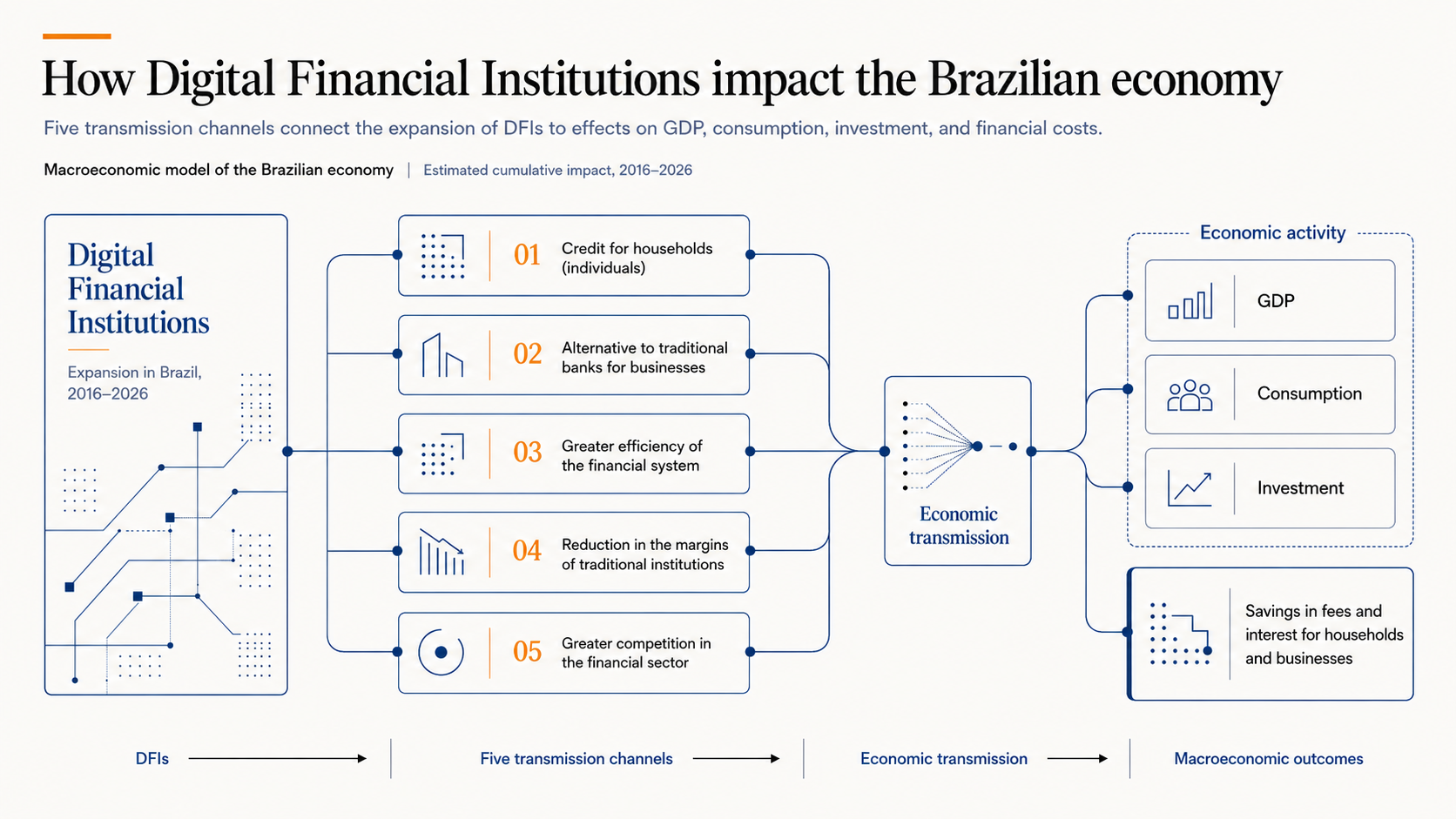
In this study, we estimate the impact of DFIs on the Brazilian economy between 2016 and 2026 using a macroeconomic model that reproduces how the country's economy functions. We assess how DFIs affected GDP, consumption, investment, and how much households and firms saved on fees and interest, breaking the impact down into five channels through which DFIs operate: they offered households more credit, gave firms an alternative to traditional banks, increased the efficiency of the financial system, pressured traditional institutions to lower their margins, and broadened competition in the sector. Figure 2 illustrates the mechanisms through which DFIs affect the economy.
Figure 2: Five transmission channels between DFIs and the macroeconomy.
1.3. Banking concentration in Brazil
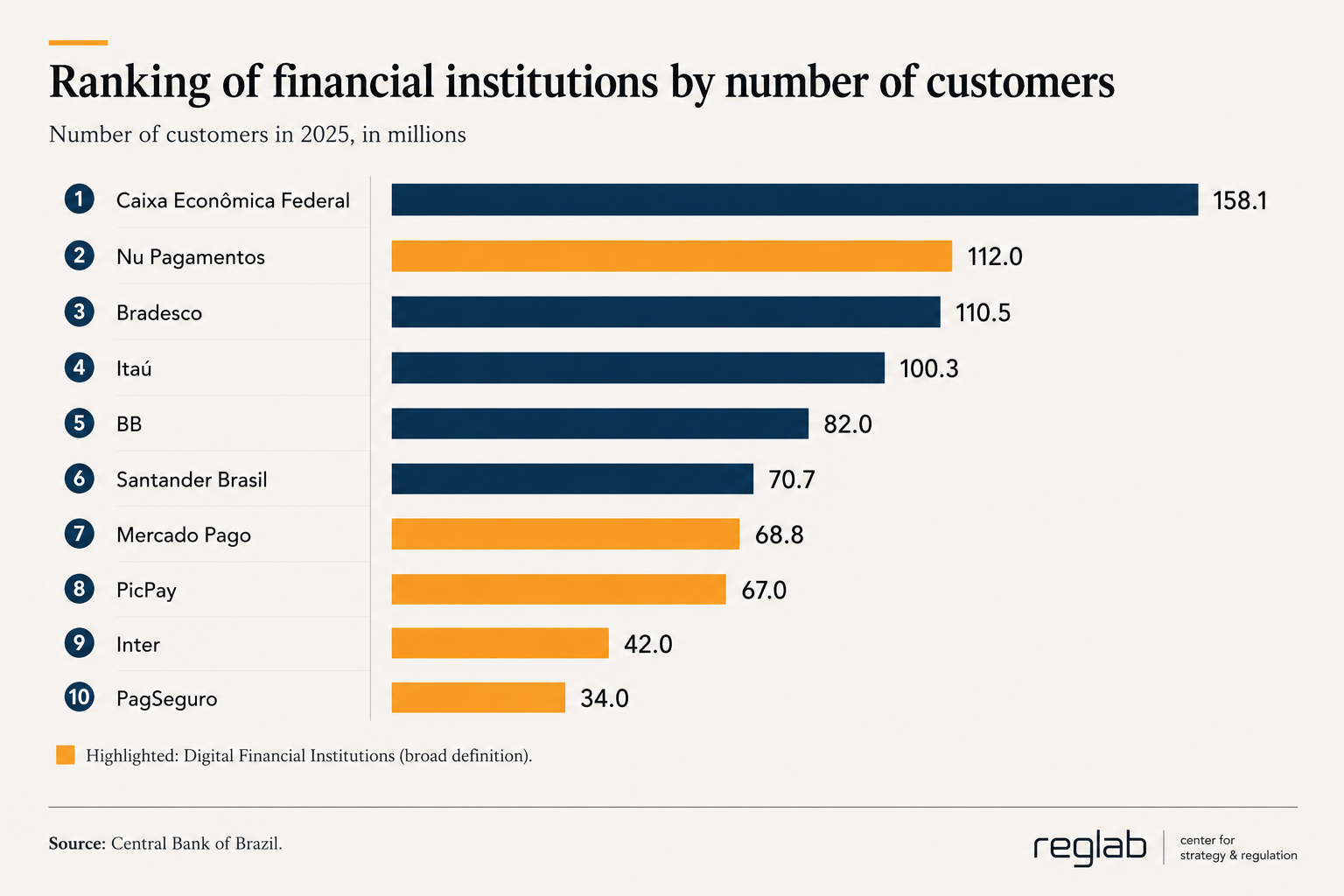
The entry of DFIs reshaped the financial system's competitive structure. One way to gauge this is by the number of customers, looking not only at PIs, SCDs, and SEPs (narrow definition), but also at a broad definition that includes digitally native Payment Institutions (excluding acquirers controlled by traditional banks) and digital banks that migrated to a full banking license (a complete list of institutions is provided in the Methodology Annex).
Figure 3: Ranking of financial institutions by number of customers (2025 data). Source: authors' elaboration based on BCB data.
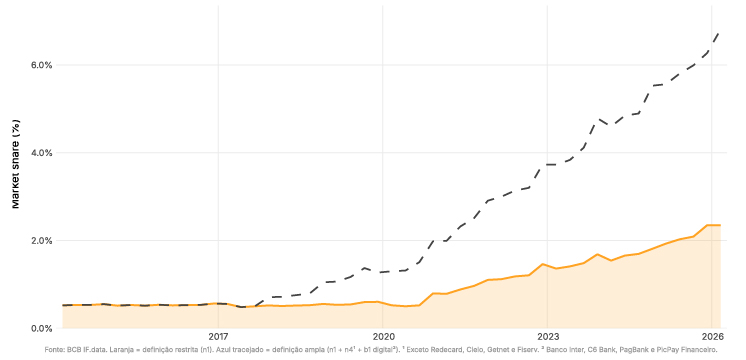
Another way to observe these changes is to examine shifts in financial institutions' market share, based on total assets (i.e., the sum of everything each financial institution owns or is entitled to receive, such as cash on hand, public and private securities, loans extended, real estate, equipment, and other resources).
In 2016 the share was below 0.6%. The divergence between the two metrics widened from 2018 onward, when the leading digital banks obtained authorization to operate as multiple banks. In the first quarter of 2026, DFIs' share of total assets measured under the narrow definition reached 2.4%, while under the broad definition it stood at 6.1% (we use this broad definition in our theoretical model).
Market share – Digital Institutions – Total Assets
Figure 4: DFIs' share of total assets in the Brazilian financial system (2000–2026). The orange area represents the share under the narrow definition, while the dotted line reflects the broader definition. Source: authors' elaboration based on BCB IF.data (digital financial institutions authorized by the BCB).
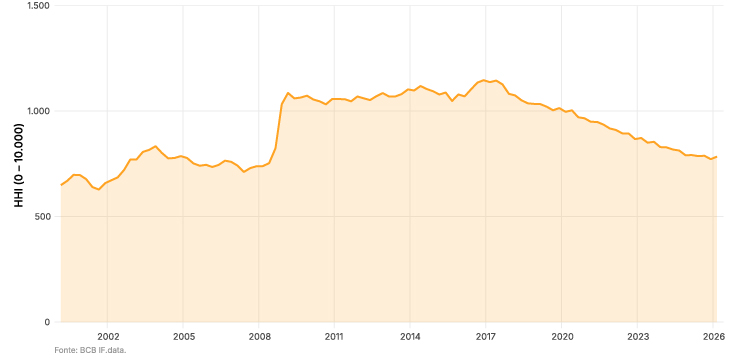
Other statistics corroborate the hypothesis of a shift in the financial system's competitive structure. The first is the standard measure of market concentration, the Herfindahl-Hirschman Index (HHI), which sums the squared market shares of each conglomerate operating in the Brazilian financial system. In Figure 5, considering the assets of institutions authorized by the Central Bank of Brazil, two moments stand out in the HHI's trajectory since the early 2000s. First, the "jump" that occurred in 2008–2009, resulting from the merger between Banco Itaú and Unibanco. Then, a downward trend began in 2017, alongside the expansion of DFIs. By 2026, concentration had reached a level close to that prevailing before the aforementioned merger.
HHI – Total Assets
Figure 5: Herfindahl-Hirschman Index (HHI) of the Brazilian financial system based on total assets (2000–2026). Source: authors' elaboration based on BCB IF.data.
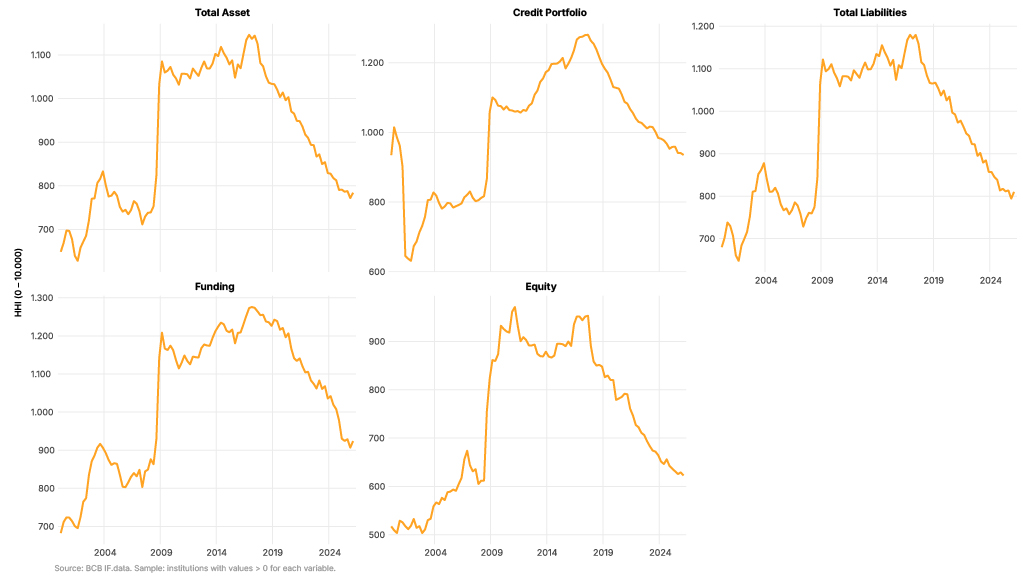
Does this movement hold across other dimensions? As shown in Figure 5, the upward (2008–2009) and downward (from 2017) trajectories extend beyond total assets, also appearing in the credit portfolio (the total loans and financing the institution has extended to individuals and firms and has not yet received back); in liabilities (everything the institution owes to third parties and will have to pay, such as customer deposits, debt issued in the market, government transfers, and other obligations with a maturity date); in funding (a subset of liabilities formed specifically by the resources the institution raises from the public and the market to finance its demand-deposit, savings, and fixed-income security operations such as CDBs, LCIs, LCAs, among others); and in shareholders' equity (the book value left for shareholders after subtracting all debts from total assets; it represents the institution's own capital).
HHI by financial variable – 2000-2026
Figure 6: Hirschman-Herfindahl Index (HHI) of the Brazilian financial system by financial variables (2000–2026). Source: authors' elaboration based on BCB IF.data.
The correlation between the expansion of DFIs in Brazil and the behavior of concentration metrics corroborates international evidence on bank competition and the compression of margins and interest rates (Hodula, 2023; Naceur et al., 2026; Bejar et al., 2022). For Brazil specifically, in addition to the Xu (2026) study already cited, Ornelas and Pecora (2022) find that bank competition driven by the entry of digital platforms that connect investors with capital directly to small businesses that demand it (so-called peer-to-peer, or P2P, lending) generates social welfare gains by creating downward pressure on interest rates.
Given the literature on the impacts of DFIs on the economy and the financial system, and in light of the shift in Brazil's competitive structure over the past ten years, this study sets out to answer the following question: what was the macroeconomic impact of DFIs on the Brazilian economy between 2016 and 2026?
2. Methodology
2.1. A dynamic structural macroeconomic model
To quantify the impact of DFIs, we use a Dynamic Stochastic General Equilibrium (DSGE) model. This class of models is among the leading analytical tools used by central banks — for example, the Central Bank of Brazil, which uses the SAMBA model (Castro et al., 2011) to analyze economic policy and run counterfactual simulations.
A DSGE model is a mathematical representation of the economy as an interconnected system. It comprises three groups of agents: households that work, consume, save, and borrow using assets such as real estate as collateral; firms that invest, hire workers, and produce goods, financing part of their investment with bank credit; and banks that take deposits from saving households, extend loans to borrowing households and firms, and charge different interest rates on each side, generating an intermediation margin. Monetary policy, in turn, influences the economy's interest rates and, through them, the decisions of all other agents, who make their choices based on the resources available to them and the constraints they face — not only in the present, but also taking into account their expectations for the future.
The model we use is based on Gerali et al. (2010), originally developed for the euro area. Building on it, we extended and adapted it for Brazil. As in the original work, we assume that banks have market power — that is, just as a firm with few competitors can charge more for its product, banks in concentrated markets can charge higher interest rates on loans and pay less on deposits than they would in a competitive market.
This premise is supported by consistent Brazilian empirical literature. Zeidan (2020) synthesizes the empirical literature on bank spreads in Brazil and shows that market concentration consistently appears as an important determinant, meaning that more concentrated markets exhibit higher spreads. Joaquim, van Doornik, and Ornelas (2023), drawing on regional variation in banking competition, document that greater competition among banks reduces the cost of credit and stimulates economic activity in the country. Ornelas and Pecora (2022) show, using Brazilian microdata, that the entry of FDIs reduces the financing costs paid by borrowers. Taken together, this evidence supports two modeling choices: (i) treating the Brazilian banking sector as a market with pricing power; and (ii) modeling the arrival of FDIs as a factor that gradually erodes the markup of incumbent banks.
The central advantage of this approach is that, by explicitly specifying how each channel operates, it allows for rigorous counterfactual experiments — that is, we can simulate what would have happened to the economy had DFIs never emerged.
In the absence of a natural experiment or exogenous variation that would allow the effect of DFIs on the Brazilian economy to be isolated, structural models, such as the one used in this study, offer the most robust methodological alternative available for constructing a counterfactual scenario — that is, an estimate of how the main macroeconomic variables would have evolved absent the expansion of DFIs. Unlike policy evaluations at the microeconomic or regional level, where it is often possible to compare treatment and control groups (municipalities, firms, or individuals exposed and not exposed to the intervention), the expansion of DFIs is a nationwide, gradually evolving phenomenon, with no "control Brazil" that would allow for direct comparison.
It should be noted that the results presented here refer to the intensive margin of DFIs' activity: the gains for households and firms that were already participating in the financial system at the time these institutions entered the market.
2.2. The five DFI channels
The starting point is a DSGE model with a banking sector under monopolistic competition — that is, a market with several banks competing with one another, but each holding some power to set its own rates, because customers face switching costs and perceive institutions as differentiated. This allows banks to charge interest above their effective cost of funding without immediately losing their entire customer base. The model was recalibrated with Brazilian parameters, adjusting the values that describe the economy, such as capital's share in output, household and firm indebtedness, and, above all, bank spreads — historically much higher in Brazil than in Europe — and was estimated with quarterly data from 2012 to 2026, meaning its parameters were statistically fitted so that the simulated trajectories match as closely as possible what actually occurred in the Brazilian economy over that period.
The model was extended to capture five specific DFI channels:
Channel 1 — Uncollateralized personal credit: households gain access to a second source of credit based on income rather than collateral, representing credit cards and digital personal loans.
Channel 2 — Alternative credit for firms: firms now choose between credit from traditional institutions and credit from DFIs, switching when DFIs offer more favorable terms.
Channel 3 — Productive efficiency gains: the digitalization of payments and financial services reduces firms' operating costs.
Channel 4 — Competitive pressure on margins (business credit): the bank's margin on business credit becomes endogenous — that is, it falls as DFIs gain market share.
Channel 5 — Competitive pressure on margins (consumer credit): the bank's margin on household credit also becomes endogenous and falls as DFIs gain share of the personal credit market. The mechanism is the same as in Channel 4 — that is, traditional banks, pressured by competition from DFIs, gradually reduce the markup charged on loans to individuals so as not to lose customers.
Based on the model and the channels listed above, we can estimate the impact on GDP, consumption, and aggregate investment using a counterfactual exercise: what would have happened to the Brazilian economy if DFIs had not increased their market share since 2016?
The complete methodology of this study is detailed in the Annex.
3. Results
3.1. Impact on GDP, consumption, and investment, and savings on interest and fees
The estimated impacts of DFIs in numbers (2016–2026)
Indicator
Estimated cumulative impact 2016/2026
How to read this number
Gross Domestic Product
R$1.6 trillion
Without the expansion of DFIs, the Brazilian economy would have produced less wealth between 2016 and 2026
Household consumption
R$982 billion
A significant share of the gain shows up in consumption, indicating greater household spending capacity
Aggregate investment
R$371 billion
Investment was the indicator with the largest proportional difference in early 2026
Savings on Interest and Fees
R$149 billion
Households and firms paid less in financial costs: R$47 billion in fees and R$102 billion in interest
Table 1. Impact quantified by the model calibrated with Brazilian data for the period between 2016 and 2026.
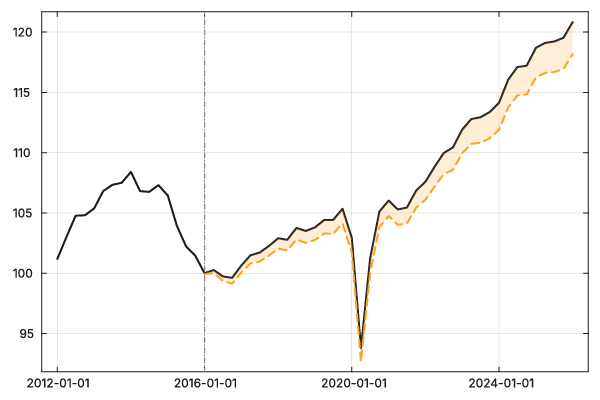
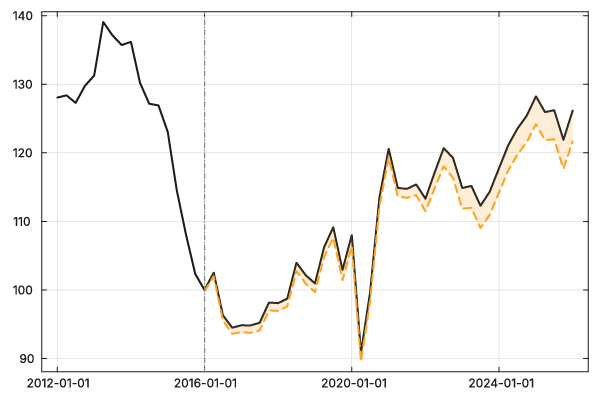
The counterfactual exercise indicates that the presence of DFIs is associated with a cumulative differential of approximately R$1.6 trillion in GDP, calculated as the sum of the differences between the observed trajectory and the trajectory simulated by the model without the presence of these digital institutions (Figure 7), expressed at 2026 prices. For example, based on the exercise, one can infer that, according to the model, in the absence of DFIs, GDP in the first quarter of 2026 would have been approximately 2.2% lower in real terms (that is, not accounting for price changes) than the value actually recorded by IBGE.
Total GDP (index 2016-Q1 = 100)
Figure 7: Total GDP (index 2016-Q1 = 100): observed trajectory versus structural counterfactual without DFIs (estimated DSGE model, 2012–2026). The vertical dotted line marks the entry of DFIs. The shaded area is the estimated contribution of DFIs to GDP. Source: IBGE (observed data); DSGE model (counterfactual).
Two important points must be highlighted in Figure 7. First, the gains grow larger over time, which is consistent with the evidence of DFIs' rising share of the Brazilian financial system since 2017. Second, during an acute crisis such as the one caused by the pandemic, the natural decline in financial activity (whether from traditional or digital institutions) leaves less room for the sector's contribution. These results were not imposed on the model, but estimated from the aggregate data.
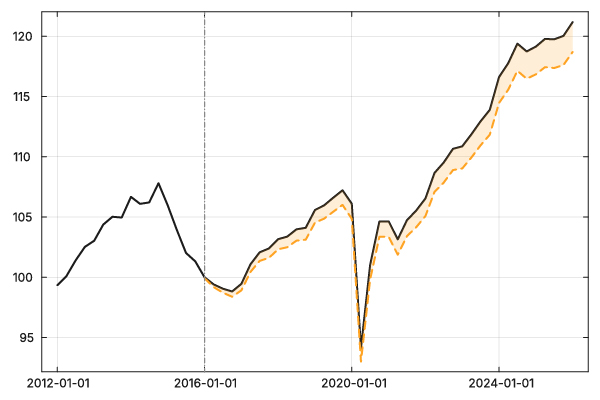
A substantial part of this difference between observed GDP and GDP in the counterfactual scenario is attributable to aggregate consumption. In an exercise analogous to the one performed for GDP, when we consider aggregate consumption, the cumulative differential relative to the scenario without DFIs was R$982 billion at 2026 prices. Comparing the level observed in the first quarter of 2026 with the counterfactual simulation, for example, aggregate consumption would have been 2.04% lower in real terms without the presence of DFIs (Figure 8).
Aggregate consumption (index 2016-Q1 = 100)
Figure 8: Aggregate consumption (index 2016-Q1 = 100): observed trajectory versus structural counterfactual without DFIs (estimated DSGE model, 2012–2026). The vertical dotted line marks the entry of DFIs. The shaded area is the estimated contribution of DFIs to consumption. Source: IBGE (observed data); DSGE model (counterfactual).
Another important component is aggregate investment. As with GDP and consumption, the model's counterfactual exercise also attributes a positive differential to DFIs in aggregate investment: the value observed in the first quarter of 2026 would have been 3.55% lower in real terms in the scenario without DFIs. As observed in the exercises for GDP and consumption, the contribution to investment growth is larger after the economy recovers from the effects of the pandemic, as shown in Figure 9.
Aggregate investment (index 2016-Q1 = 100)
Figure 9: Aggregate investment (index 2016-Q1 = 100): observed trajectory versus structural counterfactual without DFIs (estimated DSGE model, 2012–2026). The vertical dotted line marks the entry of DFIs. The shaded area is the estimated contribution of DFIs to investment. Source: IBGE (observed data); DSGE model (counterfactual).
Although this is not evidence obtained through causal inference methods (an opportunity for future research) — such as when an experiment allows one to observe what happened to a control group (without the intervention) and a treatment group (with the intervention) — the results of the quantitative exercise support the hypothesis that DFIs contribute positively to the Brazilian economy, based on GDP, consumption, and investment data.
It is important to note that there is a difference between the cumulative contribution to GDP (R$1.6 trillion) and the sum of the impacts on consumption (R$967 billion) and investment (R$371 billion), which together total R$1.34 trillion. This reflects the contribution of the economy's external channel: in the open-economy version of the model, the spread compression driven by DFIs narrows the domestic-foreign interest rate differential, which is associated with a slight depreciation of the real exchange rate and, consequently, an improvement in net exports. Since the conduct of fiscal policy is outside the scope of this study, government spending does not contribute to the difference.
Beyond the impact on output, consumption, and aggregate investment, digital financial institutions — whether through competitive effects that lower market-wide interest rates, or by offering services with reduced or zero fees — generate other direct, measurable benefits for households. For example, the absence of credit card annual fees leaves households with more disposable income, which in turn frees up room for consumption. The model helps us approximate the savings associated with these two channels (fee savings and interest savings), although future research could quantify these effects more precisely.
In the case of the banking fee channel, competitive pressure from DFIs reduced traditional banks' markups, leading them to charge lower fees. The size of this reduction is estimated by multiplying the proportional decline in markups (obtained from the model) by traditional banks' total fee revenue each quarter, taken from the income statements reported to the Central Bank via IF.data. In addition, customers who migrated to DFIs (whose fees are close to zero) stopped paying the fees they would have paid at a conventional bank; this gain is calculated as the difference in fees per unit of credit between the two types of institution, multiplied by DFIs' loan portfolio. Accumulated between 2016-Q1 and 2026-Q1 and adjusted for IPCA inflation, the two components add up to R$47 billion at 2026 prices.
In the interest channel, the model estimated, for each quarter, what the non-earmarked credit interest rate (for both individuals and firms) would have been in the absence of DFIs. The difference between this counterfactual interest rate and the observed interest rate, applied to the actual non-earmarked credit balance (based on Central Bank data), provides the estimate of interest savings in each period. The figures were adjusted for inflation and total R$102 billion over the same period.
Channels of Fee and Interest Savings
Channel
Cumulative value (2026-Q1 prices)
Channel 1 – Fees (total)
R$47 billion
Channel 2 – Savings on interest paid
R$102 billion
Total
R$149 billion
Table 2: Fee and interest savings. Note: Channel 1B is "small" because DFIs classified as SCDs (Direct Credit Companies) operate predominantly in high-ticket business credit, with a fee-to-portfolio ratio similar to that of traditional banks.
4. Analysis and Discussion
This section analyzes the study's findings, relating them to the academic literature and expert opinion through the lens of this study's authors.
4.1. Financial competition is also economic policy
The results of this study suggest that the entry of Digital Financial Institutions in Brazil should be understood not merely as a sectoral transformation of the financial system, but as a shift with significant macroeconomic effects. The counterfactual exercise indicates that, without the expansion of these institutions, Brazilian GDP would have been about 2.2% lower in the first quarter of 2026, and that DFIs' cumulative contribution to GDP between 2016 and 2026 was estimated at approximately R$1.6 trillion at 2026 prices. The same pattern appears in household consumption, with an estimated cumulative impact of R$982 billion, and in aggregate investment, which would have been 3.55% lower in the first quarter of 2026 in the scenario without DFIs.
Financial digitalization does not appear merely as the replacement of branches with apps, nor as a simple convenience for consumers. The main effect identified is more structural: by lowering costs, expanding credit alternatives, and pressuring bank margins, DFIs appear to have influenced household consumption, corporate investment, and the way the financial system allocates resources. In this sense, pro-competition policies in the financial sector can also function as instruments of economic policy.
This reading, however, does not warrant the automatic conclusion that every instance of digital financial expansion will produce growth. The finance-and-growth literature itself shows that positive effects depend on institutional quality, regulatory design, and the articulation between the financial system and the real economy. The central finding is therefore more precise: in a country like Brazil, with a historically concentrated banking system and high spreads, the entry of new digital competitors appears to have produced economic gains when combined with a regulatory environment that allowed for contestability, business-model innovation, and cost reduction.
4.2. Small market share, large competitive pressure
This mechanism helps explain why a significant share of the estimated benefits arises outside the direct relationship between a customer and a digital institution. We estimate R$47 billion in savings on banking fees and R$102 billion in interest savings, totaling R$149 billion in direct benefits for households and firms. We also identify a benefit of approximately R$46 billion for customers of traditional institutions. In other words, even consumers who never opened an account at a digital institution may have benefited from the competitive pressure these institutions exerted on the market.
A methodological caveat is warranted, however**: the decline in concentration and margins occurred during a period also marked by Pix, the digitalization of traditional banks, the pandemic, and macroeconomic shifts.** Even so, the convergence between the model, the concentration data, and the literature on bank competition reinforces the hypothesis that DFIs played a significant role in this reconfiguration.
4.3. Policy implications
The results indicate that regulation should promote competition. Its benefits extend beyond financial inclusion and customer welfare, reaching economic activity as well, with effects on GDP and its components. At the same time, regulation should monitor and mitigate the specific risks associated with the financial system, without presuming a trade-off between competition and stability that is not supported by the available empirical evidence.
The public agenda should not treat financial innovation merely as a matter of technological modernization, nor merely as a source of prudential risk. The results suggest that DFIs can generate positive effects on GDP, consumption, and investment, and help reduce fees and interest rates. The literature also raises concerns about risks such as financial instability, over-indebtedness, and bias in automated decisions, but these are ongoing concerns on the regulatory agenda rather than established empirical evidence — on the contrary, meta-analyses that directly test the relationship between competition and stability do not find the trade-off this hypothesis presupposes (Zigraiova and Havranek, 2015; Bandaranayake et al., 2020).
For policymakers and regulators, four directions appear especially relevant:
Preserve the contestability of the financial market. Rules on Open Finance, portability, interoperability, and barriers to mobility and the entry of new players should also be assessed for their effect on competition, financial costs, and bank margins, given that broader competition is one of the structural mechanisms consistently associated, in the Brazilian empirical literature, with lower credit costs for end borrowers.
Adaptive regulatory capacity and periodic review. As the financial system incorporates new business models, instant payments, and complex digital arrangements, the regulatory framework needs formal mechanisms for periodic review, allowing prudential requirements to be calibrated in light of accumulated empirical evidence on actual risks. Tools such as structured public consultations, ex ante and ex post regulatory impact assessments, and regulatory sandboxes (controlled environments in which the regulator authorizes the temporary testing of innovative financial products on a limited scale, generating empirical evidence on actual risks) are especially useful in this adaptation effort.
From financial inclusion to financial health. Account ownership is an incomplete indicator, and even robust inclusion indicators (usage, retention, credit use, savings) do not fully capture citizens' financial well-being. Public policy should complement these with financial health indicators: the capacity to absorb income shocks, healthy credit use, building reserves, and resilience to stress. This conceptual distinction, now well established in the international debate (the CFPB in the United States, the Financial Health Network, and the financial well-being metrics incorporated into the BCB's own 2025 Financial Citizenship Report), allows for a fuller reading of how financial services affect users' everyday lives.
Track risks with recurring metrics, contextualized by their macroeconomic determinants. The Central Bank already conducts systematic monitoring of delinquency, over-indebtedness, operational stability, and infrastructure concentration — institutional capacity that should be preserved and adapted to the growth of digital credit. Interpreting these indicators, however, requires context: in Brazil, household delinquency shows a correlation of around 0.77 with the interbank interest rate lagged six months (authors' calculation using BCB SGS data, 2011–2025), reflecting delinquency's strong dependence on the monetary policy cycle. Factors such as the labor market, income shocks, and successive supply shocks in the post-2020 period round out the picture of macroeconomic determinants. In this context, digital credit, which still accounts for a minority share of the total credit stock, should be monitored as one component of a broader landscape, not as an isolated determinant of aggregate dynamics.
The regulatory implication, therefore, is to promote competition in the financial system, expanding the macroeconomic gains documented here in GDP, consumption, investment, interest, and fees. In parallel, the specific risks that emerge when credit, payments, data, and automated decisions operate at greater scale and speed should be monitored and mitigated. These two efforts are complementary rather than mutually exclusive, as the available empirical evidence already indicates, which does not support a systematic trade-off between competition and stability. In practical terms, pro-competition frameworks can be instruments of growth and inclusion, provided they are accompanied by transparency, proportional supervision, and public tracking indicators.
Finally, it is worth contextualizing these considerations in light of Brazil's recent regulatory moment. Between September 2025 and early 2026, a series of rules expanded the prudential and operational requirements applicable to DFIs: an increase in the Social Contribution on Net Income, higher minimum capital requirements, new operational restrictions, the end of pooled ("bolsão") accounts, among others. The Central Bank's own estimates indicate that a significant share of existing Payment Institutions will need to be reclassified by 2028. Each measure has its own prudential justification, but the results of this study suggest that the regulatory agenda should explicitly consider the potential economic cost of reducing the system's competitive contestability. Recent meta-analyses find no robust evidence of a trade-off between competition and stability (Zigraiova and Havranek, 2015; Bandaranayake et al., 2020); Joaquim, van Doornik, and Ornelas (2023) estimate that the convergence of Brazilian spreads to the world average could raise GDP by about 5%; and Scalco, Tabak, and Teixeira (2021) show that the tightening of prudential measures in Brazil tends to increase bank markups and reduce competition. Prudent regulation and a competitive environment are not mutually exclusive goals: they can be complementary, provided the design of the rules preserves room for entry, innovation, and competition for customers.
5. Conclusion
What did we set out to answer with this study?
The central objective of this research was to quantify the real macroeconomic impact of the rise of Digital Financial Institutions (DFIs) in Brazil. Given a decade marked by profound structural transformations in the banking sector, what remained to be understood was whether the physical disintermediation and digitalization of financial services translated into aggregate gains for the Brazilian economy, or whether it amounted merely to a redistribution of market share between new and old players in the banking sector.
To answer this, isolating cyclical noise**, we estimated a Dynamic Stochastic General Equilibrium (DSGE) structural model fed with historical Brazilian data, projecting a counterfactual scenario for the 2016–2026 period.**
And what did we find?
The model's results support the hypothesis that the expansion of DFIs is associated with an improvement in the efficiency of the Brazilian economy, generating positive impacts on three key fronts:
Aggregate macroeconomic stimulus: the counterfactual exercise indicates that the presence of DFIs was associated with increases in GDP, household consumption, and aggregate investment. The period of fastest growth for these institutions coincided with the post-pandemic period, when the Brazilian economy posted consistently positive performance — a pattern for which DFIs may represent one of the explanatory structural drivers.
Reduced transaction costs: these macroeconomic gains stem from the contraction in financial intermediation costs. Using the same model, we estimate significant savings for citizens and firms on banking fees and interest expenses. In this sense, the results suggest that the expansion of DFIs adds to the drivers acting on the cost of credit in Brazil — a dimension that has historically been central to the country's economic policy agenda.
Increased competition was the main driver of the gains. The main transmission mechanism identified was not simply customers migrating from branches to digital channels. The pressure exerted by DFIs forced incumbent banks to reduce their margins and fees, benefiting even the share of the population that never opened an account at a digital institution.
And why does this matter?
These findings shift the level of the debate on financial digitalization in Brazil, moving it from a purely technological perspective to evidence relevant to economic policy.
The study offers an analytical basis for decision-makers, indicating that agendas to stimulate competitiveness — such as the regulation of Direct Credit Companies (SCDs) and Peer-to-Peer Lending Companies (SEPs), the advancement of Open Finance, and data portability — are not merely pro-innovation measures, but generators of social welfare and economic growth. Conversely, artificial barriers to the growth of DFIs exact a real and high cost on economic activity.
For the financial sector, the results suggest that digital transformation has consolidated a new competitive configuration in the Brazilian financial system. Preserving the gains documented here over the long run depends on combining the promotion of this competition with continuous prudential monitoring of the specific risks of digitalization.
6. Directions for Future Research
The results of this study open up several possibilities for future research.
From a quantitative standpoint, a promising agenda consists of developing models capable of integrating, within a single framework, the intensive and extensive effects of DFIs. Extensions featuring endogenous participation in the financial system could simultaneously capture the expansion of banking access and its effects on consumption, savings, and investment. Likewise, models with agent heterogeneity along other dimensions would make it possible to investigate how the gains associated with DFIs are distributed across different income groups, age brackets, and credit-access profiles.
Another relevant direction involves the explicit incorporation of new digital instruments and infrastructures. Modeling the effects of Pix, Open Finance, and data portability mechanisms on competition, allocative efficiency, and monetary policy transmission remains relatively unexplored. The interaction between DFIs and financial stability also deserves attention, including issues related to market concentration, operational risk, technological dependence, and potential channels for shock propagation.
On the empirical front, access to administrative microdata could enable more precise causal identification strategies for the effects of DFIs across different dimensions, such as financial inclusion, bank switching, credit costs, delinquency, and wealth accumulation. Regional studies could also investigate whether the observed benefits were distributed evenly across the national territory or whether they helped reduce geographic inequalities in access to financial services.
Finally, qualitative approaches can complement the quantitative evidence by exploring the institutional and behavioral aspects of the digital transformation of finance. Case studies of regulatory trajectories, interviews with policymakers, and analyses of user experience can help clarify how trust, financial literacy, usability, and perceived security influence the adoption of new financial services. Combining quantitative and qualitative methods tends to offer a more comprehensive view of the economic and social impacts of DFIs, enriching the academic debate and supporting the improvement of Brazil's regulatory framework.
References
AGUIAR, M.; GOPINATH, G. Emerging Market Business Cycles: The Cycle Is the Trend. Journal of Political Economy, v. 115, n. 1, 2007.
ARCAND, J. L.; BERKES, E.; PANIZZA, U. Too much finance? Journal of Economic Growth, v. 20, n. 2, p. 105-148, 2015.
BANDARANAYAKE, S.; DAS, K. K.; REED, R. W. Another Look at 'Bank Competition and Financial Stability: Much Ado about Nothing'? Journal of Economic Surveys, v. 34, n. 2, p. 344-371, 2020. DOI: 10.1111/joes.12352.
BARTLETT, R.; MORSE, A.; STANTON, R.; WALLACE, N. Consumer-Lending Discrimination in the FinTech Era. Journal of Financial Economics, v. 143, n. 1, p. 30–56, 2022.
BEJAR, P.; ISHI, K.; KOMATSUZAKI, T.; SHIBATA, I.; SIN, J.; TAMBUNLERTCHAI, S. Can fintech foster competition in the banking system in Latin America and the Caribbean? Latin American Journal of Central Banking, v. 3, n. 2, art. 100061, 2022.
BERG, T.; BURG, V.; GOMBOVIĆ, A.; PURI, M. On the Rise of FinTechs: Credit Scoring Using Digital Footprints. Review of Financial Studies, v. 33, n. 7, p. 2845–2897, 2020.
BLATTNER, L.; NELSON, S. How Costly Is Noise? Data and Disparities in Consumer Credit. [S. l.]: arXiv, 2021. Working Paper. DOI: 10.48550/arXiv.2105.07554.
BOOT, A.; HOFFMANN, P.; LAEVEN, L.; RATNOVSKI, L. Fintech: What's Old, What's New? Journal of Financial Stability, v. 53, art. 100836, 2021.
BOTEV, J.; ÉGERT, B.; JAWADI, F. The nonlinear relationship between economic growth and financial development: Evidence from developing, emerging and advanced economies. International Economics, 2019. DOI: 10.1016/j.inteco.2019.06.004.
CASTRO, M.; GOUVÊA, S.; MINELLA, A.; SANTOS, R.; SOUZA-SOBRINHO, N. SAMBA: Stochastic Analytical Model with a Bayesian Approach. Brasília: Banco Central do Brasil, 2011. (Working Paper, 239).
CEVIK, S. The Dark Side of the Moon? Fintech and Financial Stability. Washington, DC: International Monetary Fund, 2023. (IMF Working Paper, WP/2023/253).
CIPRIANI, M.; EISENBACH, T. M.; KOVNER, A. Tracing Bank Runs in Real Time. New York: Federal Reserve Bank of New York, 2024. (Staff Reports, n. 1104).
CORNELLI, G.; FROST, J.; GAMBACORTA, L.; RAU, R.; WARDROP, R.; ZIEGLER, T. Fintech and Big Tech Credit: Drivers of the Growth of Digital Lending. Journal of Banking & Finance, v. 148, art. 106742, 2023.
CORNELLI, G.; FROST, J.; GAMBACORTA, L.; JAGTIANI, J. The impact of fintech lending on credit access for U.S. small businesses. Basel: Bank for International Settlements, 2022. (BIS Working Papers, n. 1041).
CRUZ, J. D. L. Financial Development and Economic Growth: New Evidence. Economica, v. 43, p. 47-64, 2020. DOI: 10.18800/economia.202001.003.
DAUD, S. N. M.; AHMAD, A. H.; KHALID, A.; AZMAN-SAINI, W. N. W. FinTech and Financial Stability: Threat or Opportunity? Finance Research Letters, v. 47, art. 102667, 2022.
DEHAAN, E.; KIM, J.; LOURIE, B.; ZHU, C. Buy Now Pay (Pain?) Later. Management Science, v. 70, n. 8, p. 5586–5598, 2024.
DEIDDA, L.; FATTOUH, B. Non-linearity between finance and growth. Economics Letters, v. 74, n. 3, p. 339-345, 2002.
DEMIRGÜÇ-KUNT, A.; KLAPPER, L.; SINGER, D.; ANSAR, S. The Global Findex Database 2021: Financial Inclusion, Digital Payments, and Resilience in the Age of COVID-19. Washington, DC: World Bank, 2022.
DI MAGGIO, M.; YAO, V. Fintech Borrowers: Lax Screening or Cream-Skimming? Review of Financial Studies, v. 34, n. 10, p. 4565–4618, 2021.
DING, N.; GU, L.; PENG, Y. Fintech, Financial Constraints and Innovation: Evidence from China. Journal of Corporate Finance, v. 73, art. 102194, 2022.
DUARTE, A.; FROST, J.; GAMBACORTA, L.; KOO WILKENS, P.; SHIN, H. S. Central Banks, the Monetary System and Public Payment Infrastructures: Lessons from Brazil's Pix. Basel: Bank for International Settlements, 2022. (BIS Bulletin, n. 52).
DURUSU-CIFTCI, D.; ISPIR, M.; YETKINER, H. Financial development and economic growth: Some theory and more evidence. Journal of Policy Modeling, v. 39, p. 290-306, 2017. DOI: 10.1016/j.jpolmod.2016.08.001.
FUSTER, A.; GOLDSMITH-PINKHAM, P.; RAMADORAI, T.; WALTHER, A. Predictably Unequal? The Effects of Machine Learning on Credit Markets. Journal of Finance, v. 77, n. 1, p. 5–47, 2022.
FUSTER, A.; PLOSSER, M.; SCHNABL, P.; VICKERY, J. The Role of Technology in Mortgage Lending. Review of Financial Studies, v. 32, n. 5, p. 1854–1899, 2019.
GERALI, A.; NERI, S.; SESSA, L.; SIGNORETTI, F. Credit and Banking in a DSGE Model of the Euro Area. Journal of Money, Credit and Banking, v. 42, n. 6, 2010.
HODULA, M. Does fintech credit substitute for traditional credit? Evidence from 78 countries. Finance Research Letters, v. 46, art. 102469, 2022.
HODULA, M. Interest rates as a finance battleground? The rise of Fintech and big tech credit providers and bank interest margin. Finance Research Letters, v. 53, art. 103685, 2023.
IBRAHIM, M.; ALAGIDEDE, P. Effect of financial development on economic growth in sub-Saharan Africa. Journal of Policy Modeling, 2018. DOI: 10.1016/j.jpolmod.2018.08.001.
IBRAHIM, M.; ALAGIDEDE, P. Nonlinearities in financial development–economic growth nexus: Evidence from sub-Saharan Africa. Research in International Business and Finance, 2017. DOI: 10.1016/j.ribaf.2017.11.001.
INGOLD, J.; MONAGHAN, M. Evidence translation: an exploration of policy makers' use of evidence. Policy & Politics, v. 44, n. 2, p. 171-190, Apr. 2016.
INTERNATIONAL MONETARY FUND. Financial Access Survey 2025: Fintech, a Catalyst for Financial Services Access, Innovation and Growth. Washington, DC: IMF, 2025. Available at: https://www.imf.org/en/news/articles/2025/10/29/pr-25351-imf-releases-the-2025-financial-access-survey-results. Accessed on: 29 Jul. 2026. IWASAKI, I.; KOČENDA, E. Quest for the general effect size of finance on growth: a large meta-analysis of worldwide studies. Empirical Economics, v. 66, p. 2659-2722, 2023. DOI: 10.1007/s00181-023-02528-1.
JAGTIANI, J.; LEMIEUX, C. Do Fintech Lenders Penetrate Areas That Are Underserved by Traditional Banks? Journal of Economics and Business, v. 100, p. 43–54, 2018.
JOAQUIM, G.; VAN DOORNIK, B.; ORNELAS, J. R. H. Bank Competition, Cost of Credit and Economic Activity: Evidence from Brazil. Basel: Bank for International Settlements, 2023. (BIS Working Papers, n. 1134).
KEELEY, M. C. Deposit Insurance, Risk, and Market Power in Banking. American Economic Review, v. 80, n. 5, p. 1183-1200, 1990.
KHATIB, A. M. G. A. Beyond linearity: a critical review of the finance–growth nexus. Cogent Economics & Finance, v. 13, 2025. DOI: 10.1080/23322039.2025.2514690.
KHATIB, A. M. G. A. The complexity of financial development and economic growth nexus in Syria: A nonlinear modelling approach with artificial neural networks and NARDL model. Heliyon, v. 9, 2023. DOI: 10.1016/j.heliyon.2023.e20265.
KHATIB, A. M. G. A.; ALSHAIB, B. M.; KANAAN, A. The Interaction Between Financial Development and Economic Growth: A Novel Application of Transfer Entropy and Nonlinear Approach in Algeria. SAGE Open, v. 13, 2023. DOI: 10.1177/21582440231217871.
KHERA, P.; NG, S. Y.; OGAWA, S.; SAHAY, R. Is Digital Financial Inclusion Unlocking Growth? Washington, DC: International Monetary Fund, 2021. (IMF Working Paper, 21/167).
KING, R. G.; LEVINE, R. Finance and growth: Schumpeter might be right. The Quarterly Journal of Economics, v. 108, n. 3, p. 717-737, 1993.
KRINICHANSKII, K. V. The relationship between financial development and economic growth: The issue of nonlinearity. Finance and Credit, 2022. DOI: 10.24891/fc.28.6.1212.
LEVINE, R. E. Financial development and economic growth: views and agenda. Washington, D.C.: World Bank Group, 1999. (Policy, Research working paper, n. WPS 1678). Available at: http://documents.worldbank.org/curated/en/194291468766487705. Accessed on: 1 Jul. 2026.
LIU, Y.; ZHANG, Y. Digital Financial Inclusion and Sustainable Growth of Small and Micro Enterprises — Evidence Based on China's New Third Board Market Listed Companies. Sustainability, v. 12, n. 9, art. 3733, 2020.
MARIANI, L. A.; ORNELAS, J. R. H.; RICCA, B. Banks' Physical Footprint and Financial Technology Adoption. Brasília: Banco Central do Brasil, 2023. (Working Paper Series, 576).
MARTINS, T. C.; RICCA, B.; TABURET, A. Competing for Loan Informal Seniority: theory and evidence. Brasília: Banco Central do Brasil, out. 2025. (Working Paper Series, 632). Available at: https://www.bcb.gov.br/content/publicacoes/WorkingPaperSeries/WP632.pdf. Accessed on: 30 Jul. 2026. MATUTES, C.; VIVES, X. Imperfect Competition, Risk Taking, and Regulation in Banking. European Economic Review, v. 44, n. 1, p. 1-34, 2000.
NACEUR, S.B.; CANDELON, B.; ELEKDAG, S.; Emrullahu, D. (2026). Is FinTech Eating the Bank's Lunch?. Journal of International Financial Management & Accounting, 37: 225-246. https://doi.org/10.1111/jifm.12242
ORNELAS, J. R. H.; PECORA, A. R. Does Fintech Lending Lower Financing Costs? Evidence From An Emerging Market. Brasília: Banco Central do Brasil, 2022. (Working Paper Series, 571).
PHILIPPON, T. The Fintech Opportunity. Cambridge, MA: National Bureau of Economic Research, 2016. (NBER Working Paper, 22476).
SAMPAIO, M. C.; ORNELAS, J. R. H. Payment Technology Complementarities and their Consequences in the Banking Sector: Evidence from Brazil's Pix. Brasília: Banco Central do Brasil, 2024. (Working Paper Series, 600).
SCALCO, P. R.; TABAK, B. M.; TEIXEIRA, A. M. Prudential measures and their adverse effects on bank competition: The case of Brazil. Economic Modelling, v. 100, art. 105495, 2021. DOI: 10.1016/j.econmod.2021.105495. SHI, X.; ZHOU, Y. The effects of FinTech development on corporate employment. International Review of Economics and Finance, v. 101, art. 104172, 2025. SURI, T.; JACK, W. The long-run poverty and gender impacts of mobile money. Science, v. 354, n. 6317, p. 1288-1292, 2016. VIVES, X. Digital Disruption in Banking. Annual Review of Financial Economics, v. 11, p. 243–272, 2019.
XU, R. Fintech Competition and Banks' Shrinking Margins in Brazil. Washington, DC: International Monetary Fund, 2026. (IMF Working Paper, WP/2026/007).
YANG, L.; ZHANG, Y. FinTech adoption and financial inclusion: Evidence from household consumption in China. Journal of Banking & Finance, v. 145, 2022.
ZEIDAN, R. Why is bank credit in Brazil the most expensive in the world? Revista Brasileira de Finanças, v. 18, n. 4, 2020. Available at: https://periodicos.fgv.br/rbfin/article/view/81507. Accessed on: 29 Jul. 2026.
ZIGRAIOVA, D.; HAVRANEK, T. Bank competition and financial stability: Much ado about nothing? Journal of Economic Surveys, v. 30, n. 5, p. 944-981, 2016.
Reglab Methodology Annex
POLICY BRIEF REGLAB
AUTORSHIP
João Ricardo Costa Filho and Thais Palanca
Title
The Impact of Digital Financial Institutions on the Brazilian Economy
Research Question
What is the causal impact of DFIs on GDP, consumption, credit rates, and the direct welfare of households and firms in Brazil between 2016 and 2026?
Methodology Summary
The macroeconomic modeling was developed from the DSGE model of Gerali et al. (2010), extended to capture the effects of productivity on the growth trend (Aguiar and Gopinath, 2007). The model's technical architecture simultaneously processes 128 endogenous variables under the impact of 19 structural exogenous shocks. The model was estimated using real quarterly data for the Brazilian economy, covering the period from 2012-Q2 to 2026-Q1. Five observable variables were used: the growth rates of GDP per capita, consumption, investment, the Selic rate, and the bank spread on non-earmarked credit operations. The data come from IBGE SIDRA (table 6613/1846), the continuous PNAD household survey, and the Central Bank's Time Series Management System (SGS 4189/20783/24370/433). Estimation used the Metropolis-Hastings algorithm via MCMC (Markov Chain Monte Carlo) simulation, structured in two chains of 10,000 iterations each with a scale factor of 0.30, together with the Kalman smoother algorithm to refine and ensure the historical consistency of the captured data.
Data Collection
Secondary-data desk research, as follows: Macroeconomic series for DSGE estimation (5 quarterly observables, 2012-Q2 to 2026-Q1): GDP at market prices, household consumption expenditure, and gross fixed capital formation – IBGE SIDRA, tables 6613 and 1846; Working-age population – continuous PNAD; Selic rate – BCB, Time Series Management System (SGS), series 4189; Non-earmarked credit bank spread – BCB, SGS, series 20783; IPCA deflator (base 2026-Q1 = 100) – BCB, SGS, series 433; Credit balances for measuring direct benefits: Non-earmarked credit stock, individuals – BCB, SGS, series 20570; Non-earmarked credit stock, firms – BCB, SGS, series 20543; Balance-sheet data for financial institutions: IF.data (BCB), 105 quarters (2000-2026) by banking conglomerate
Data Analysis
Model structure The model is a closed economy with seven types of agents: (i) patient households (savers); (ii) impatient households, which take out mortgage credit and, with DFIs, also uncollateralized personal credit; (iii) entrepreneurs, which take out business credit; (iv) capital producers; (v) retailers, which supply the final goods and services consumed by households; (vi) banks; and (vii) a central bank that conducts monetary policy through a Taylor rule. Endogenous bank markups The central methodological innovation is to make bank markups endogenous to DFIs' market share. The effective markup converges to its target through an AR(1) process, affecting credit rates. The calibration of the DFI market-share parameter in the model (14.5% of the individual + business non-earmarked credit stock) considers, in addition to institutions classified by the BCB as N1-N4 (PIs, SCDs, SEPs), also digital banks that today operate under a Multiple Bank license (B2) but retain an originally DFI business model. This inclusion is justified by the continuity of the economic competition channel captured by the model, since what matters is whether the institution competes with incumbent banks through digital means, not its current regulatory classification. Decomposition of direct benefit channelsChannel 1A (competitive effect on fees):econ_1A(t) = tarifa_trad(t) × [gap_mk_PF(t) × share_PF(t) + gap_mk_PJ(t) × share_PJ(t)] where: gap_mk_PF = exp(mk_bh_cf) / exp(mk_bh_with) – 1 [excess markup in the counterfactual]Channel 2 (interest savings): *rate_gap_PF(t) = [exp(r_bh_cf(t)) – exp(r_bh_with(t))] × 400 [p.p. p.a.] econ_juros(t) = (rate_gap_PF/400) × saldo_PF(t) + (rate_gap_PJ/400) × saldo_PJ(t) Source of balances: BCB SGS 20570 (individuals, non-earmarked credit) and 20543 (firms, non-earmarked credit). Deflator: IPCA, base 2026-Q1 = 100 (BCB SGS 433). * Bayesian estimation The model was estimated using the Metropolis-Hastings method (MCMC), using five observable quarterly data series for the Brazilian economy: growth in GDP per capita, consumption, investment, the Selic rate, and the bank spread. The estimation covers 56 quarters, from 2012-Q2 to 2026-Q1. The counterfactual exercise The quantification of DFIs' impact is carried out through a counterfactual exercise that answers: what would the GDP trajectory have looked like if DFIs had not entered the financial system? The method works in four steps: Extraction of historical shocks: the Kalman filter recovers the complete sequence of all estimated economic shocks that hit the economy from 2012 to 2026.'With DFIs' simulation: the model is simulated with these shocks and with all five DFI channels active, reproducing the observed historical GDP trajectory.'Without DFIs' simulation: the same model is simulated with the same shocks, but with the DFI competition channels switched off.Gap: the difference between the two trajectories. This gap is the estimated contribution of DFIs to the macroeconomic variables.Measurement of direct benefits In addition to GDP, consumption, and aggregate investment, we calculate two other direct benefit channels using balance-sheet data from all financial system institutions (BCB IF.data, 105 quarters, 2000–2026): (i) the reduction in banking fees due to competitive pressure from DFIs; and (ii) savings on interest paid on the non-earmarked credit balance of individuals and firms. All figures are adjusted for IPCA inflation and expressed at 2026-Q1 prices.
Bias Reduction Procedures
To reduce bias, we relied on empirical analysis references that are widely established in the literature. In addition, the methodological approach was discussed and assessed internally on two occasions so that suggestions and criticisms could be incorporated before the analysis was carried out. Other procedures adopted include: Double validation at critical stages: two authors independently reviewed the text. In cases of disagreement, a third person was brought in to arbitrate and reach consensus.Recordkeeping and methodological transparency: we kept detailed records of all file and research versions, preserving the history and enabling more systematic review.
Other Methodological Limitations
The model is a closed economy (no external sector). An open-economy version produces similar results (+1.87% of GDP in the first quarter of 2026, for example), but the closed version is used as the reference because of its greater numerical stability. The model does not capture regional heterogeneity or distributive effects across income brackets. The contribution of Channel 1B is small in the aggregate; a product-level analysis (credit cards vs. business credit) could reveal other types of effects in the retail segment. Several of the data used in this study were obtained through open APIs and automated data extraction from institutions (e.g., IBGE, BCB). On the interpretation of the results: The effects estimated in this study exclusively capture the intensive margin of DFIs' activity, that is, the gains generated for households and firms that were already part of the financial system at the time these institutions entered. By construction, the model does not incorporate the macroeconomic effects arising from the extensive margin, that is, the entry into the system of previously unbanked people. Since consumption, investment, and credit uptake by these potential new entrants also contribute to aggregate economic activity, the results reported here should be interpreted as a conservative estimate of DFIs' total impact on the Brazilian economy — in other words, a lower bound on the true effect, whose full structural quantification would require incorporating the extensive margin into the model, an agenda that remains open for future research.
Software Used
Dynare 6.1, through MATLAB R2024b and Julia 1.12.4, for implementation, Bayesian estimation (Metropolis-Hastings), and simulation of the extended Gerali et al. (2010) DSGE model, as well as for running the counterfactual exercise and the direct-benefit calculations. R 4.4 (packages rcbc, WDI, tidyverse, ggplot2) for collecting, processing, and harmonizing Central Bank of Brazil series (SGS and IF.data). Claude Code for auditing references and organizing the citation database. ChatGPT: brainstorming, drafting, editing, structural refinement, and generation of visual concepts. Consensus: academic literature search and initial mapping of scientific articles. Google Workspace: document storage, drafting, collaboration, and version management.
Ethical Guidelines
This research was funded by Zetta. To ensure the integrity of this work, the authors developed, conducted, and analyzed the study independently, without any contribution or interference from the company, which also did not influence or interfere with the interpretation of the results. The authors retain full professional independence and responsibility for the content and conclusions of this work. Respect for privacy and confidentiality: The data used are in the public domain and were obtained from accessible sources (IBGE, the Central Bank of Brazil's Time Series Management System, the World Bank), without violating the privacy or confidentiality of any individual or institution, with a methodology replicable via repository. Responsible use of public data: Although the data analyzed are public, they were used responsibly and ethically, exclusively for academic research purposes. Non-discrimination and respect for diversity: The research was conducted in a manner that respects diversity and avoids any form of discrimination.
Classification of Digital Financial Institutions (2026-Q1) Source: BCB IF.data · Reference date: March 2026 Narrow Definition — TCB = n1 (237 institutions)
99PAY SOCIEDADE DE CRÉDITO DIRETO S.A.
C&A PAY SOCIEDADE DE CRÉDITO DIRETO S.A.
FACTA S.A. CFI – FINANCEIRO
MAGNUM SOCIEDADE DE CRÉDITO DIRETO S.A.
SANTINVEST S.A. – CRÉDITO, FINANCIAMENTO E INVESTIMENTOS
A55 SOCIEDADE DE CRÉDITO DIRETO S.A.
CALCRED S.A. – CRÉDITO, FINANCIAMENTO E INVESTIMENTO
FAMÍLIA PAULISTA COMPANHIA HIPOTECÁRIA
MERCADO PAGO IP – FINANCEIRO
SANTS SOCIEDADE DE CRÉDITO DIRETO S.A.
ACCREDITO – SOCIEDADE DE CRÉDITO DIRETO S.A.
CAPITAL CONSIG SOCIEDADE DE CRÉDITO DIRETO S.A.
FARMTECH SOCIEDADE DE CRÉDITO DIRETO S.A.
MICROCASH SOCIEDADE DE CRÉDITO AO MICROEMPREENDEDOR E À EMPRESA DE PEQUENO PORTE LTDA.
SCB CRÉDITO SOCIEDADE DE CRÉDITO AO MICROEMPREENDEDOR E À EMPRESA DE PEQUENO PORTE LTDA.
AGÊNCIA DE FOMENTO DE GOIAS S/A
CARTOS SOCIEDADE DE CRÉDITO DIRETO S.A.
FATORI SOCIEDADE DE CRÉDITO AO MICROEMPREENDEDOR E À EMPRESA DE PEQUENO PORTE LTDA.
MIDWAY S.A. – SOCIEDADE DE CRÉDITO, FINANCIAMENTO E INVESTIMENTO
SEM PARAR SOCIEDADE DE CRÉDITO DIRETO S.A.
AGÊNCIA DE FOMENTO DO AMAPA S.A.
CARUANA S.A. – SOCIEDADE DE CRÉDITO, FINANCIAMENTO E INVESTIMENTO
FFCRED SOCIEDADE DE CRÉDITO DIRETO S.A..
MONETARIE SOCIEDADE DE CRÉDITO DIRETO S.A.
SER FINANCE SOCIEDADE DE CRÉDITO DIRETO S.A.
AGÊNCIA DE FOMENTO DO ESTADO DE RORAIMA S/A
CASA DO CRÉDITO S.A. SOCIEDADE DE CRÉDITO AO MICROEMPREENDEDOR
FIDEM SOCIEDADE DE CRÉDITO DIRETO S/A
MONEY PLUS
SETHI SOCIEDADE DE CRÉDITO DIRETO S.A.
AGÊNCIA DE FOMENTO DO ESTADO DO RIO DE JANEIRO S.A.
CDC SOCIEDADE DE CRÉDITO DIRETO S.A.
FIDO SOCIEDADE DE EMPRÉSTIMO ENTRE PESSOAS S.A.
MOTTU SOCIEDADE DE CRÉDITO DIRETO S.A.
SHPP BRASIL IP – FINANCEIRO
AGÊNCIA DE FOMENTO DO RIO GRANDE DO NORTE S.A.
CELCOIN SOCIEDADE DE CRÉDITO DIRETO S.A.
FIDÚCIA SOCIEDADE DE CRÉDITO AO MICROEMPREENDEDOR E À EMPRESA DE PEQUENO PORTE LIMITADA.
MOVA SOCIEDADE DE EMPRÉSTIMO ENTRE PESSOAS S.A.
SIMPALA S.A. CRÉDITO, FINANCIAMENTO E INVESTIMENTO
AGORACRED S/A SOCIEDADE DE CRÉDITO, FINANCIAMENTO E INVESTIMENTO
CENTROCRED S.A. CRÉDITO, FINANCIAMENTO E INVESTIMENTOS
FINAMAX S.A. – CRÉDITO, FINANCIAMENTO E INVESTIMENTO
MULTICRED SOCIEDADE DE CRÉDITO DIRETO S.A.
SINOSSERRA FINANCEIRA S/A – SOCIEDADE DE CRÉDITO, FINANCIAMENTO E INVESTIMENTO
AGROLEND SOCIEDADE DE CREDITO, FINANCIAMENTO E INVESTIMENTO S.A.
CF GROUP SOCIEDADE DE EMPRÉSTIMO ENTRE PESSOAS S.A.
FINANCRED – SOCIEDADE DE CRÉDITO AO MICROEMPREENDEDOR E A EMPRESA DE PEQUENO PORTE LTDA.
MULTIPLIKE FINANCEIRA S.A. SOCIEDADE DE CRÉDITO, FINANCIAMENTO E INVESTIMENTO
SOCIALCRED S/A – SOCIEDADE DE CRÉDITO AO MICROEMPREENDEDOR E À EMPRESA DE PEQUENO PORTE
AGÊNCIA DE FOMENTO DE ALAGOAS S.A.
CHG-MERIDIAN DO BRASIL ARRENDAMENTO MERCANTIL S.A.
FINAZO SOCIEDADE DE CRÉDITO DIRETO S.A.
MÉRITO DTVM – FINANCEIRO
SOCIEDADE DE CRÉDITO, FINANCIAMENTO E INVESTIMENTO EFÍ S.A.
AGÊNCIA DE FOMENTO DO ESTADO DE MATO GROSSO S/A – DESENVOLVE MT
CLOUDWALK FINANCEIRA S.A. CRÉDITO, FINANCIAMENTO E INVESTIMENTO
FINLEV SOCIEDADE DE CRÉDITO DIRETO S.A.
NAGRO SOCIEDADE DE CRÉDITO DIRETO S.A.
SOCINAL S.A. – CRÉDITO, FINANCIAMENTO E INVESTIMENTO
AGÊNCIA DE FOMENTO DO ESTADO DE PERNAMBUCO S.A.
COBANSA COMPANHIA HIPOTECÁRIA
FISERV SOCIEDADE DE CRÉDITO DIRETO S.A.
NATURA &CO PAY SOCIEDADE DE CRÉDITO DIRETO S.A.
SOCRED S.A. – SOCIEDADE DE CRÉDITO AO MICROEMPREENDEDOR E À EMPRESA DE PEQUENO PORTE
AGÊNCIA DE FOMENTO DO ESTADO DE SANTA CATARINA S.A.-BADESC
COBUCCIO S/A – SOCIEDADE DE CRÉDITO, FINANCIAMENTO E INVESTIMENTOS
FONTECRED – SOCIEDADE DE CRÉDITO DIRETO S/A
NEGRESCO S.A. – CRÉDITO, FINANCIAMENTO E INVESTIMENTOS
SOLFÁCIL SOCIEDADE DE CRÉDITO, FINANCIAMENTO E INVESTIMENTO S.A.
AGÊNCIA DE FOMENTO DO ESTADO DO AMAZONAS S.A. – AFEAM
CODEPE
G5 SOCIEDADE DE CRÉDITO DIRETO S.A.
NEON
SOMAPAY SOCIEDADE DE CRÉDITO DIRETO S.A.
AGÊNCIA DE FOMENTO DO ESTADO DO TOCANTINS S.A.
COMPREV – CRÉDITO, FINANCIAMENTO E INVESTIMENTO S.A.
GALLERIA – SOCIEDADE DE CRÉDITO DIRETO S/A
NEXOOS SOCIEDADE DE EMPRÉSTIMO ENTRE PESSOAS S.A.
SQUID SOCIEDADE DE CRÉDITO DIRETO S.A.
AGÊNCIA DE FOMENTO DO PARANÁ S.A.
CONLIFE SOCIEDADE DE CRÉDITO DIRETO S/A
GAZINCRED S.A. SOCIEDADE DE CRÉDITO, FINANCIAMENTO E INVESTIMENTO
NG CASH SOCIEDADE DE CRÉDITO DIRETO S.A.
STARA FINANCEIRA S.A. – CRÉDITO FINANCIAMENTO E INVESTIMENTO
AGÊNCIA DE FOMENTO E DESENVOLVIMENTO DO ESTADO DO PIAUÍ S.A.
CONTA SIMPLES SOCIEDADE DE CRÉDITO DIRETO S.A.
GERU SOCIEDADE DE CRÉDITO DIRETO S.A.
NIXFIN SOCIEDADE DE CRÉDITO DIRETO S.A.
STARK SOCIEDADE DE CRÉDITO DIRETO S.A.
AL5 S.A. SOCIEDADE DE CRÉDITO, FINANCIAMENTO E INVESTIMENTO
CORA SOCIEDADE DE CRÉDITO, FINANCIAMENTO E INVESTIMENTO S.A.
GIRO – SOCIEDADE DE CRÉDITO DIRETO S/A
NUBANK
STONE IP – FINANCEIRO
ALESTA SOCIEDADE DE CREDITO DIRETO S.A.
CORPORE SOCIEDADE DE CRÉDITO DIRETO S.A.
GLOBAL FINANÇAS SOCIEDADE DE CRÉDITO AO MICROEMPREENDEDOR E À EMPRESA DE PEQUENO PORTE LTDA.
NUMBRS SOCIEDADE DE CRÉDITO DIRETO S.A.
SUDACRED SOCIEDADE DE CRÉDITO DIRETO S.A.
ALL IN CRED SOCIEDADE DE CREDITO DIRETO S.A.
CREDFC SOCIEDADE DE CRÉDITO DIRETO S.A.
GO SOCIEDADE DE CRÉDITO DIRETO S.A.
NVIO BRASIL SOCIEDADE DE CRÉDITO DIRETO S.A.
SUMUP SOCIEDADE DE CRÉDITO DIRETO S.A.
ARTTA SOCIEDADE DE CRÉDITO DIRETO S.A
CREDI-SHOP – SOCIEDADE DE CRÉDITO DIRETO S.A.
GOLCRED S/A – CRÉDITO, FINANCIAMENTO E INVESTIMENTO
ONCRED – SOCIEDADE DE CRÉDITO DIRETO S.A.
SUPERLÓGICA SOCIEDADE DE CRÉDITO DIRETO S.A.
ASA SOCIEDADE DE CRÉDITO FINANCIAMENTO E INVESTIMENTO S.A.
CREDIARE S.A. – CRÉDITO, FINANCIAMENTO E INVESTIMENTO
GRAZZIOTIN FINANCEIRA S/A – CRÉDITO, FINANCIAMENTO E INVESTIMENTOS
OPEA SOCIEDADE DE CRÉDITO DIRETO S.A.
TAMBASA SOCIEDADE DE CRÉDITO DIRETO S.A.
ASAAS SOCIEDADE DE CRÉDITO, FINANCIAMENTO E INVESTIMENTO S.A.
CREDIFIT SOCIEDADE DE CRÉDITO DIRETO S.A.
GUARDIAN SOCIEDADE DE CRÉDITO DIRETO S.A.
OPPENS SOCIEDADE DE EMPRÉSTIMO ENTRE PESSOAS S.A
TENTOS S.A. CRÉDITO, FINANCIAMENTO E INVESTIMENTO
ASPENFIN-BR – SOCIEDADE DE CRÉDITO AO MICROEMPREENDEDOR E A EMPRESA DE PEQUENO PORTE LTDA.
CREDIMÓVEL SOCIEDADE DE CRÉDITO DIRETO S.A.
HARMOS S.A. – SOCIEDADE DE CRÉDITO, FINANCIAMENTO E INVESTIMENTO
OXY CH – FINANCEIRO
TINO SOCIEDADE DE CRÉDITO DIRETO S.A.
ASSOCIACAO DE POUPANCA E EMPRESTIMO – POUPEX
CREDITÁ S/A CRÉDITO, FINANCIAMENTO E INVESTIMENTO
HBI SOCIEDADE DE CRÉDITO DIRETO S/A.
PAGOL SOCIEDADE DE CRÉDITO DIRETO S.A.
TODESCREDI S/A – CRÉDITO, FINANCIAMENTO E INVESTIMENTO
ATF SOCIEDADE DE CRÉDITO DIRETO S.A.
CREDPAR – SOCIEDADE DE CRÉDITO DIRETO S/A
HP FINANCIAL SERVICES ARRENDAMENTO MERCANTIL S.A.
PALMA SOCIEDADE DE CRÉDITO DIRETO S.A.
TORRA SOCIEDADE DE CRÉDITO DIRETO S.A.
ATICCA – SOCIEDADE DE CRÉDITO DIRETO S.A.
CREDSYSTEM SOCIEDADE DE CRÉDITO DIRETO S.A.
HR DIGITAL – SOCIEDADE DE CRÉDITO DIRETO S/A
PARATI – CREDITO, FINANCIAMENTO E INVESTIMENTO S.A.
TRINUS
ATLANTA SOCIEDADE DE CRÉDITO AO MICROEMPREENDEDOR LTDA
CREFAZ SOCIEDADE DE CRÉDITO AO MICROEMPREENDEDOR E A EMPRESA DE PEQUENO PORTE S.A.
HR SOCIEDADE DE CRÉDITO AO MICROEMPREENDEDOR E À EMPRESA DE PEQUENO PORTE LTDA.
PB SOCIEDADE DE CREDITO DIRETO S.A.
TTSCD SOCIEDADE DE CRÉDITO DIRETO S.A.
BADESUL DESENVOLVIMENTO S.A – AGÊNCIA DE FOMENTO/RS
CSILATINA ARRENDAMENTO MERCANTIL S.A.
HS FINANCEIRA S/A CREDITO, FINANCIAMENTO E INVESTIMENTOS
PEFISA S.A. – CRÉDITO, FINANCIAMENTO E INVESTIMENTO
UNAVANTI SOCIEDADE DE CRÉDITO DIRETO S/A
BAMAQ CAPITAL – SOCIEDADE DE CRÉDITO DIRETO S/A
DAPPER – SOCIEDADE DE CRÉDITO DIRETO S/A
HSCM – SOCIEDADE DE CRÉDITO AO MICROEMPREENDEDOR E À EMPRESA DE PEQUENO PORTE LTDA.
PERCAPITAL SOCIEDADE DE CRÉDITO DIRETO S.A.
UP.P SOCIEDADE DE EMPRÉSTIMO ENTRE PESSOAS S.A.
BANSUR JM SOCIEDADE DE CRÉDITO DIRETO S/A
DAUX SOCIEDADE DE CRÉDITO DIRETO S.A.
IFOOD PAGO SOCIEDADE DE CRÉDITO DIRETO S.A.
PERSONAL SOCIEDADE DE CRÉDITO DIRETO S.A.
URBANO S.A. – SOCIEDADE DE CRÉDITO, FINANCIAMENTO E INVESTIMENTO
BARU
DELCRED SOCIEDADE DE CRÉDITO DIRETO S.A.
INCO SOCIEDADE DE EMPRÉSTIMO ENTRE PESSOAS S.A.
PINTOS S.A. CRÉDITO, FINANCIAMENTO E INVESTIMENTO
UY3 SOCIEDADE DE CRÉDITO DIRETO S/A
BECKER FINANCEIRA S.A. – CRÉDITO, FINANCIAMENTO E INVESTIMENTO
DELTA GLOBAL SOCIEDADE DE CRÉDITO DIRETO S.A.
INTEGRAÇÃO DE CRÉDITO E COBRANÇA SOCIEDADE DE CRÉDITO DIRETO S.A.
PLANNER
VALOR S/A SOCIEDADE DE CRÉDITO, FINANCIAMENTO E INVESTIMENTO
BEZZ SOCIEDADE DE CRÉDITO DIRETO S.A.
DESENBAHIA – AGÊNCIA DE FOMENTO DO ESTADO DA BAHIA S.A.
J17 – SOCIEDADE DE CRÉDITO DIRETO S/A
PLANTAE S.A. – CRÉDITO, FINANCIAMENTO E INVESTIMENTO
VBS SOCIEDADE DE CRÉDITO DIRETO S.A.
BFC SOCIEDADE DE CRÉDITO DIRETO S.A.
DESENVOLVE SP – AGÊNCIA DE FOMENTO DO ESTADO DE SÃO PAULO S.A.
JBCRED S.A. SOCIEDADE DE CREDITO, FINANCIAMENTO E INVESTIMENTO
PORTO SEGURO
VIA CERTA FINANCIADORA S.A. – CRÉDITO, FINANCIAMENTO E INVESTIMENTOS
BIGCASH SOCIEDADE DE CREDITO DIRETO S.A.
DGBK CREDIT S.A. – SOCIEDADE DE CRÉDITO DIRETO.
KANASTRA FINANCEIRA S.A, CREDITO, FINANCIAMENTO E INVESTIMENTO
PROFITTO – SOCIEDADE DE CRÉDITO AO MICROEMPREENDEDOR E À EMPRESA DE PEQUENO PORTE LTDA.
VIVO PAY SOCIEDADE DE CRÉDITO DIRETO S.A.
BIT SOCIEDADE DE CRÉDITO DIRETO S.A.
DIREÇÃO S.A. – SOCIEDADE DE CRÉDITO, FINANCIAMENTO E INVESTIMENTO
KIKAI SOCIEDADE DE CRÉDITO DIRETO S.A.
PÓLOCRED SOCIEDADE DE CRÉDITO AO MICROEMPREENDEDOR E À EMPRESA DE PEQUENO PORTE LTDA.
VNK SOCIEDADE DE CRÉDITO AO MICROEMPREENDEDOR E À EMPRESA DE PEQUENO PORTE LTDA.
BM4 SOCIEDADE DE CRÉDITO DIRETO S.A.
DIVI SOCIEDADE DE CREDITO DIRETO S.A.
KREDILIG S.A. – CRÉDITO, FINANCIAMENTO E INVESTIMENTO
QI
VUON SOCIEDADE DE CRÉDITO DIRETO S.A.
BMS SOCIEDADE DE CRÉDITO DIRETO S.A.
DMCARD
LAMARA SOCIEDADE DE CRÉDITO DIRETO S.A.
QISTA S.A. – CRÉDITO, FINANCIAMENTO E INVESTIMENTO
VÓRTX
BMW
DUFRIO FINANCEIRA, CRÉDITO, FINANCIAMENTO E INVESTIMENTOS S.A.
LARCA CAPITAL – SOCIEDADE DE CRÉDITO DIRETO S.A.
QUEROCRED SOCIEDADE DE CRÉDITO DIRETO S.A.
Z-ON SOCIEDADE DE CRÉDITO DIRETO S.A.
BNK DIGITAL SOCIEDADE DE CRÉDITO DIRETO S.A.
E.SIGA SOCIEDADE DE CRÉDITO DIRETO S.A.
LAUNCH PAD SOCIEDADE DE CRÉDITO DIRETO S.A.
RAPIDIUM SOCIEDADE DE CRÉDITO AO MICROEMPREENDEDOR E À EMPRESA DE PEQUENO PORTE S.A.
ZEMA CRÉDITO, FINANCIAMENTO E INVESTIMENTO S/A
BNQI SOCIEDADE DE CREDITO DIRETO S.A.
EAGLE SOCIEDADE DE CRÉDITO DIRETO S.A.
LEASEPLAN ARRENDAMENTO MERCANTIL S.A.
REALIZE SOCIEDADE DE CRÉDITO, FINANCIAMENTO E INVESTIMENTO S.A.
ZIPDIN SOLUÇÕES DIGITAIS SOCIEDADE DE CRÉDITO DIRETO S/A
BONUSPAGO SOCIEDADE DE CRÉDITO DIRETO S.A.
EASY MONEY SOCIEDADE DE CRÉDITO DIRETO S.A.
LECCA CRÉDITO, FINANCIAMENTO E INVESTIMENTO S/A
RED SOCIEDADE DE CRÉDITO DIRETO S.A.
ZM SOCIEDADE DE CRÉDITO DIRETO S.A.
BPCE EQUIPMENT SOLUTIONS BRASIL S.A. – ARRENDAMENTO MERCANTIL
EASYCREDITO SOCIEDADE DE CREDITO DIRETO S.A.
LEND SOCIEDADE DE CRÉDITO DIRETO S.A.
REVOLUT SOCIEDADE DE CRÉDITO DIRETO S.A.
ÓPERA SOCIEDADE DE CRÉDITO DIRETO S.A.
BRCARD SOCIEDADE DE CRÉDITO DIRETO S/A
ECONOMISA COMPANHIA HIPOTECÁRIA.
LISTO SOCIEDADE DE CREDITO DIRETO S.A.
RP FINANCEIRA S.A. – SOCIEDADE DE CRÉDITO, FINANCIAMENTO E INVESTIMENTO
BRCONDOS SOCIEDADE DE CRÉDITO DIRETO S.A.
EMCASH SERVIÇOS FINANCEIROS SOCIEDADE DE EMPRÉSTIMO ENTRE PESSOAS S.A.
LOAN BRASIL SOCIEDADE DE CRÉDITO DIRETO S.A.
RPW S/A SOCIEDADE DE CRÉDITO, FINANCIAMENTO E INVESTIMENTO
BULLLA IP – FINANCEIRO
EURO17 SOCIEDADE DE CRÉDITO DIRETO S.A.
MAGALUPAY – SOCIEDADE DE CRÉDITO, FINANCIAMENTO E INVESTIMENTO S.A.
RV2 SOCIEDADE DE EMPRÉSTIMO ENTRE PESSOAS S.A.
Broad Definition — additions to the narrow definition Payment Institutions — TCB = n4 (178 institutions)
99PAY
DATANOMIK BRASIL
MAGALUPAY
PROTEGE CASH
A27S
DELEND
MAX
PROTOTYPE
ACESSO SOLUÇÕES DE PAGAMENTO
DLOCAL BRASIL
MERCADO BITCOIN
QUERO-QUERO VERDECARD
ACG
DM
MERCADO PAGO
REAG IP
ADYEN DO BRASIL
DOCK
MONERY
RECARGAPAY
AFINZ
EAGLE
MR S.A
RENDIMENTOPAY
APROMS NET
EBANXS
MT SA
REPASSES FINANCEIROS E SOLUCOES TECNOLOGICAS
APUSDIGITAL
EDENRED SOLUCOES DE MOBILIDADE E HU
MUEVY SA
REPOM HUSA
ASAAS GESTÃO FINANCEIRA
EDENRED SOLUCOES E AHA
MULVI
ROADCARD INTEGRADO DA LOGISTICA
ASTRO
EFEX
MW
S MAPS
AVANCARD PROVER
EFÍ
MÊNTORE
SAFETYPAY BRASIL
AWX BRASIL
EMPRESA BRASILEIRA DE BENEFICIOS E PAGAMENTOS
NAIP
SEM PARAR
B3
EWALLY
NEON PAGAMENTOS
SENFFNET
BANQI
F & F S. A.
NG CASH
SERVNET
BANRISUL SOLUÇÕES EM PAGAMENTOS
FACEBOOK DO BRASIL
NSTECH IP
SHPP BRASIL E SERVIÇOS DE PAGAMENTOS
BEES
FACILITA
NU PAGAMENTOS
SISPAY
BEETELLER
FINNET
NUPAY FOR BUSINESS
SMART SOLUTIONS GROUP
BELLUNO
FITS
NVIO BRASIL BITSO
SOLVER
BELVO
FLAGSHIP
OKTO
SRM BANK
BITZ
FLASH TECNOLOGIA E
OMIE
STARK BANK
BIZ
FORIS GFS BR
ONEKEY PAYMENTS SA
STONE
BK
FRIDAYS
P R DO BRASILS
STRADA PAY
BLU
GALAX PAY
PAGARE
STRIPE BRASIL SOLUCOES DE PAGAMENTO
BOLT CARDS
GOOGLE PAY BRASIL
PAGBRASIL TECNOLOGIA
SUMUP BRASIL
BRASIL CASH S.A
GOWD
PAGCERTO
SUPERBID PAY
BRINKS PAY
GREENPASS TECNOLOGIA E HUE
PAGHIPER
SWAP
BS2 PAYMENTS
HINOVA PAY
PAGME
SWILE
BSN PAGAMENTOS
IDEA MAKER
PAGPRIME
TBANKS SA
BULLLA
IFOOD PAGO
PAGSEGURO INTERNET
TRANSFEERA S.A
CACTVS S.A
INFINIA BRASIL
PAGSMILE
TRANSFERO
CALCARD
INICIADOR
PAGUEVELOZ
TRIO
CAPPTA
INOVANTI
PARTNERBANK
UNLIMIT BRASIL
CELCOIN
INTER PAG
PAY
UZZIPAY
CLARA
ISSUER
PAY BROKERS IP
V3
CLARO PAY
IUGU
PAY2ALL
VOX
CLOUDWALK E SERVIÇOS
IUPI
PAY4FUN
VUE
CONPAY E TECNOLOGIA S.A
KIWIFY
PAYFACE
WASU – WALLET SUPPORT
CONTA PRONTA
KLAVIS E GESTÃO DE DADOS
PAYMEE BRASIL
WE PAY OUT
CONTAAZUL
LB PAY
PAYPAL DO BRASIL
WISE BRASIL
COOPER BENEFÍCIOS
LEND
PICPAY
WOOVI
COOPER CARD
LINA S.A
PINBANK BRASIL
WORLDPAY DO BRASIL
CREDI-SHOP
LÍQUIDO
PINPAG
WX
CREDSYSTEM
LISTO
PLUGGY BRASIL
ZERO
CRYSTAL BMC
LP DO BRASIL
PLUXEE BRASIL
CUMBUCA
MAG
POMELO
Digital banks with full banking license — TCB = b1
C6 BANK
INTER
PAGBANK-PAGSEGURO
PICPAY – FINANCEIRO
Note: The narrow definition covers all institutions classified by the BCB as TCB = n1 (non-bank conglomerates and independent non-bank institutions). The broad definition adds: (i) Payment Institutions (TCB = n4), except acquirers controlled by traditional banks — Redecard (Itaú), Cielo (BB/Bradesco), Getnet (Santander), and Fiserv; and (ii) digital banks that obtained a full banking license (TCB = b1): INTER, C6 BANK, PAGBANK-PAGSEGURO, and PICPAY – FINANCEIRO. Names of n4 institutions are shown without the legal suffix "Instituição de Pagamento S.A./Ltda."
For simplicity, we use a definition of financial institutions for calculating total assets and concentration indices that also includes regional development agencies (agências de fomento). Given their small market share, excluding them does not substantially change the results. Moreover, since their activity is analogous to that of regional development banks, their behavior is not included in the study's quantitative exercises.