AI in Newsrooms: A Transformative Movement in Brazilian Journalism
How is artificial intelligence being adopted inside Brazilian newsrooms? And what does that change in practice?
To answer this question, Reglab conducted in-depth interviews with 11 professionals from Brazilian news outlets. The result is the Policy Brief “AI in Newsrooms: A Transformative Movement in Brazilian Journalism” (No. 6).
The study shows that AI has moved beyond speeding up routine tasks: in part of the newsrooms studied, it has enabled journalistic products that weren’t feasible before, such as chatbots that query verified archives, real-time disinformation monitoring, and large-scale data analysis systems for reporting.
What you’ll find in this study:
Uneven AI adoption among outlets with different levels of structure;
In-house AI policies created by newsrooms, with mandatory human oversight as a common thread;
Challenges reported by interviewees, from concerns about AI-generated content quality to the lack of consensus on transparency with the public.
QUEIROZ, Bruna Scoralick; RIBEIRO, Natália. IA nas Redações: um movimento transformador no jornalismo brasileiro. São Paulo: Reglab, 2026. (Policy Briefs Reglab, n. 6).
Queiroz, B. S., & Ribeiro, N. (2026). IA nas Redações: um movimento transformador no jornalismo brasileiro (Policy Briefs Reglab, No. 6). Reglab.
Queiroz, Bruna Scoralick, and Natália Ribeiro. 2026. IA nas Redações: Um Movimento Transformador no Jornalismo Brasileiro. Policy Briefs Reglab 6. São Paulo: Reglab.
Autores
Bruna Scoralick
Natália Ribeiro
Tags
Artificial Intelligence (AI), Digital Regulation
Executive Summary
This study investigates how Brazilian journalism organizations are incorporating artificial intelligence to transform and innovate their work. Drawing on 11 in-depth interviews with journalists and experts, the report maps concrete cases where technology produced notable changes in the sector's processes, products, and capabilities.
Key findings:
New products and ways of reaching audiences: The newsrooms investigated developed transformative uses of AI, enabling products and projects that would not have been possible before. Gathered in a casebook format, the cases include chatbots for querying verified archives, real-time misinformation monitoring tools, and large-scale data analysis systems aimed at news reporting. They offer concrete references for the sector on how technology can expand journalism's reach.
Uneven adoption: The capacity to absorb technology varies across outlets and is directly reflected in how AI is adopted. Newsrooms with more infrastructure, resources, and internal policies are able to turn the tool into a competitive and editorial advantage. Others face more obstacles, run greater risks regarding data security, and have more fragmented use without clear guidance.
Self-governance: Even without sector-specific regulation, a large proportion of the outlets investigated developed their own institutional policies with guidelines for AI use. The consensus among them is mandatory human oversight and editorial accountability on the part of journalists. Some outlets also adopted transparency practices with their audiences about the use of technology, reinforcing credibility as a differentiator in the face of misinformation.
Perceived challenges: The interviews also captured concerns about declining traffic for media outlets, alongside the fear of role substitution in newsrooms. Apprehension was also observed regarding the quality of content produced with AI support, as well as the risks of hallucinations and plagiarism.
Introduction
The advancement of artificial intelligence (AI) technologies over the past four years, especially those based on generative models, has been reshaping production routines in Brazilian journalism. While the debate initially focused on whether these tools would be adopted, the current landscape indicates that the question is no longer whether AI will be used in journalistic ecosystem organizations, but how that incorporation is taking place in practice and what effects it has on the craft of journalism (Coelho, 2026).
This movement is already visible in Brazil and around the world. Recent research illustrates the extent of this transformation. One study, conducted by ESPM in partnership with the newsletter Jornalistas&Cia (2024), shows that more than half of Brazilian journalists use AI tools at some stage of their work, particularly in tasks related to writing, reporting, and distribution. On a global scale, the JournalismAI project identified, in a survey of 105 newsrooms from 46 countries, that 90% of respondents had already used these technologies in at least one stage of production (Beckett; Yaseen, 2023).
This transformation also extends to news consumption. According to the Reuters Institute's Digital News Report 2026, the weekly use of AI chatbots to stay informed grew from 7% to 10% globally in one year, reaching 17% among younger demographics. While usage remains incipient and marked by low trust – with only 20% trusting news generated by these systems – it nonetheless signals an ongoing, global reconfiguration of information habits (Egan et al., 2026).
Within newsrooms, adoption has become sufficiently consolidated for them to have begun formalizing their own guidelines for the use of technology. In Brazil, media outlets such as O Globo, Estadão, G1, and Folha de S. Paulo have already published editorial guidelines covering everything from mandatory human oversight of AI-generated content to transparency rules with the public and data protection (Barbosa, 2026).
Unlike previous technological adoptions, AI acts as a layer that simultaneously reorganizes production processes, formats, and the relationship between newsrooms and their audiences, what Barreira Junior and Saad (2026) call the infrastructural “orchestrator” of the information ecosystem. These transformations call for a close look at how this movement is materializing in practice, especially in the context of Brazilian newsrooms.
We thus begin with the following question: how are Brazilian newsrooms incorporating AI into their routines to transform and innovate the execution of their daily activities?
In this study, we investigate how the use of AI has generated concrete transformation and innovation in newsroom routines. These changes go beyond the automation of tasks and include creative and innovative applications of technology capable of altering the way journalistic work is produced, organized, and distributed. They encompass both interventions in work processes and new forms of interaction with the audience, without ignoring the challenges of adoption.
In other words, to precisely understand the scope of this transformation, it is necessary to differentiate between two uses of AI. The first is AI applied to the internal processes of news organizations, focusing on production, reporting, and newsroom management, such as interview transcription, translation, text correction and standardization, monitoring institutional sources, and large-scale document analysis. This usage primarily impacts the efficiency and operational capacity of newsrooms, without directly altering the relationship between the media outlet and the public.
The second is AI in relation to the audience and content distribution, such as chatbots to query journalistic archives and generative AI tools that respond to public searches. This usage reconfigures how the public finds and consumes information, with effects on traffic, monetization, and the visibility of the journalism produced by newsrooms. While both dimensions frequently connect in practice, treating them separately helps pinpoint the impact of artificial intelligence on the sector.
By prioritizing an empirical approach, the report aims to contribute to a qualified understanding of the current dynamics of AI adoption in Brazilian journalism, offering evidence on its potential, limitations, and implications for the future of the sector.
Methodology
The use of AI in Brazilian newsrooms is recent, heterogeneous, and still taking shape. This context demands an approach capable of capturing nuances, interpretations, and practices that are still consolidating. For this reason, the research strategy was qualitative and exploratory, prioritizing the listening to and understanding of concrete experiences (Denzin; Lincoln, 2006).
The focus was placed on initiatives that transformed work within the sector. In other words, cases where technology was not merely adopted, but altered, in some way, the craft of journalism.
Data collection was developed in two stages. The first consisted of gathering public data to understand the context of the phenomenon in Brazilian journalism and to identify initiatives and professionals with particularly significant experiences for the object of study. Selection was intentional and guided by the logic of extreme case sampling, prioritizing initiatives with a transformative character for the field.
The second stage consisted of conducting 11 semi-structured, in-depth interviews with professionals working in newsrooms or developing AI solutions for journalism, seeking to capture the perspective of those experiencing these transformations firsthand.
The interviews were analyzed across two complementary tracks. Initially, each case was examined individually, preserving the logic and trajectory of each reported experience, which supported the construction of the analytical casebook, in line with the within-case analysis approach (Miles; Huberman; Saldaña, 2020).
Subsequently, a cross-cutting thematic analysis was conducted (Braun; Clarke, 2006) in an iterative process of reading, coding, and analytical refinement guided both by the previously mapped context and research questions, as well as by the elements that emerged from the interviews themselves. Codes were grouped into intermediate categories and, later, into broader themes, allowing for a comparative analysis across cases.
1st Coding Level
2nd Coding Level
3rd Coding Level (Themes)
“It started quite early — the Núcleo has a very startup-like team, you know? (…) So since 2023, when the Chat thing started getting more popular.” (Jade)
AI Implementation
The arrival of AI in newsrooms
“Those of us who work on combating disinformation have to deal with disinformation agents who are using AI to increase their productivity. We simply cannot afford not to use AI.” (Marcela)
Context and Need
“At the beginning it was a mix — some people didn’t want it, then they started using it — it was a mix of feelings, but always very aligned with the company’s leadership about what they wanted or didn’t want.” (Mariana)
Team reception
“Everything we needed came together: a real reason, a historic moment in the country, and the technology to help — that was exactly what we wanted. So we cloned Reinaldo Azevedo’s voice and put it on the radio on the Wednesday of Fux’s vote, the entire Reinaldo Azevedo commentary made by AI.” (Lilian)
Transformative use experiences
AI in journalistic work
“They involve you doing a mechanical task, like looking for spelling errors. Sure, I can do that, but I can ask AI to help me do it and then check whether it did it correctly.” (Reinaldo)
Everyday use of AI in the newsroom
“The root of journalism, the core — investigating, being there in the moment and place — that’s something AI doesn’t do. And we have to find a way to finance journalism so it can keep doing what only it can do.” (Lilian)
Not replaceable by AI
“Since we always use the concept of AI as support, authorship always belongs to the person, and that’s very important to us in the sense of people genuinely feeling responsible for the information they’re conveying.” (Lilian)
AI and Authorship
Governance and accountability
“Older journalists still have a certain difficulty using AI — they don’t know how to use the tools. And of course, that’s a barrier that can be overcome. We provide training on these topics.” (Reinaldo)
Training
“I don’t demonize its use, but I like to be transparent with the reader about what we’re using.” (Mariana)
Transparency
“We’re building this as we go, we’ve been talking about it as things happen. To be honest, the editorial manual already has some rules…” (Luana)
AI use guidelines
“The last update was in September 2025. I just don’t remember what changed, but we look at that policy because things change, right? Technology evolves, things change.” (Jade)
AI policy updates
“There are stories that are in that format, or that we managed to develop because of AI, that without AI we would have done differently or wouldn’t have been able to analyze that volume of data in that time frame.” (Jade)
Positive outcomes
Impacts and perspectives
“AI is very easy to manipulate, right? So we have disinformation agents publishing disinformation content at scale, using AI for that — to manipulate AI.” (Marcela)
Perceived challenges
“And I’m somewhere in the middle — I’m very much in favor. I think it came to help and it helps me a lot every day, but at the same time I see many people becoming dependent on it and [ending up] losing the essence of being a journalist.” (Luciano)
Personal perception
“There are the socio-environmental risks stemming from the infrastructure that AI demands. Data centers are arriving in full force and are already harming a lot of people.” (Miguel)
Socio-environmental challenges
“If we’re talking about generic artificial intelligence tools, I believe reliability is a major point.” (Renato)
Suggestions for improvements
The presentation of results adopts the casebook format. Each organization has its story narrated individually, but the themes identified in the analysis run across the cases and guide the comparative reading throughout the report.
The complete methodology, with details on the procedures adopted, can be found at the end of the report.
Results
Casebook
The cases analyzed bring together organizations of distinct profiles: a newstech focused on the journalism market, an investigative journalism association, a political news portal, a business magazine, a fact-checking organization, television and radio broadcasters, a financial news portal, an environmental journalism outlet, and one of the country’s largest newspapers. The selection was intentional: we sought organizations that were already incorporating AI in concrete and observable ways into their routines.
This diversity allows us to observe how institutional context, team size, business model, and editorial mission shape the choices about when, how, and for what purposes AI is adopted.
1. Onze News
About
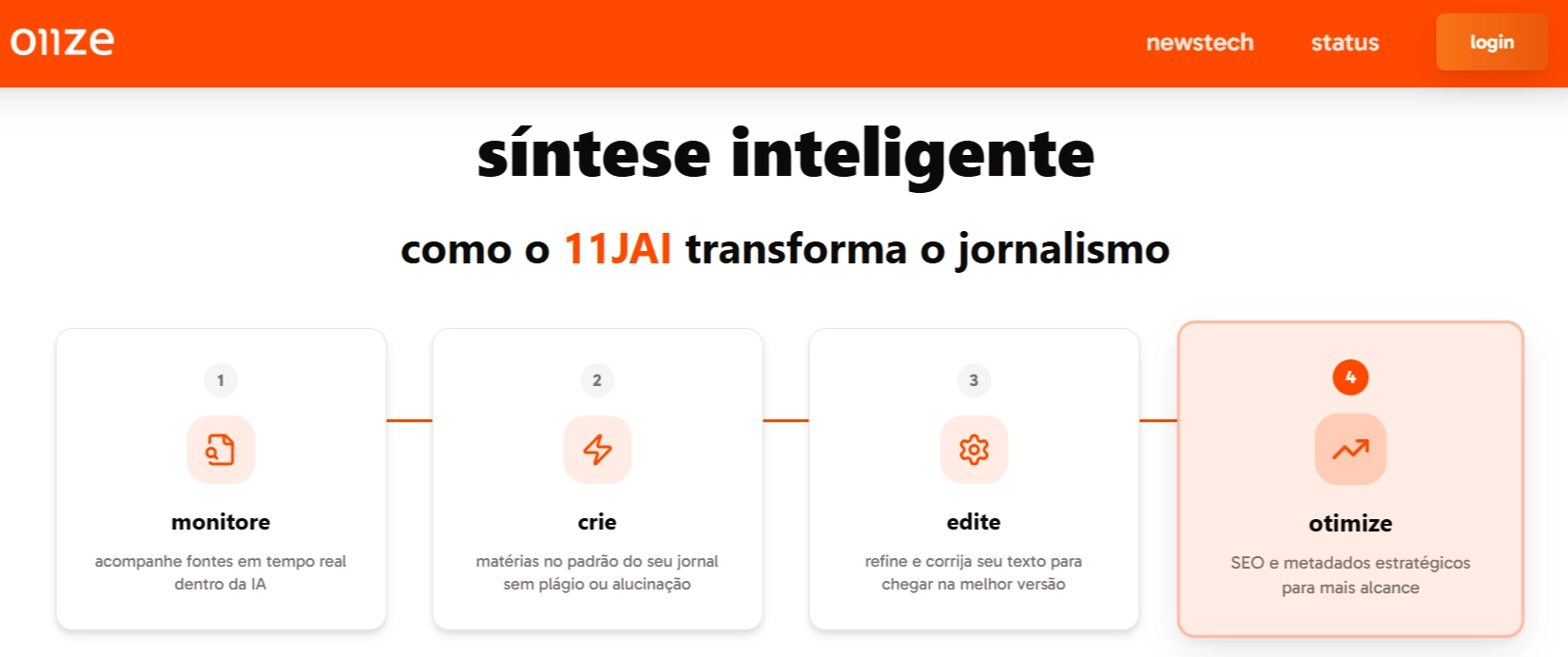
Onze News is a Brazilian newstech focused on journalism. Its main product is 11JAI (journalism-specific artificial intelligence), an AI tool developed to support newsrooms in tasks related to the journalistic workflow.
How it uses AI
11JAI handles transcription, text revision and optimization, multilingual translation, and the retrieval and rewriting of hard news, adapted to each newsroom’s editorial guidelines and practices.
What changed
The tool reduced the time spent on mechanical tasks, boosted productivity in breaking news, and freed journalists for reporting, interviews, and in-depth coverage.
Adoption conditions
Regular use depends on integration into the newsroom’s workflow, clearly defined functions, formal training, and institutional usage guidelines.
Challenges and Limitations
The main challenges involved fear of replacement, risk of plagiarism, hallucination, loss of authorship, and the AI’s “aesthetic signature.” Human review remains central.
We spoke with Onze News founder Renato Arthur. With a background in content production, Renato worked as a podcast host in partnership with Poder360, a journalism communications group. Through that contact with newsrooms, he identified opportunities that led him to build a company at the intersection of technology and journalism.
At Onze News, the engagement with AI began before the ChatGPT boom: Renato had already been testing predictive AI between 2019 and 2020. When ChatGPT gained traction, Onze News was already developing 11JAI. Initially tested at Poder360, 11JAI automates mechanical tasks in daily operations, saving journalists’ time.
The team received the technology favorably.
“They received it in a positive way. These were journalists who had a good view of technology. What do I mean by that? The team we implemented it with first was a team of very young people who already had a lot of contact with a wide range of different software tools.”
There was also resistance, including cases of opposition to the tool’s implementation, which the founder attributes to the natural process of market restructuring.
Today, AI is present in the day-to-day operations of the newsrooms served by Onze News, across various stages of the workflow. According to the interviewee, the difference compared to generic tools like ChatGPT and Gemini is that 11JAI has been integrated into the routine and developed for the specific demands of journalism.
He adds that general-purpose tools tend to enter in a less consistent way, due to their broader scope and concerns around hallucination and plagiarism. 11JAI, however, being specialized, with defined functions and team training, is used regularly and impacts both products and processes.
11JAI operates across four fronts of the journalistic workflow:
1. Transcription: converts interviews and audio recordings into text, with attention to punctuation, capitalization, acronyms, and numbers, and allows for quick review and editing by the journalist.
2. Editing and optimization for digital distribution: 11JAI offers agents for grammar correction, text quality improvement, and alignment with SEO (search engine optimization) and GEO (generative engine optimization) practices, increasing the visibility of stories in search engines and in responses from generative AI systems.
3. Multilingual translation: enables journalists to work with sources and data in other languages without interrupting the workflow to translate manually.
4. Retrieval and rewriting of hard news: used to track what wire services or competitors are publishing and to republish with the outlet’s own language and editorial focus. According to Renato, this can take up hours of the day. 11JAI automates part of the process without replacing the journalist in the reporting.
“The journalist is the one who gathers the data, picks up the information, hands it over to the tool, and the tool delivers a text adapted to the editorial style guide and the writing practices of that particular newspaper.”
Onze provides training to all newsrooms that begin using 11JAI. The company also makes a usage guidelines document available, inspired by international references, which can be adopted by the outlet as an institutional policy.
Renato estimates that 11JAI increased productivity by roughly 300% in breaking news production and by 100% in mid-depth stories. He also projects a 10% to 60% increase in traffic, depending on the outlet’s SEO maturity.
By automating mechanical tasks, the tool frees up time for more in-depth reporting. He cites the case of an intern who, with that extra time, investigated and published previously unreported information about the Banco Master case.
The main challenges are plagiarism and hallucination. Journalists fear that AI tools may reproduce passages from other stories or invent plausible information, which can create legal risks.
Renato states that Onze News’ product includes anti-plagiarism and anti-hallucination checks, but emphasizes that the risk is not eliminated and depends on the quality of the data provided by the journalist.
On authorship and transparency, each client defines its own practice. Some newsrooms inform readers when AI is involved in production; others treat it as support without disclosure. In all cases, Onze News only publishes content after human review.
Another challenge is the AI “aesthetic signature,” which reveals recognizable patterns and generates rejection.
There is also fear of replacement, but in the case of 11JAI, that concern is seen as mitigated because the tool depends on the journalist’s active participation:
“I believe that with the way we built our technology, this is well mitigated, because we genuinely need the journalist to make the tool work.”
When asked about expectations for the future of journalism, Renato explains that AI does not tend to replace journalists, but to redistribute the time they dedicate to operational tasks. The analogy he uses is that of the lamp lighter:
“In the old days, the lamp lighter (…) used to stay inside restaurants and public places, lighting the lamp — when it went out, they’d pick up the small torch, bring it over, light the lamp, remove it, and so on. When electricity arrived, it replaced them outright. (…) But it’s interesting that (…) many of them were redeployed within that same operation for other, more strategic functions, because this person didn’t spend the whole day just lighting lamps — they did other things too, delivered things, helped out here and there, helped clean, and so on. So they started being used in a more strategic way. I believe that’s the direction we’re headed.”
In his view, the movement we observe is one of increased productivity and the reallocation of journalistic capacity toward reporting, interviews, and in-depth coverage.
2. ABRAJI (Brazilian Association of Investigative Journalism)
About
ABRAJI is a non-profit organization dedicated to strengthening investigative journalism, working on data journalism projects, training, and the defense of transparency and public information.
How it uses AI
Uses AI daily to research people and companies, translate texts, cross-reference information, and support programming; applies generative models to process large volumes of documents and automate routines.
What changed
It increased investigative reporting capacity, enabling analyses that were previously impractical; automated repetitive tasks, freeing up time for more complex analysis.
Challenges and Limitations
Risk of insufficient checking and poor results with poorly constructed prompts; dependence on free models; risk of exposing sensitive information; generational barrier and difficulty of use; absence of a sector standard on when and how to disclose AI use to the public.
The interviewee, Reinaldo Chaves, is a journalist and project coordinator at ABRAJI.
At ABRAJI, the use of AI began with machine learning techniques via programming to process large volumes of documents and cross-reference information at scale. With the popularization of LLMs, the tools came to be used primarily in chatbot format, broadening access to these resources.
The interviewee uses AI daily to research people and companies, translate texts, cross-reference information, and support programming.
At ABRAJI, use is less standardized among colleagues, but intensifies in projects requiring intensive data analysis, such as the monitoring of judicial decisions.
Beyond these tasks, AI also enables reporting at scale through automated document processing. One example is the analysis of 200 judicial proceedings using generative models via programming, an activity that would take days without this resource.
The processing of information is vastly superior to what a human could do quickly. Of course, I could read a 500-page document and carry out the analyses I need, but that would probably take me several days to do in any kind of qualified way.”
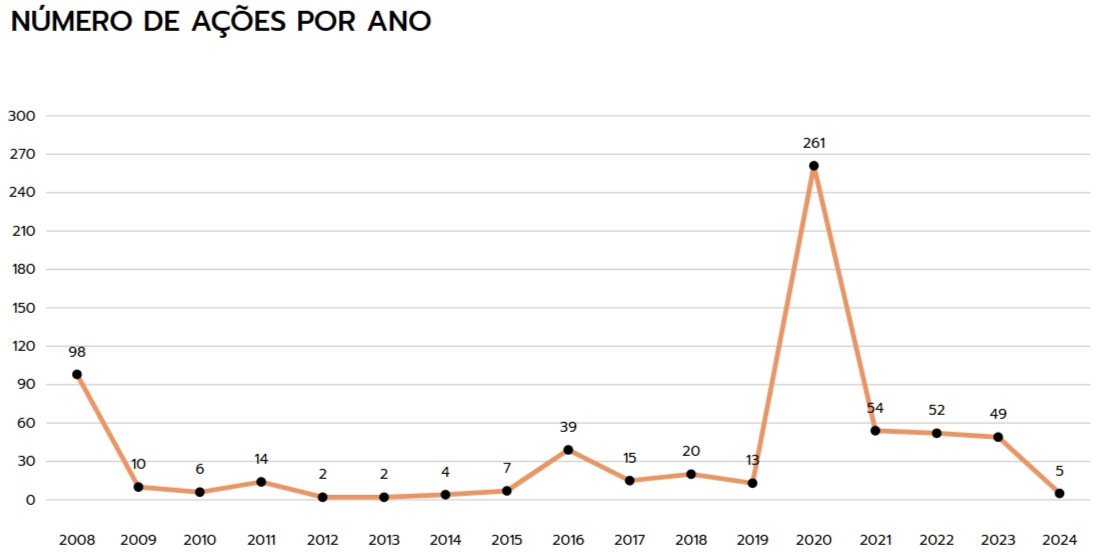
The Judicial Harassment Monitor is an ABRAJI project that maps the abusive use of the judiciary to silence journalists in Brazil, gathering data and analyses of lawsuits filed in retaliation by individuals or groups with disproportionate power. Reinaldo also developed a script that accesses the APIs of the Federal Senate and the Chamber of Deputies on a daily basis, identifies legislative proposals related to journalism, generates summaries, and sends them by email.
Number of actions per year. Source: project page of “Monitor de Assédio Judicial contra Jornalistas,” developed by ABRAJI. Available at https://assediojudicial.abraji.org.br/.
CruzaGrafos, a tool that allows for the cross-referencing and visualization of relationships between people and companies from large databases, uses graph theory to map connections between politicians, companies, business partners, and donations, supporting investigations into conflicts of interest, money laundering, and irregularities.
The platform’s programming uses AI assistance to improve data processing efficiency.
ABRAJI also invested in capacity building. The Gemini Tools Kit, aimed at journalists, used AI itself to improve the prompts worked on in training sessions and to teach techniques for obtaining better results in day-to-day work.
In addition to the projects detailed in the interview, ABRAJI maintains other initiatives mapped on its website:
“Publique-se” is a search engine that indexes judicial proceedings with politicians as parties, facilitating access to evidence in investigations about candidates.
“Ctrl+X” monitors lawsuits filed by politicians to suppress journalistic information.
“Achados e Pedidos”, closed in 2026, compiled a collection of freedom of information requests and used AI to identify the main topics of requests made to government bodies.
ABRAJI has an internal AI use policy. The guidelines state that everything produced or gathered with the support of these tools must be checked; they prohibit the full generation of journalistic content by AI; they require transparency with the audience; and they ban the sharing of sensitive information with these tools.
In Chaves’ assessment, the general landscape of AI adoption among journalists is still marked by difficulties.
“People ask very simple questions, without context, without specifying the type of task they want, the type of output format they want.”
He also notes a generational barrier, as more experienced journalists have greater difficulty using the tools. ABRAJI has been addressing this through AI training sessions.
Regarding transparency, Chaves points out that there is no standardized procedure in journalism. The use of AI in the reporting process is not systematically disclosed to readers, but when content is entirely generated by the tool, the public must be informed.
“There is a consensus, or near-consensus, that if content was entirely generated by AI, it must be disclosed.”
On authorship, the approach is similar. ABRAJI cites the primary source (the judicial proceeding, transparency portal, or document), not the tool that mediated access.
Chaves affirms that AI has expanded investigative reporting at ABRAJI by enabling the fast, low-cost processing of hundreds of documents.
The automation of repetitive tasks, such as the daily monitoring of legislative proposals, has freed up time for more complex analyses. Internal training has also broadened AI literacy, including among more experienced professionals.
Chaves identifies four challenges: (1) insufficient checking of AI-generated outputs, (2) low quality with poorly constructed prompts, (3) dependence on free models, and (4) the risk of exposing sensitive data. Added to this is the lack of consensus on how to disclose AI use, leaving ethical ambiguities unresolved.
3. Núcleo Jornalismo
About
Núcleo Jornalismo is an independent journalism organization specializing in coverage of the impact of social media and AI on society, at the intersection of journalism and technology[^1].
How it uses AI
Uses AI as support at stages of the workflow: analysis of large volumes of documents, classification of materials, interview transcription, and support for the creation of interactive formats. They have developed products with AI, as well as one-off projects.
What changed
It expanded productive capacity: enabled stories that would have required manual analysis of large data volumes, and allowed for the creation of new formats and products. It optimized tasks like translation and transcription, freeing up time for reporting.
Adoption conditions
Before adopting, the team drafted an AI use policy. There was no formal training: autonomous learning and informal sharing; use incorporated according to individual demands. The policy provides for transparency with the public via a seal indicating content made only by humans or with AI assistance.
Challenges and Limitations
Systematic human review of outputs (which are prone to errors); standardization and the “language signature” (AI texts can stand out from the editorial standard); traceability of sources, as tools do not always indicate the origin of the information they produce. The policy also stipulates that stories must be written by humans.
We spoke with Jade Drummond, a journalist who currently holds the position of executive director.
The incorporation of AI at the organization began in 2023, from the moment tools like ChatGPT gained public visibility. Adoption stemmed from an initiative by the team itself, eager to evaluate the potential of the tools for journalistic operations and product development.
Before adopting the tools, Núcleo involved the team in the collaborative drafting of an AI use policy. Recognized as the first Brazilian outlet to publish formal guidelines on the subject, Núcleo defines AI in its document as support for journalistic work and stipulates that stories must be written by humans. Auxiliary uses, such as translation, summaries, transcription, and document analysis, are encouraged.
There was no formal training. Knowledge was built autonomously and shared informally within the organization. The team’s reception was positive.
“This [AI use] appeared before us as something to look at and try to see what we could extract for journalism, for our operations.”
In daily use, AI appears at different stages of work: reporters turn to AI for the analysis of large volumes of documents, classification of materials, interview transcription, and in some cases to support the creation of interactive formats.
This use created conditions for initiatives that structurally altered the organization’s products and workflows:
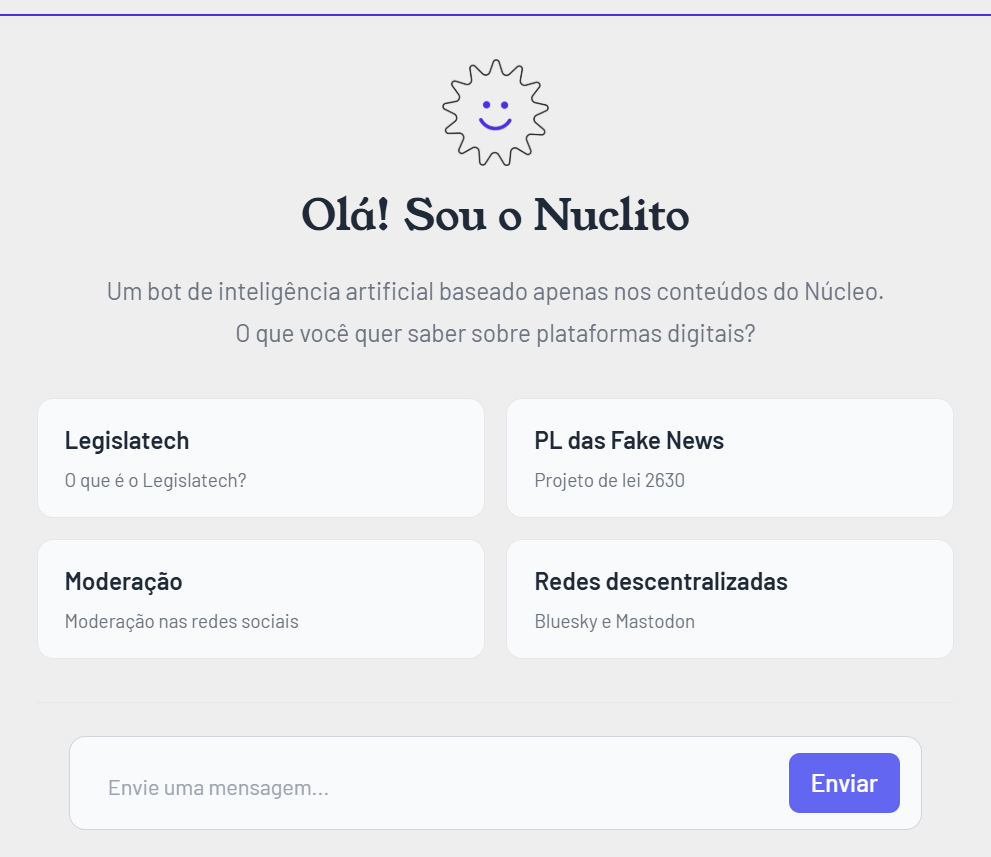
1. Nuclito: a chatbot trained on Núcleo’s content, developed so that readers can query information from its archive directly. According to the organization, the project emerged from the desire to test AI functionalities and to build community loyalty.
2. Núcleo Resume: automatically generates three-point summaries for each story, helping readers decide whether to read it.
3. Legislatech: started as an internal tool for monitoring legislation and official documents and evolved into a subscription service, also becoming a source of revenue for the organization.
The team also developed one-off products using AI, such as the game Cyberfall, in quiz format.
Transparency with the public is part of the editorial policy. Each piece of content receives a seal indicating whether it was made only by humans or with AI assistance. When the technology is used, the outlet explains how and why.
“People tend to appreciate the transparency, our not being afraid to use it and explaining what we’re using and how we’re using it. The experimental nature of Núcleo’s work is what draws attention.”
For Núcleo, the question of authorship is not a problem, as the use of AI is treated as a support tool and not as the content writer. External sources used in the process are referenced with links, following editorial standards.
AI has expanded Núcleo’s productive capacity by enabling stories that require the analysis of large data volumes and by allowing new formats and products. By automating translation and transcription, it has freed up time for reporting. The outlet also stood out by publishing a public AI use policy.
The main challenges are the systematic human review of outputs, which are prone to errors, language standardization, as AI texts are increasingly identifiable and can deviate from the editorial standard, and source traceability, since the tool does not always indicate the origin of the information it produces.
4. EXAME
About
Exame is a Brazilian business magazine covering economics, financial markets, technology, and careers.
How it uses AI
Interview transcription; text correction and standardization according to the style guide; workflow automations. Initiatives: trigger-based automation to monitor sources; ValePush; an agent with editorial guidelines; and a platform that centralizes inputs and converts formats.
What changed
Efficiency gains, style standardization, and unlocking of previously difficult routine tasks; a cultural effect of greater familiarity with technology.
Adoption conditions
Adoption initially occurred among those with greater affinity for it; it scaled after alignment with the company’s leadership. Governance oriented toward data control and tool dispersion. Updated internal guide; ongoing training. The rule is that nothing is created from scratch by AI without human review.
Challenges and Limitations
Initial discomfort due to fear of replacement and authorship concerns; risk of inappropriate use and reputational impacts; fear of reducing creativity and critical thinking; business model challenges (decline in organic traffic); commercial agreements with AI companies are still incipient. Transparency and authorship challenges regarding AI usage
We spoke with Mariana Martucci, Exame’s head of social media and audience. A journalist working in the area of content distribution, metrics, and editorial technology.
Exame began using generative AI in mid-2023, initially with professionals more familiar with technology. Adoption scaled after Mariana and the technology editor brought the subject to leadership, to define limits and uses before expanding without coordination.
The arrival of AI generated initial discomfort in the newsroom due to fear of replacement, new demands from management, and impact on authorship. According to Mariana, the strategy was neither to demonize nor impose use.
Adoption advanced as journalists perceived efficiency gains and began using the tools on their own initiative.
In day-to-day newsroom work, AI tools came to be integrated across various stages of journalistic work. Interview transcription and text correction and standardization according to the editorial style guide are among the most frequent uses. These applications span from generative tools to automation solutions.
Beyond everyday use, Mariana cited initiatives created by journalists that transformed the editorial workflow:
1. Trigger-based automation: to monitor institutional sources. Instead of checking the CVM and the Official Gazette (Diário Oficial) every day to verify new publications, the system downloads new communications and automatically sends them to the responsible journalist’s cell phone, reducing rework and accelerating response time.
2. ValePush: a tool created on journalists’ initiative to support editorial decisions about push notifications. In the face of declining click rates, the team gathered historical performance data by topic and format and trained an agent that assesses whether a story has affinity with the reader base, presenting the reasoning behind the recommendation.
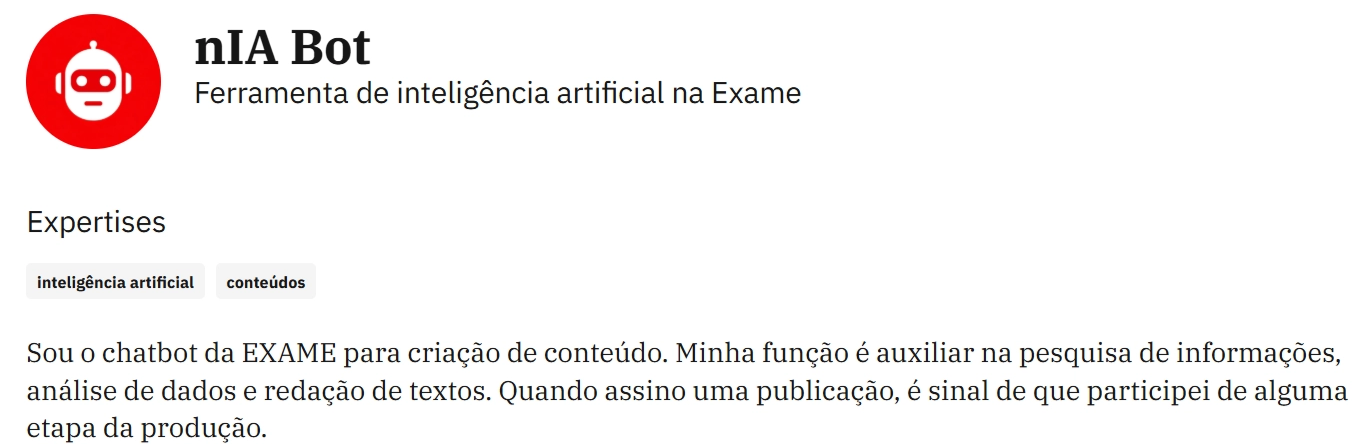
3. NIA: an agent configured within ChatGPT with an extensive prompt containing all of Exame’s editorial guidelines. The tool was used to support content production. The idea was to offer the newsroom a tool configured with Exame’s editorial guidelines.
“We gave her a name, NIA, we thought it was important to give her a name, to see if journalists would become more familiar.”
4. Prisma: an ongoing project with Blue Engine and Google’s AI Lab. The platform centralizes inputs (audio, video, text, and data) and converts formats according to the editorial line, for example, turning videos into articles and articles into scripts.
The goal is to strengthen governance: reduce the dispersion of tools and control the sharing of data with third parties. Exame set a target of a 15% productivity gain, prioritizing data control over maximizing production.
Exame maintains an internal AI guide, updated frequently, to define limits and best practices. The core rule is that no text can be generated from scratch by AI without human review.
The company also conducts semi-annual training and ongoing reinforcement whenever new tools or use cases emerge.
“We look at what’s new, good uses, bad uses, and so on. But every six months we’re back sitting in an auditorium discussing what has and hasn’t changed. So we have constant AI training here, and also a lot in day-to-day practice.”
The transparency policy was adopted from the beginning of NIA. The guideline provided for co-authorship (journalist + NIA) in texts made with the tool’s support.
With the expansion of use and the team’s insecurity about the impact on credibility, co-signing was discontinued. NIA came to be treated only as an internal resource, not as an author.
“They were wary of what people might think of them co-signing a story with an AI, right? We started not using NIA as an author. (…) NIA went on to become one of the most-read authors on the site, and that caused another massive stir, because we saw a very rapid spike in production when the newsroom began to adopt it more broadly.”
Mariana attributes the gains to three effects: AI enabled tasks that were previously unviable (such as analyzing large spreadsheets); NIA standardized style by applying the editorial guide; and repeated use increased the team’s familiarity with the technology.
For Mariana, a major challenge is the business model with the arrival of AI. The concern is the decline in organic traffic due to features like AI Overview and the migration of the audience to AI interfaces, which could impact clicks and revenue. According to Mariana, Brazil still lacks commercial agreements and partnerships that remunerate publishers, as is the case in the US and Europe.
Another risk is inappropriate use. There have been cases of AI-generated texts published without review, resulting in negative repercussions, which led to the rule that no text created from scratch can be published on the site without human review.
Mariana also fears that AI could reduce creativity and critical thinking, as well as discourage deeper reporting.
5. O Antagonista
About
O Antagonista is a political and economic journalism portal, reformatted in 2024 as an open portal; the group also operates Crusoé.
How it uses AI
Day-to-day tools: Pinpoint for document organization and research; and NotebookLM. AI for standardizing and reorganizing archive tags; for data analysis; and for generating symbolic images and illustrations.
What changed
It enabled operation with a lean team and efficiency gains; archive reorganization improved internal navigation and search; increased analytical capacity and opened a product line under development, such as an analytical sub-product.
Adoption conditions
Adoption by necessity during the restructuring. It began with content organization and support for reporting and editing. The commitment is not to publish anything entirely generated by AI without human review. Editorial guide with an AI section (revised frequently), plus training with Google and partners.
Challenges and Limitations
Concerns regarding the potential decline in organic traffic and dependency on platform rules. Continuous adjustments to SEO and Discover updates. Transparency is restricted to final products generated by AI; authorship remains human; ongoing necessity for human oversight.
The interviewee, Luana Araújo, is the head of marketing and new business at O Antagonista.
According to Luana, the adoption of AI at O Antagonista arose out of necessity. In 2024, during the portal’s restructuring, the team concluded that the volume of content required was incompatible with the size of the newsroom. The search for partners led to two vendors using AI to produce and optimize texts and headlines.
According to Luana, the team embraced AI enthusiastically. Use started with content organization tools, and the newsroom made a commitment not to publish anything entirely generated by AI without human review.
In day-to-day work, Luana highlights the use of two Google tools: Pinpoint and NotebookLM. Pinpoint functions as a collaborative folder for gathering and searching documents, texts, and data. NotebookLM only responds based on the provided sources, which reduces the risk of hallucination. The WordPress-based website also uses plugins to optimize images, videos, and search performance.
Beyond everyday use, O Antagonista developed initiatives that generated new products and analytical capabilities for the newsroom, enabling initiatives that would have been operationally unviable without AI:
1. Archive reorganization with AI: during the migration to the portal, there were ten years of content with inconsistent tags, featuring multiple versions for the same topic or public figure. With support from a Google consultancy, the team used AI to consolidate and standardize the labels, reducing the total number of random tags by over 40%. The result was improved internal navigation and search, making it easier to retrieve older stories and historical references.
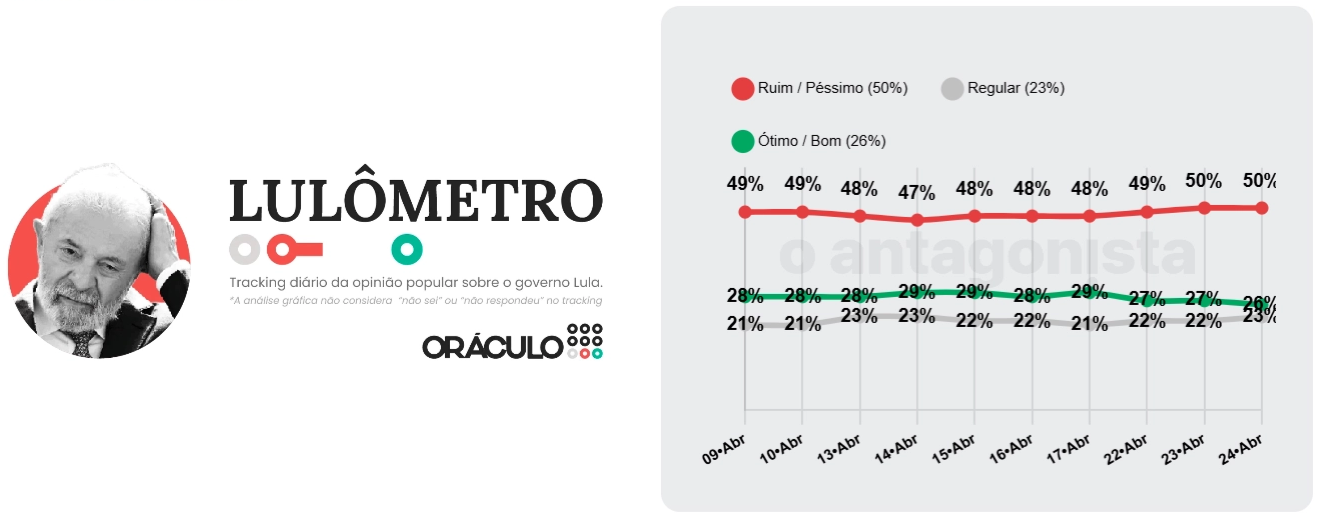
2.Oráculo: a product under development, created with Real Time Big Data, to track presidential candidates and their government plans with sector-based data-driven analyses. As part of the project, the “Lulômetro” is already up and running: it measures the current president’s popularity on a daily basis, and using a historical database, employs AI to cross-reference variables (gender, age group, and region) and identify fluctuations without needing to manually analyze spreadsheet after spreadsheet.
The Oráculo can be adapted to different sectors and candidates. It will be an independent platform with its own website and subscription model, freeing the team to focus on journalistic analysis rather than raw data processing.
Luana highlighted the use of AI to generate symbolic images, with a note in the caption, given that politics and economics are topics that are difficult to illustrate. At Crusoé, the feature appears frequently in covers, often with an ironic tone.
O Antagonista maintains the guidelines in its editorial guide and has conducted training. The rule is that nothing goes live without human review, and the policy is revised as needed.
In terms of transparency and authorship, when AI-generated images are used, this is indicated in the caption. The commitment is that no editorial content is produced entirely by AI. Thus, technology is used as support for reporting, organization, and editing, preserving journalistic authorship.
Luana reported efficiency and analytical capacity gains. The tag reorganization improved internal navigation and search. AI deepened the Lulômetro analysis, and tools like NotebookLM facilitated cross-referencing and organization of large volumes of information.
According to the interviewee, the challenge is structural: the decline in organic traffic, exacerbated by features like AI Overview and Google Discover, reduces monetization. Content is consumed, but it doesn’t always translate into clicks.
Regarding future expectations, Luana describes herself as optimistic about AI's potential for journalism, especially in creating context and making political and economic news more accessible to audiences less familiar with these topics.
At the same time, she criticizes the fact that the technological solutions currently under development are focused on the end-user experience, without a clear logic for how content producers will sustain themselves in this new environment.
6. Aos Fatos
About
Aos Fatos is a journalism organization dedicated to combating disinformation and fact-checking, combining journalism and technology to monitor and verify content.
How it uses AI
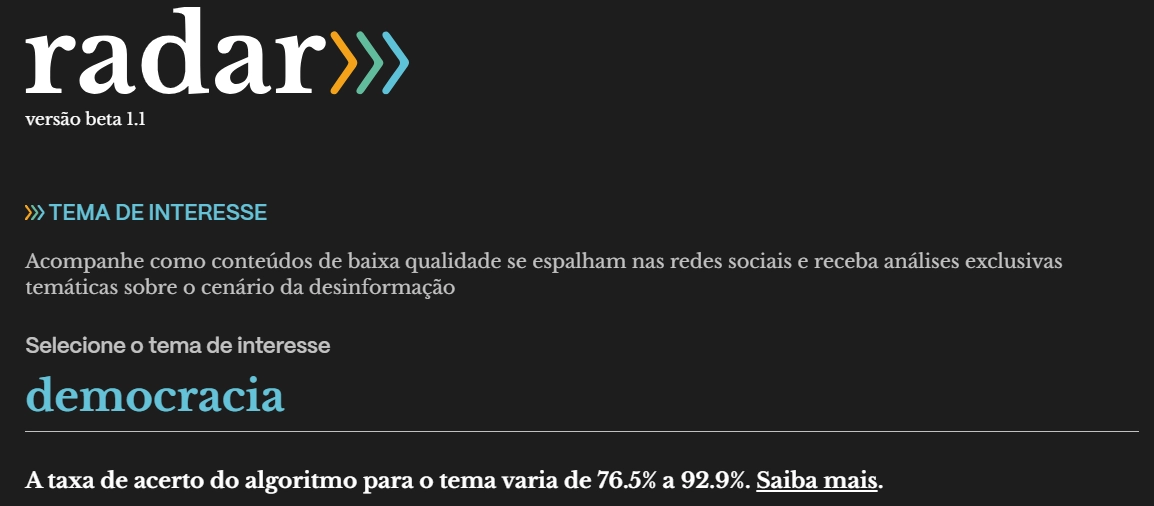
Uses AI to transcribe, monitor, and support fact-checking, always with human review. Maintains its own tools: Escriba (transcription), Radar (monitoring), Fátima (archive chatbot), and BuscaFatos (under development for real-time fact-checking).
What changed
AI enabled scale and speed to confront the mass production of disinformation, creating real-time reporting workflows and expanding public access to verified information.
Adoption conditions
Adoption was driven by the need to compete in productivity with disinformation agents. There is a use policy with the rule that nothing generated by AI goes public without human oversight; when AI enters into reporting and publication, the use can be explicitly disclosed to the public.
Challenges and Limitations
Risk of errors without human oversight, the need for high precision (especially in fact-checking), and structural challenges: model training using journalistic content not always through commercial agreements, synthetic disinformation feeding the ecosystem, and low transparency from the AI industry regarding data, methods, and conditions.
We spoke with Marcela Duarte, a journalist and currently the organization’s director of innovation, focused on the development of technological tools that support journalistic work.
In the fact-checking ecosystem, AI adoption was driven by the operational need to confront the large scale and high speed at which disinformation agents use technology to produce and distribute false content.
“Those of us who work on combating disinformation have to deal with disinformation agents who are using AI to increase their productivity. We simply cannot afford not to use AI — we have to compete with them on equal footing.”
Moreover, the detection of synthetic content often depends on tools that also use AI, making rapid response an important part of the work.
In fact-checking journalism, AI was adopted with less resistance but with caution, given that these teams deal daily with its negative effects.
At Aos Fatos, AI is used at specific stages — transcription, monitoring, and fact-checking — and not for writing journalistic texts. Every application undergoes human review before publication.
Aos Fatos also developed a set of proprietary tools. These are products that created new workflows, real-time reporting capabilities, and new ways for the public to access verified information:
1. Escriba: the newsroom’s transcription tool, with 97% accuracy. It converts audio and video to text and integrates with the reporting workflow, especially during election periods. As there is a margin of error, however small, the guideline is to maintain human oversight, since an incorrect name, number, or term can compromise a fact-check.
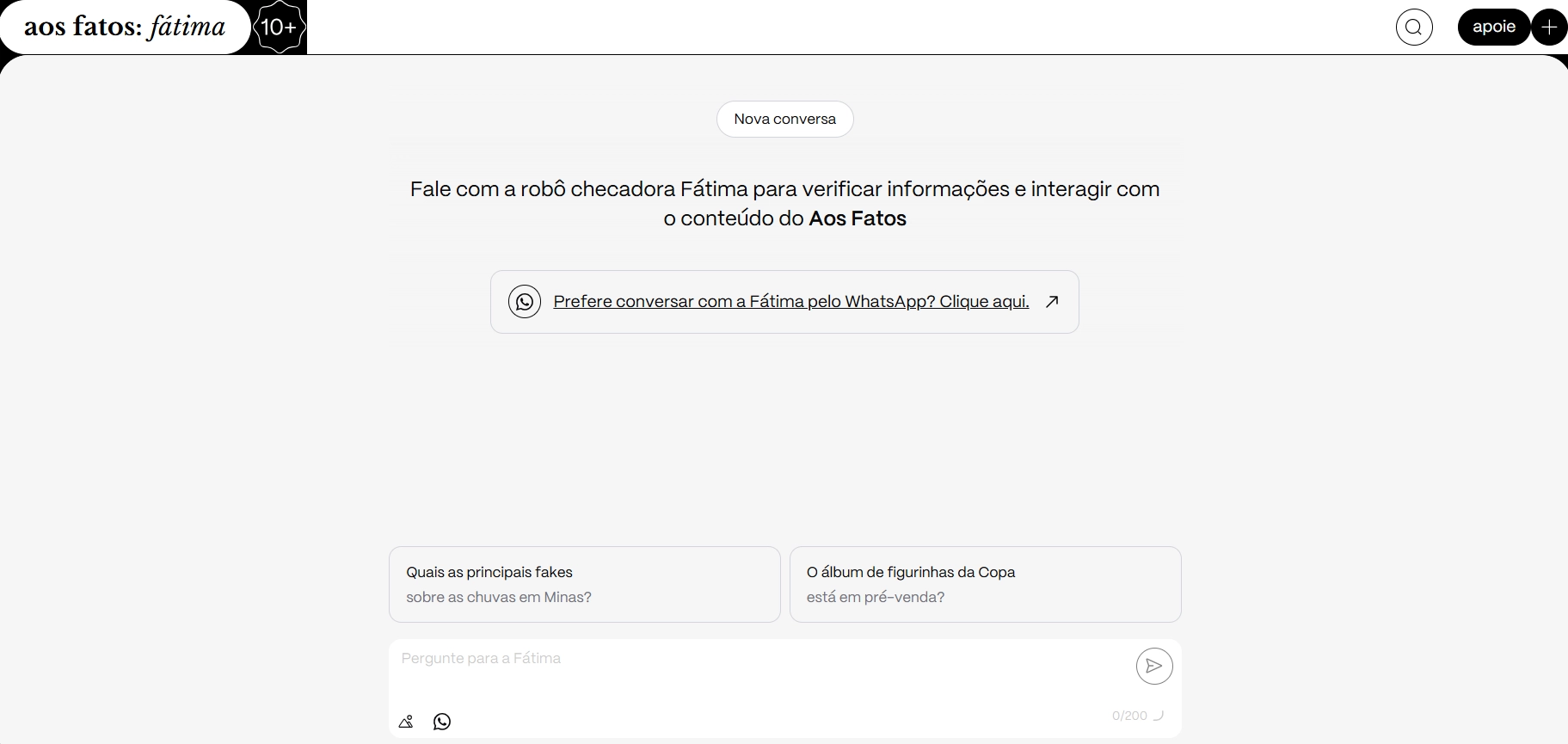
3. Fátima: Aos Fatos’ chatbot for public access to its fact-check archive. Launched in 2019 and updated in 2024, it allows users to search verified information in natural language, with responses limited to the organization’s database to ensure greater accuracy.
4. BuscaFatos: focused on the election period, it had not yet been launched at the time of the interview. The tool transcribes debates and interviews in real time and compares them against the fact-check archive. When it identifies a statement that has already been verified, it suggests the corresponding link to the reporter, accelerating the response.
Aos Fatos was one of the first Brazilian journalism organizations to formalize AI usage in a policy, published on its website in 2024. This policy is integrated into its IFCN (International Fact-Checking Network) certification and establishes that nothing generated by AI is published without human oversight. As it is already part of their routine, it does not require specific formal training.
In terms of transparency, Aos Fatos explicitly states in its own fact-checks when it uses AI. The team discloses at which stage and for what purpose the technology was used.
The main challenge highlighted is the use of AI without human oversight. Marcela cites cases of journalistic errors caused by unreviewed, AI-generated content and notes that, at a time of declining trust in journalism, this type of uncontrolled publication tends to deepen the sector's credibility crisis.
She also draws attention to the use of AI by disinformation agents, who employ the technology to produce and distribute false content at scale, expanding its reach. Furthermore, Marcela expresses apprehension regarding the possibility of AI companies using journalistic content for model training without authorization or commercial agreements.
About the future, Marcela evaluates that the main transformation has already occurred or is underway: using AI to create products and tools that support journalistic work. Going forward, less novelty is expected and more refinement of models, with a reduction in hallucinations and a more normalized and targeted use of what is pertinent.
“For the reality we live in today, the big change has already happened and is underway. Maybe it’s not fully consolidated yet, but it’s underway, and I think more than half the journey has been traveled — which is really using AI to produce tools.”
7. BAND Minas – Grupo Bandeirantes de Comunicação
About
Band Minas is Grupo Bandeirantes’ regional operation in Belo Horizonte, part of one of the country’s largest free-to-air TV networks, with a local newsroom and daily journalistic coverage.
How it uses AI
Practical, everyday use led by individual initiatives such as interview transcription and logging, summaries to support reporting, and in editing with synthetic voice, when re-recording is not possible.
What changed
It accelerated production routines and facilitated corrections in post-production, making delivery faster in a high-demand routine.
Adoption conditions
Adoption is decentralized, without a formal policy, without structured training, and depends on the interest of each professional. Management signals that AI helps but cannot replace journalistic work.
Challenges and Limitations
Risk of dependency among professionals, with loss of depth; resistance and skepticism from some more experienced staff; absence of guidelines on transparency and authorship; and concern about role replacement in less complex tasks.
We interviewed Luciano Dias, a journalist and reporter at the broadcaster in Belo Horizonte.
The presence of AI in Band’s journalistic routine intensified toward the end of 2024, although the interviewee acknowledges that AI tools were already in use, such as in transcriptions and automatic summaries, without professionals identifying them as such.
“The truth is that we already had AI on our side, we just didn’t associate it with AI. (…) I was already using AI without knowing it was AI.”
Adoption was not institutional. Each collaborator began seeking out tools on their own. An internal talk in 2025 consolidated collective recognition of the technology in the newsroom.
With a predominantly young team, the reception was positive, and AI came to be seen as a resource to accelerate production.
Management reinforced that the tool should provide support without dictating the pace or generating dependency.
“I think artificial intelligence came to add to and support our work, and it does a great job of speeding up some production processes, but it cannot — it cannot dictate the pace of work, it cannot be the journalist.”
The reporter observes that more veteran journalists showed skepticism and resistance, while younger professionals incorporated the tools more naturally.
“The interns — the young people coming in now — they already come with this more naturally. I even think it’s excessive, right? For anything, any little piece of reporting, it’s artificial intelligence to do it, to deliver a text summary, or deliver the finished text.”
In day-to-day newsroom work, the reporter primarily uses AI for interview logging. Automatic transcription speeds up the understanding of the material and also the editing process.
Reporting team members use AI tools to obtain summaries of more complex subjects, and producers also have their own resources to speed up their processes.
In the editing of television material, AI can appear in the final product. One example is the reproduction of a reporter’s voice to correct grammatical errors in already-recorded segments:
“There was an agreement error in the text and I couldn’t get hold of the reporter. And then an editor […] managed to correct that agreement error using a tool that uses the voice.”
To date, as Luciano explains, Band Minas has not developed its own AI tools. Use is individual, decentralized, and dependent on each collaborator’s initiative. There is also no structured AI use policy in the newsroom, nor a formal training process.
Transparency with the public is not systematic, and there are no clear guidelines on when to disclose AI use. Authorship is also not formally discussed: content continues to be signed by those responsible, without indicating AI’s participation.
Among the challenges, the reporter highlights the risk of professionals, especially younger ones, becoming dependent on AI tools, reducing journalistic depth and autonomous reporting.
The absence of institutional policies on use, transparency, and authorship is also a weakness, as each collaborator adopts their own criteria without formal guidance from the company.
Finally, he expresses concern about the possible replacement of professionals in less complex functions and about layoffs in newsrooms as a consequence of technological advancement.
8. Vibra Digital – Grupo Bandeirantes
About
Vibra Digital is Grupo Bandeirantes’ digital unit, founded in 2020, responsible for online products and operations and for structuring technology initiatives within the group.
How it uses AI
Uses AI for transcription, story idea support and source suggestions, creation of captions and lower thirds, post creation, and document reading. Developed a monitoring agent and production support. Also uses AI in final products, such as voice cloning and AI-generated images, with notice to the public.
What changed
Increased productivity and operation speed, and opened space for automations and new workflows, with agents taking on part of the monitoring and organization of material for publication.
Adoption conditions
Gradual adoption, under the leadership of product and technology. There are internal guidelines, training, and ongoing capacity building by area. The rule is to always have a human validating; public communication is mandatory when the final product is generated by AI.
Challenges and Limitations
Initial resistance due to text quality, authorship and accountability challenges. In the ecosystem, concern about disinformation at scale and the financing model in the post-search landscape.
We spoke with Lilian Ferreira, a journalist and director of product and technology at Vibra Digital.
AI adoption at Vibra Digital was gradual. When Lilian arrived, there were already experimental initiatives underway, but the decision to scale use was made in 2025, under her management.
The first step was to contract Gemini Enterprise, to increase data control, since free tools can use the information entered to train their models.
The introduction of the tool met resistance in different areas. In journalism, initial rejection focused on the quality of AI-generated texts.
In Human Resources, the team started out skeptical but began using the technology after seeing practical results. Lilian says she observed no relationship between age or gender and willingness to adopt the tool.
“We always say that our use of AI is as support — it’s a technology, like you use a computer, you use AI. It’s not meant to be the final product, because the final product of AI is not that great, but if it’s helping you make your work more efficient.”
In the company, AI is present across nearly the entire journalistic production journey. According to the director, the most immediate impact comes from transcribing audio and interviews, especially in radio: material sent by reporters in the field becomes text and goes directly to publication.
AI also supports story structure, source suggestions, the creation of captions and lower thirds for TV, the production of social media posts, and the reading of extensive documents. Lilian states that adoption increased the volume of stories published on the website by 12%.
Beyond this use, the company developed initiatives that created new flows and new journalistic products:
1. AI agent system for monitoring and production: Vibra Digital created a monitoring agent that monitors municipal government websites, public portals, and competing outlets and sends summaries to guide coverage. Other agents support story structuring, and after interview transcription, they assemble the program’s rundown and a version for the website; the journalist then validates the result.
2. The voice cloning case of commentator Reinaldo Azevedo: during the trial of former President Jair Bolsonaro at the STF (Brazilian Supreme Court), after the dissenting vote by Justice Fux, Azevedo was unable to go on air due to a voice problem. The Vibra team, which had already been evaluating this resource, synthesized the commentator’s voice using AI. Azevedo wrote the text, signed authorization, and approved the result. The commentary was broadcast on the radio with notice that the voice had been generated by AI and was well received by broadcast professionals and the audience.
“Everything we needed came together in that moment: a real reason, a historic moment in the country, and the technology to help — that was exactly what we wanted. So we cloned Reinaldo Azevedo’s voice and put it on the radio.”
3. Use of AI-generated images on “Brasil Urgente”: the program covers crimes but rarely has images of the events. The team began using AI to generate images that visually contextualize the narrated stories, always with an indication of AI use.
4. Agents beyond journalism: the company is developing agents for other internal functions, such as an HR agent that monitors the validity of presenter contracts and issues alerts about renewals, reporting efficiency increases of up to 80% after adoption.
Vibra Digital formalized internal AI use guidelines, accessible to all employees. The document covers journalism and administrative areas and requires human validation of all content.
“I always give the example of Google. Everyone uses Google, right? And Google makes mistakes, doesn’t it? If you pull from a not-very-reliable source, you’ll write something wrong.”
It also provides guidance on when to inform the public that AI was used — such as in images or audio with synthesized voice. The policy distinguishes two situations. If AI is only support and the final text is signed by a journalist, there is no notice. If the final product is generated by AI, identification is mandatory.
“Nobody writes ‘I used Google to do this story.’ So the reasoning is the same: when the AI product is what we use in the end, as in the case of the images, Reinaldo Azevedo’s voice, then we notify people.”
The company also conducted training for employees, the recorded content of which became part of the onboarding process for new hires. After the introductory course, Vibra Digital began offering area-specific training on an ongoing basis.
Lilian highlights challenges that go beyond the newsroom’s day-to-day operations. With AI, it became easier to produce content at scale, which also facilitates disinformation: websites can look like journalistic portals and publish hundreds of false texts. For her, the greatest risk is the use of technology by those who are not journalists and do not follow verification criteria.
Within the newsroom, the question of accountability and authorship also arose. In the beginning, some professionals attributed errors to the tool, which weakened editorial responsibility. For this reason, the policy was revised and final responsibility was made to always rest with the journalist, even when AI is used in the process.
The interviewee also highlights a journalism funding challenge. With the popularization of direct answers in language models, her perception is that people may stop accessing original sources, which could lead to a reduction in clicks.
Lilian expresses concern regarding the remuneration of those who produce the content consumed by AI systems and its potential impacts on the sustainability of journalism.
As for future expectations, Lilian assesses that AI can strengthen journalism and highlights the importance of a sustainable funding model. In her view, the technology tends to absorb lower-value content, freeing up newsrooms to investigate, report, and cover events. The structural challenge highlighted is that, paradoxically, in-depth investigative journalism currently generates less direct revenue than the mass production of clickbait content.
For Lilian, the way out involves public policies and regulation. She also suggests that platforms use watermarks in metadata, so that it is possible to identify what was generated or edited by AI. For her, this is the main contribution that the technology industry can offer to journalism right now.
9. InfoMoney
About
InfoMoney is a financial journalism portal focused on investments and financial education, part of the XP Inc. ecosystem, with content aimed at retail investors.
How it uses AI
Combines tools to edit and refine texts, reorganize paragraphs, and generate follow-up content. In projects, uses AI to analyze documents and support interviews.
What changed
It enabled coverage at scale of highly technical and voluminous topics — especially the earnings season — and helped accelerate editorial routines without abandoning journalistic review.
Adoption conditions
Gradual adoption, driven by enthusiasts within the newsroom. There are internal guidelines with mandatory human review and a requirement for verified sources; there was targeted training on prompts (e.g., headline optimization).
Challenges and Limitations
Risk of use without editorial curation, with loss of quality and transparency; concern about rewriting third-party reporting without attribution; and the effect on the profession, such as the erosion of junior positions and the risk of “shortcuts” that discourage deeper coverage.
We interviewed Rodrigo Petry, coordinator of editorial projects at InfoMoney, with a background in financial journalism.
Rodrigo describes himself as one of the first ChatGPT enthusiasts at InfoMoney. In 2023, when testing the tool, he identified practical uses for financial journalism and began sharing experiments with colleagues. This led him to join a project with XP’s data science team, in partnership with Microsoft, aimed at automated earnings coverage.
Adoption, however, faced initial resistance. According to Rodrigo, there was skepticism about the technology’s capabilities and the prevailing posture was to keep routines as they were. Over time, use advanced gradually and in a decentralized way, without a single directive for the entire newsroom. He states:
“[AI use] is increasingly being accepted in the [journalistic] field, because there’s no going back now.”
At InfoMoney, daily AI use combines ChatGPT (paid version) and Jarvix, XP’s internal system created to reduce the risk of sensitive information leakage.
In editorial work, AI supports text editing, the improvement of leads and headlines, alignment with SEO practices, bias adjustment, paragraph reorganization, and the creation of follow-up content from already-published pieces.
Beyond this use, InfoMoney developed applications that created new production flows and expanded the newsroom’s capacity to cover technical subjects:
1. Automated earnings coverage: this was the first initiative. In roughly 45 days, approximately 400 companies release results, making manual coverage unviable. A system was created that reads PDFs from the CVM (Brazilian Securities and Exchange Commission), processes the data with a language model, and generates texts for journalistic review before publication. The prompts were adapted by sector to prioritize the most relevant indicators.
“There are roughly 400 companies listed on the stock exchange. So it’s humanly impossible to cover everything, right?”
2. Technical analysts as content producers: to cover day trading and technical analysis, InfoMoney hired two professionals without journalistic training who, with AI support and specific prompts, began producing stories from live transcriptions and WhatsApp interviews. One of the texts reached 300,000 page views.
3. Use of AI to prepare for interviews: based on the interviewee’s public content, Rodrigo maps topics and structures relevant question scripts in ChatGPT, including in English, to put to the interviewee.
InfoMoney has internal AI usage guidelines that are not publicly disclosed. The core principles are mandatory human review and attribution of verified external sources. There was a targeted training session focused on crafting prompts for headline optimization, but use remains largely individual, by team, without centralized governance.
The outlet adopts transparency practices: texts generated with the technology are signed as “AI InfoMoney.” In stories that repurpose content from other outlets, external source attribution is mandatory.
The main challenges identified are the use of AI without journalistic curation and the reduction of junior positions in the profession.
Content produced without oversight tends to “give itself away” through the absence of quotes, identified sources, and a basic journalistic structure.
Added to this is the risk of rewriting third-party reporting without attribution — something AI makes easier. Finally, by delivering content already “pre-digested,” technology can discourage deeper engagement with the covered topics.
On future expectations, Rodrigo evaluates that current tools already deliver the essentials. The next step is to automate the end-to-end process, capturing documents, processing them with AI, and forwarding the content for review and publication.
He emphasizes that exclusive reporting and original stories remain irreplaceable, a domain that, in his assessment, will continue to be human.
“Nothing will replace the person interviewing a source — that story will be exclusively theirs.”
10. Ambiental Media
About
Ambiental Media is a non-profit organization for investigative journalism in science and data, focused on environmental coverage.
How it uses AI
Uses AI for transcription, search, document organization, translation, and support for visual production and development. Created CAPÍ, a chatbot with a verified database.
What changed
Reduced production time and cost, and enabled product experiments and interactive formats.
Adoption conditions
Adoption since the end of 2022, with leadership support. There is a use policy: AI supports the process; the final text is human. No formal training.
Challenges and Limitations
Maintenance, funding, transparency challenges, and risk of disinformation and quality decline.
We interviewed Miguel Vilela, a journalist and editor at Ambiental Media since 2023.
At Ambiental Media, AI entered the agenda after the launch of ChatGPT in late 2022. Miguel reports a positive reception, with some skepticism toward large technology companies, and highlights that leadership support was decisive.
Today, use is daily and spans various stages of production, in a relationship he compares to the use of Google.
In reporting and editing, AI supports interview transcription, document organization, source research, cross-referencing of information, and translation. In visual production, it is used to generate bases and backgrounds for illustrations, reducing time and costs. In programming, it helps with code development and the prototyping of interactive infographics.
Beyond everyday use, Ambiental Media developed other projects:
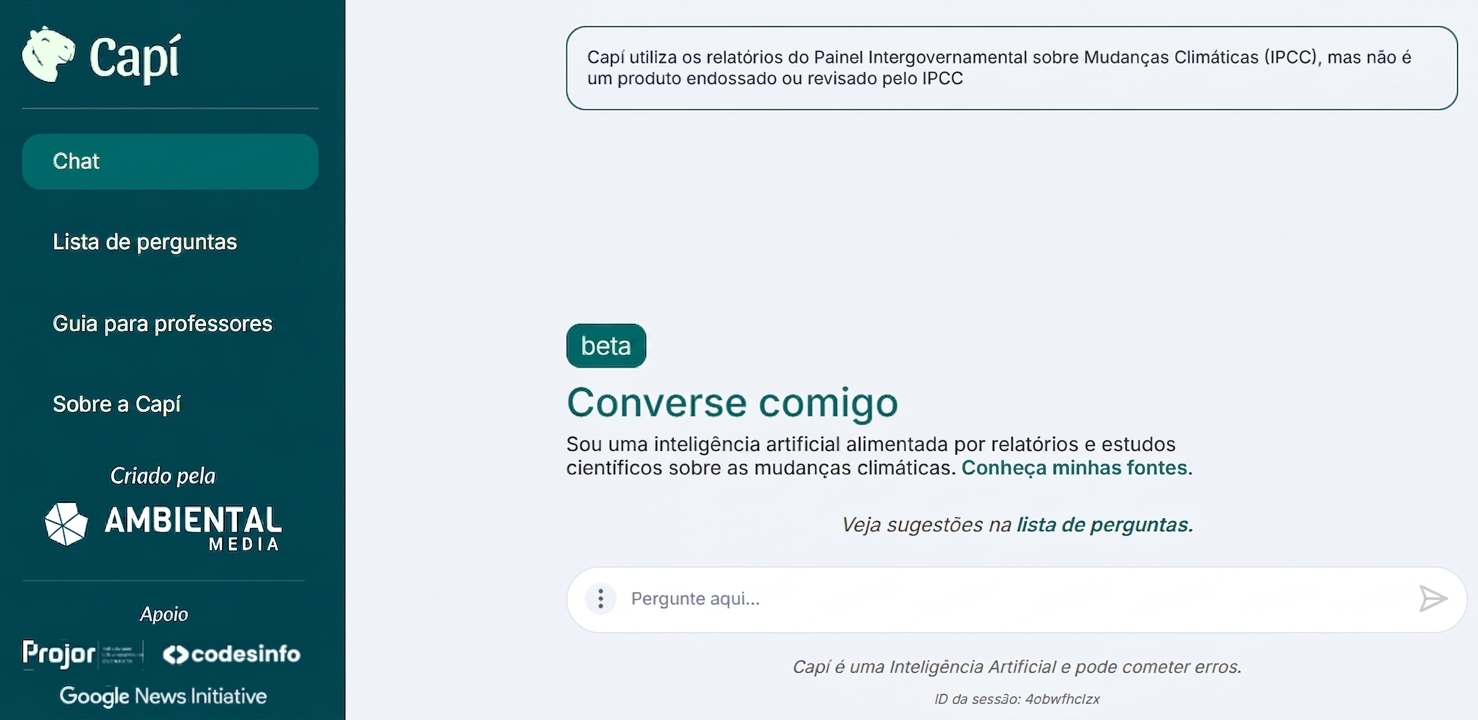
1. CAPÍ: a chatbot specializing in climate change that represents the organization’s most far-reaching initiative in the AI field.
The tool was born from the observation that available language models made errors when answering on the topic, producing imprecise responses about global warming, the greenhouse effect, and deforestation — and from the assessment that AI could be used in a way that benefits specialized journalism.
CAPÍ was built using the RAG (Retrieval Augmented Generation) method. It combines a language model with a verified database made up of scientific articles, books, and IPCC (Intergovernmental Panel on Climate Change) reports. This way, the tool responds based on reliable sources and is also able to handle questions that go beyond what is in the database.
Two other projects illustrate the use of AI in visual production:
2. In Cerrado: Jornada das Águas, a visual project in which an outside collaborator responsible for the infographics used image-generation tools to create bases and backgrounds for illustrations, reducing production time and costs.
3. In Rio 60, a project that imagines an urban configuration of Rio de Janeiro adapted to extreme rainfall, the use of AI in visual production was necessary given the utopian character of the visualizations, Miguel explains.
Ambiental Media has an AI use policy, with permitted and prohibited uses in journalistic production. The organization does not allow AI to write content for the public. Use is permitted in internal documents and for structuring information, but the final version is always authored by a human. The team did not undergo formal training.
On transparency, the policy provides for disclosing when content or visualizations involve AI. Miguel evaluates that full transparency is difficult, as the tools cut across nearly all stages of the work. For this reason, the priority is to flag uses that could generate mistaken interpretations, such as the difference between photographs and artificially generated images. All published content is signed by an identified person.
The challenges, however, are significant. CAPÍ is currently on hold because the initiative's funding was a one-time grant. Without a viable monetization model, it was not possible to keep pace with general-purpose language models, which have become much more accurate since its launch.
On a broader scale, Miguel points to two fears for the digital ecosystem: the replacement of professionals by automated systems and the proliferation of low-quality, AI-generated texts, which, in contrast, could create a demand for “natural intelligence”.
11. Folha de S. Paulo
About
Folha de S. Paulo is one of Brazil’s leading newspapers, with both print and digital operations.
How it uses AI
Uses AI in an internal hub for transcription, translation, summarization, story angle suggestions, and editorial support. Developed tools such as an automatic image describer for accessibility and projects for the external public.
What changed
Automated support tasks and accelerated workflow, expanding production capacity and accessibility, and opening a product line with AI for the public.
Adoption conditions
Adoption began in 2023, with a designated lead and critical testing; in 2024 it became an editorial section and structured its own tools via APIs. There is a public AI use policy and periodic training.
Challenges and Limitations
Risk of error, hallucination, and bias; credibility and replacement concerns; transparency dilemmas; and monetization pressure from the use of content in model training and no-click responses.
Daniela Braga, our interviewee, is a journalist at Folha de S. Paulo and the newspaper’s AI and Digital Product editor.
The incorporation of AI into Folha’s routine began in 2023, when the Editorial board designated Daniela to investigate uses for the technology. The guidance was to test with a critical eye, prioritizing internal tools and treating the newsroom as a laboratory.
In 2024, the initiative became a formal editorial section and began building its own tools, based on third-party APIs but developed and operated by Folha.
The team’s reception was heterogeneous: some journalists were enthusiastic from the start, while others showed distrust and apprehension, both about replacement and about loss of credibility in their coverage.
“The fear in a newsroom is no different from the fear in other parts of the industry […] the fear of losing one’s job, the fear of doing poor work, of a robot doing something poorly.”
Over time, resistance diminished. Daniela attributes the change to the work of bringing the team closer, visiting the editorial sections to explain the tools, gather feedback, and adjust products. Today, according to her, use is widespread, and a recent internal survey recorded high approval.
In day-to-day work, AI appears at various stages of the journalistic workflow. Automatic transcription eliminated manual work. Folha also developed internal translation and summarization systems that support infographic production.
In reporting and editing, AI suggests story angles, SEO-friendly headlines, and subheadings. One example is the automatic image describer that ensures descriptions for all published photos for visually impaired people.
All these tools are gathered in an internal environment that functions as a hub accessible to any journalist in the newsroom.
“We call it a Swiss Army knife because it has several tools together.”
Folha also developed initiatives aimed at the external public:
1. CozinhaAÍ project: launched in 2023 as a proof of concept. A tool that lets the user enter available ingredients and receive recipe suggestions. With no direct relation to journalism, it served as an initial AI-based product experiment.
2. Project in partnership with Hospital Sírio-Libanês: two chatbots were developed from the hospital’s database on breast cancer and prostate cancer, plus more than 200 videos with interviews produced by Folha. The free system answers public questions based on these sources and suggests related videos.
3. Folha de Redação: aimed at university entrance exam (ENEM) students. It suggests topics according to the exam’s criteria, receives essays, and grades them according to official criteria. It was trained with real essays corrected and validated by teachers; it is free up to a monthly usage limit.
Folha published an AI use policy even before the editorial section was created, publicly available in the AI chapter of its editorial project guide. The document compiles general guidelines and undergoes periodic reviews.
In parallel, the team holds periodic training with the newsroom, both on tool use and on the guidelines that define what is and is not permitted. At the beginning of the editorial section, broader seminars were held for the entire newsroom.
On transparency, Folha distinguishes what reaches the reader from what goes on behind the scenes. Content entirely generated by AI, such as illustrations or graphics, is identified with the tool and the person who generated it.
Internal uses, such as transcription, technical improvements to photos, or AI for locating sources, are not disclosed, for the same reason one does not declare using Photoshop for technical adjustments or Google for research, explains Daniela.
On authorship, the signature remains that of the journalist. The possibility of indicating AI use in the byline is mentioned only for hypothetical cases of texts entirely generated by the tool which, at the time of the interview, was not the newsroom’s practice.
Among the challenges, Daniela highlights the risk of relaxing reporting and review when one relies too heavily on AI-processed content.
She also points to biases in models trained with little diversity and hallucination, which reinforces the need for constant checking.
Daniela also expresses concern regarding the use of journalistic content by AI companies for model training without clear compensation.
Finally, there is the risk of gradual skill loss, such as difficulty crafting headlines without AI tool support after prolonged use.
Note on translation: This report was originally developed in Portuguese. All interviews were conducted in Portuguese and translated into English for this version. Every effort was made to preserve the original meaning of the interviewees' statements.
Analysis and comments
Artificial intelligence is already present in Brazilian newsrooms, and its impact goes beyond task automation. In some cases, it enables transformative use, expanding the reach and creative potential of journalism with projects and products that would not have been possible before.
At the same time, this incorporation is not happening uniformly. Conditions vary across media outlets, practices are still being defined, and the sector, for the most part, has built its own rules.
As observed, AI in journalism operates across two distinct tracks: on one side is internal use, focused on newsroom production and management (transcription, translation, monitoring, data analysis), allowing for operational efficiency gains; on the other side is audience- and distribution-focused use, such as chatbots and generative search tools, in a reconfiguration of how the public accesses news.
1. Artificial intelligence in the newsroom: practices and paths so far
The interviews indicate that the changes brought about by the arrival of AI are taking place in Brazilian newsrooms at different paces. Routine content, financial earnings coverage, monitoring of official gazettes, and schedule summaries tend to be produced more efficiently by AI. The journalist remains essential for accuracy, critical thinking, and reporting. The result is a redefinition of journalistic work at this stage.
Internal Operational Use (Production & Management)
Audience and Distribution Focused Use
Raw content processing: audio transcription and multilingual translation; Refinement: correction, standardization, and SEO/GEO; Data monitoring and analysis: institutional sources and large volumes of data.
AI tools for the public: chatbots for archive queries and other public AI products; AI-generated content displayed to the public, with a notice/disclaimer; Search and distribution mediation: such as AI Overview; Real-time fact-checking for the public.
The first impact felt in newsrooms is the time saved on routine activities. Although it seems simple, automatic interview transcription, for example, was the most frequently cited change in day-to-day work for saving hours of work and taking on a repetitive and manual activity. In lean newsrooms where professionals accumulate multiple functions, this time is returned to journalism.
AI also makes previously unviable things possible. Analyzing hundreds of documents quickly, monitoring official gazettes and legislative bills in real time, or systematically covering financial results at scale are tasks that, without technological support, would rarely fit into a newsroom’s routine. Technology does not replace the journalistic decision about what is relevant, but it expands the volume of information that can be processed before that decision.
Some journalists also make more transformative use of the tool. They begin to create more audience-appealing proposals with new monetization forms, to develop products that would previously have required technical knowledge and available time, and to lead projects of greater relevance to society. These are the professionals who define what to create, using technology as a tool.
The movement observed so far is a reconfiguration still in progress, in which technology redefines what is operational and returns to the journalist space for what the profession has that is most singular.
2. Not all newsrooms adopt AI in the same way
The incorporation of AI in newsrooms does not happen uniformly. Absorptive capacity, a concept used by Malar and Saad (2025) to describe how effectively a media outlet can integrate new technologies into its processes, varies across newsrooms and directly influences how AI is adopted.
Some newsrooms operate in a more structured manner. Formal training, institutional subscriptions, dedicated teams, and internal policies guide journalists on what is and is not permitted when using the tool. In these environments, AI tends to be used more consistently, with greater security regarding data protection, and with stronger alignment to the outlet's editorial values. The journalist understands how to use the technology, why to use it, and the boundaries of that relationship.
In other newsrooms, however, incorporation occurs in a less structured way. Usage typically stems from individual initiatives without training or clear policies. Often, there is also a lack of awareness regarding the risks involved, affecting both the quality of the content produced and the security of the information shared with these tools. In this scenario, AI integrates into daily routines but lacks the necessary institutional support to guide a responsible and strategic use.
This disparity reflects the structural conditions of Brazilian journalism, where financial resources and institutional capacity determine not only how much AI is used, but also the safety and strategy behind it. Newsrooms with proper structure can turn the tool into an advantage; those without it face more obstacles and risks.
The data gathered from the interviews point to two paths for this adoption. Where individual enthusiasm for AI was backed by institutional support – through training, tools, and guidelines – adoption tended to gain consistency and security. In some newsrooms, however, the momentum came entirely from the journalists themselves, ahead of any institutional guidance, leaving adoption much more fragmented. In these cases, AI enters the routine through personal interest, without the backing of guidelines to steer its usage.
This mismatch between adoption and institutional preparedness reflects a behavioral phenomenon that extends beyond journalism. Evidence from other organizational contexts points in the same direction. A survey by Public First (2026) identified a sharp contrast in Brazil between individual enthusiasm and institutional readiness within the context of public service. While the majority considers AI effective and has adopted it on their own initiative – generally without formal training – 61% state that their organization does not provide the necessary tools and support, leading many to rely on personal accounts and services.
Although referencing another sector, this data underscores a movement that the interviews also suggest within journalism: the enthusiasm and initiative of professionals often move faster than institutional frameworks. In many newsrooms, journalists themselves are driving adoption, while institutional policies, training, and tools lag behind. Ultimately, more than the technology itself, it is institutional maturity that shapes a secure and strategic use of AI.
3. How the sector defined its own rules
In an environment marked by the proliferation of disinformation, credibility gains even greater relevance as the benchmark of professional journalism. The sector adopts rigorous governance and human oversight because it views public trust as a key differentiator against disinformation, whether produced by machines or humans.
Organizations of various sizes and editorial profiles have developed institutional policies even in the absence of external regulation. What makes this pattern significant is precisely the convergence of distinct organizations that, independently, arrived at similar principles, suggesting that these boundaries have been recognized as necessary by the sector itself.
The most compelling finding is the unanimity surrounding human oversight. Across different newsrooms, journalist supervision over AI-generated content stands as a non-negotiable rule.
Transparency regarding AI usage is also widely valued, though it varies in intensity. Some newsrooms disclose any use of the technology, while others consider this mandatory only when AI played a defining role in the final product. In all cases, explicitly stating when and how AI is used reinforces the outlet's commitment to fact-checking and editorial accountability to the public.
Conclusion
What did we seek to answer with this study?
We investigated how journalism professionals at Brazilian outlets have been incorporating artificial intelligence into newsroom work. Drawing on the experiences of 11 different professionals, we sought to understand which uses are already consolidated, how each newsroom organizes that incorporation, and how the sector has built its own references for the responsible use of the technology.
And what did we find?
The results indicated that AI is already present in Brazilian newsrooms in diverse ways — from saving time on routine tasks to transformative use that enables products and projects that were previously unviable.
The adoption of technology varies across each outlet. In some cases, AI expands what journalism can do. In others, use remains fragmented, driven by initiatives without clear policies.
The study also identifies convergences around certain practices built by the sector itself. Human review of what AI produces appears as a rule. Transparency with the public about the use of technology is valued by a large proportion of outlets, especially digital natives and fact-checkers. However, the study also revealed that transparency still faces ambiguities, with cases where traditional outlets pulled back from explicit AI identification out of concern about credibility damage. This pattern suggests that the sector recognized these limits as necessary before any formal guidance.
And why does this matter?
This study contributes to a qualified debate about the place of artificial intelligence in Brazilian journalism. The findings may be useful to newsrooms that are still defining how to incorporate the technology, offering concrete references on how other outlets already organize this process.
For sector regulation, the study shows that part of the path has already been paved by professional practice itself, suggesting that any regulatory initiative can build on what the sector has already constructed.
By bringing together concrete experiences from different outlets, the study also functions as a record of initiatives that show how AI can renew journalism, with more creative products and more compelling proposals for the public.
Direction for future studies
This exploratory qualitative study does not exhaust the topic and highlights the need for continuous research given the fast-paced evolution of the sector. Potential research paths were identified.
Expanding the sample and diversifying the outlet profiles. The research focused on organizations with some degree of AI use structuring, which may not reflect the reality of smaller newsrooms. Future studies could include outlets from smaller cities and regions with fewer technological resources.
The perspective of frontline newsroom professionals. This study primarily heard from leaders and people involved in AI implementation. Future research could include frontline reporters and editors to capture perceptions and tensions from day-to-day work.
Surveys on AI adoption in newsrooms. In addition to qualitative interviews with specific profiles, surveys offer a complementary dimension, mapping usage patterns, perceptions, and concerns in a broader and more representative way. Future studies combining this instrument with qualitative approaches could offer a more complete picture of how AI is being incorporated in Brazilian newsrooms across different types of outlets.
Longitudinal studies on adoption. Since the use of AI in newsrooms is recent, the data collected reflect an early moment of experimentation. Longitudinal research could follow organizations over time, observing how practices consolidate, how institutional policies evolve, and which initiatives considered transformative prove sustainable after the novelty period.
The audience’s perspective. This study focused on the perceptions of professionals who produce content with AI support. Future research could investigate how the public perceives, trusts, and relates to journalistic content produced with declared AI use, including the effects of transparency on the perceived credibility of outlets.
Impacts on the journalistic labor market and employment. The interviews revealed concerns about the effects of AI on junior positions and on the training of new generations of journalists. New studies could investigate the impacts of automation on newsroom structure, the professional profiles in demand, and working conditions.
Business models and publisher sustainability. interviewees raised concerns regarding the decline in organic traffic and the use of journalistic material for AI tool training as threats to journalism's current business model. Future research can investigate how different monetization models respond to this new environment, as well as the role of regulation and public policy in the sector's economic sustainability.
References
BARBOSA, Cristiane de Lima. O novo ecossistema midiático no jornalismo: políticas de veículos brasileiros sobre uso da IA generativa. In: CANAVILHAS, João; RODRIGUES, Catarina; GIACOMELLI, Fábio; BIOLCHI, Bárbara (org.). Plataformização e inteligência artificial no jornalismo: práticas e reconfigurações. Covilhã: Labcom, 2026. p. 87-101. ISBN 978-989-9229-62-4.
BRAUN, Virginia; CLARKE, Victoria. Using thematic analysis in psychology. Qualitative Research in Psychology, v. 3, n. 2, p. 77–101, 2006. Available at: https://doi.org/10.1191/1478088706qp063oa. Accessed 30 abr. 2026.
MALAR, João Pedro; SAAD, Elizabeth Nicolau. Generative AI and digital native outlets: a possible match? Brazilian Journalism Research, Brasília, v. 21, n. 2, e1728, 2025. DOI: 10.25200/BJR.v21n2.2025.1728.
MILES, Matthew B.; HUBERMAN, A. Michael; SALDAÑA, Johnny. Qualitative data analysis: a methods sourcebook. 4. ed. SAGE Publications, 2020.
AI in the Newsroom: a transformative movement in Brazilian journalism
Research Question
How are Brazilian newsrooms incorporating artificial intelligence to transform and innovate their activities?
Methodology summary
This research adopts a qualitative and exploratory approach to understand how Brazilian newsrooms use AI in initiatives considered transformative. The research developed in two stages: (1) a survey of public information to understand the context of the phenomenon in Brazilian journalism and to identify initiatives and professionals with particularly significant experiences relevant to the object of investigation; and (2) in-depth semi-structured interviews with 11 professionals who work in newsrooms or develop AI solutions for journalism. The interviews were analyzed through thematic analysis (Braun; Clarke, 2006), in an iterative process of reading, coding, and analytical refinement guided by the elements identified in the empirical material. The codes were organized into intermediate categories and subsequently into broader themes. The results were presented in the form of an analytical casebook and a cross-cutting thematic analysis.
Data collection
Before conducting the interviews, an exploratory mapping of AI use initiatives in Brazilian newsrooms and journalism organizations was carried out. Case identification occurred through three strategies. The first was an exploratory search with AI tool support (ChatGPT Deep Research and Gemini), searching for “AI use in Brazilian journalism” and “innovative cases of AI use in newsrooms.” The second was a survey of events, panels, and publicly available interviews in which professionals discussed AI use in journalistic practice. The third was the expansion of the list through snowballing: through requests made to interviewees during the interviews. In total, 41 journalism organizations were mapped. Contact with professionals was made via email, LinkedIn, and in some cases by cell phone. A total of 69 contacts were made, of which 11 professionals agreed to participate and were interviewed. The interviews were conducted online, between March 12 and April 27, 2026, with an average duration of 50 minutes each. Sessions were recorded with the express authorization of participants via consent form. Participants agreed to be identified by name and organization in the report. Those interviewed were not remunerated. The recordings were transcribed with Gemini support and stored for analysis. The interviews followed a semi-structured script organized in thematic blocks. For methodological transparency purposes, the complete interview guide used in data collection can be accessed via this link.
Data analysis
Interview analysis was conducted through thematic analysis. After the first readings of the data, a coding map was developed for alignment between the researchers and to ensure greater consistency in the analytical process. Initial AI implementation: everything related to the beginning of AI use by professionals within the organization. Team reception: the team’s initial reactions to the implementation of technology in the work. Everyday AI use in the newsroom: uses that do not constitute transformative cases; frequency of AI tool use and the stages of work in which AI is used. Context and need: the perceived need that motivated the start of AI use or the development of a specific project. Transformative AI use experiences: specific cases developed in newsrooms, not everyday ones, that generated concrete changes in journalistic practices or results. Positive outcomes: gains identified by the interviewee in the use of AI, in the newsroom and for the public, including praise received. The interviewee explicitly states that this is a positive outcome. Perceived challenges: difficulties, risks, and concerns identified by professionals, including criticism received from the public. Suggestions for AI tool improvements: professionals’ ideas for tools to better support journalistic work. AI use guidelines: existence and content of institutional policies, guidelines, or guides on AI use in the newsroom. Training: occurrence and frequency of formal team training on AI use. Transparency: practices for communicating to the public about AI use in content production, whether total or partial. Authorship: procedures and perceptions regarding authorship when AI is used in the drafting or finalization of texts. Expectations: future perspectives, positive experiences, and concerns about the future of journalism with AI. During the coding process, additional codes emerged: personal perception, Irreplaceable by AI, socio-environmental challenges, and AI policy updates. Transcripts were coded in Atlas.ti software. Codes were then grouped by similarity into broader categories, which were in turn organized into themes, structuring the report’s comparative analysis. Data was presented in the form of a case study, preserving the empirical richness of each initiative. Data analysis was conducted between April 7 and 29, 2026.
Bias reduction procedure
Consolidated theoretical-methodological frameworks: the analysis followed recognized methodological approaches — thematic analysis (Braun; Clarke, 2006) and the qualitative data analysis tradition of within-case analysis (Miles; Huberman; Saldaña, 2020). Adhering to these established methods ensures that the material's evaluation follows clear steps that could be replicated by another researcher, thereby reducing the room for subjective interpretations. Independent double analysis: each case was initially coded by one researcher and subsequently described and reviewed by a second researcher, based on the codifications recorded in Atlas.ti, ensuring that two researchers had analytical contact with each case. The report's final results were reviewed by a third researcher from the Reglab team, ensuring multiple perspectives and the mitigation of individual biases in data interpretation. Methodological logging and transparency: all stages of the analytical process were fully documented. This practice ensures the traceability of the methodological path, in alignment with Reglab’s guidelines for transparency and replicability.
Methodological limitations
The study is qualitative and exploratory. The findings offer analytical depth and interpretive richness, but have no claim to statistical representativeness of the Brazilian journalism sector. Of the 69 professionals contacted, 11 agreed to participate. Professionals who chose not to participate may have perspectives and experiences different from those captured in the interviews. Data are based on self-reports: information about practices, outcomes, and perceptions reflects the interviewees’ point of view without independent verification of the described initiatives. The scope is exclusively Brazilian and primarily covers organizations with some degree of AI use structuring — which may not reflect the reality of the majority of the country’s newsrooms, especially smaller ones and those in regions with fewer resources.
Software use
The software used in the development of this study were: ChatGPT (Deep Research function) for the initial exploratory mapping of AI use initiatives in Brazilian journalism; Gemini for audio transcription of interviews and brainstorming; Atlas.ti for organization, coding, and analysis of qualitative data; Claude AI for initial structuring of text based on codings and image generation; Notion AI for text editing, research organization, and schedule structuring; Adobe CC Suite for layout and finalization of charts and illustrations.
Research guidelines
Research funding: this research was funded by Google Brasil Internet Ltda. To ensure the integrity of this work, the authors developed, conducted, and analyzed the study independently, without interference from the funding company, which also did not influence the interpretation of the results. The authors maintain full professional independence and assume full responsibility for the content and conclusions of this work. Personal data handling: the research involved the processing of personal data in the collection and analysis stages, in a limited and proportionate manner consistent with the study’s objectives, in compliance with Law 13,709/2018 (LGPD). Consent and participant identification: all interviewees formally authorized their participation via consent form. Participants agreed to be identified by name and organization in the report. Those interviewed were not remunerated. Purpose and adequacy: data were used exclusively for the purposes of this research, in accordance with the consent obtained, and were not used for other purposes. Record and information security: files were stored with access control limited to the researchers involved in this research. Retention and disposal: data will be stored for up to 12 months, exclusively for purposes of methodological auditing and eventual replication, after which they will be deleted. Responsible use of public data: although some of the data analyzed are public, their use was carried out in a responsible and ethical manner, with the exclusive objective of independent research. Methodological transparency: the research methodology was described in detail to ensure transparency and replicability, contributing to scientific integrity and enabling independent validation of the results. Non-discrimination and respect for diversity: the research was conducted in a manner that respects diversity and avoids any form of discrimination.
[^1]: The interview with the executive director took place in March 2026, during the data collection phase of this study. Therefore, the reports precede the pause in Núcleo Jornalismo’s operations, announced in June. For more information, see: https://nucleo.jor.br/institucional/2026/06/02/o-nucleo-precisa-fazer-uma-pausa/.