Radar Reglab — Creative Futures
How Artificial Intelligence is reshaping the creative industry in Brazil
1st Edition – 2025
About Reglab
Reglab is a private research center specializing in the media and technology sector, helping companies, associations and policymakers make strategic decisions based on data and evidence. Learn more at www.reglab.com.br
About the Radar Series
Reglab’s Radar series presents visual reports that combine qualitative and quantitative data, offering a contextualized view of specific phenomena. The Radar seeks to synthesize complex information in an accessible way, facilitating the understanding of trends and emerging topics through visual resources and graphic design.
Credits
- Executive Director: Pedro Henrique Ramos
- Research Coordinator: Marina Garrote
- Authors: Marina Garrote, Natália Ribeiro and Vinicius Pimenta
- Researchers: Natália Ribeiro and Vinicius Pimenta
- Final Layout: Stephanie Mathias de Souza and Pedro Henrique Ramos
Suggested citation: GARROTE, M.; RIBEIRO, N; PIMENTA, V. Futuros Criativos: como a Inteligência Artificial está redesenhando a indústria criativa no Brasil. Radar Reglab. n. 3. São Paulo: Reglab, 2025.
Executive Summary
Creative Futures: how Artificial Intelligence is reshaping the creative industry in Brazil
The 1st Edition of the Creative Futures study investigates how generative artificial intelligence (GAI) is transforming the Brazilian creative economy, analyzing its effects on uses, revenue, employment and sector perceptions. The report combines systematic collection of secondary data, such as quantitative research, market analyses and opinion panels, to identify economic and sociocultural patterns, articulating empirical evidence with regulatory debates on innovation, authorship and creative work.
The main findings include:
- creation with AI has ceased to be an exception — becoming part of the productive routine of the Brazilian creative economy: AI use is broad and penetrates different productive stages of the sector, with some areas standing out (digital creation, fashion and games) and others with steady but slower adoption (traditional audiovisual and the publishing market);
- creative sectors have shown uninterrupted growth over the past 5 years: there is no evidence that AI has reduced the sector’s overall revenues, and most future projections indicate that AI should accelerate the growth scenario;
- in the creative industry, there is no evidence of massive job losses due to AI, but there are important signs regarding the revaluation of roles and professions: this is because AI use in this area is predominantly augmentative, rather than automation-related — which also creates professional training challenges that need to be addressed;
- the perceptions of professionals in areas with lower technological absorption contrast with the macro data: this may suggest (i) that some creators feel the sector’s gains do not reach the individual level equally, and (ii) that there are AI digital literacy barriers that need to be overcome.
Index
- Introduction
- Sample data
- Results
- 3.1 Uses
- 3.2 Revenue
- 3.3 Sector employment
- 3.4 Perceptions
- Analysis and Commentary
- Conclusion and Directions
- Methodology Annex
Introduction
The Brazilian creative industry is experiencing one of the most promising moments in its history.
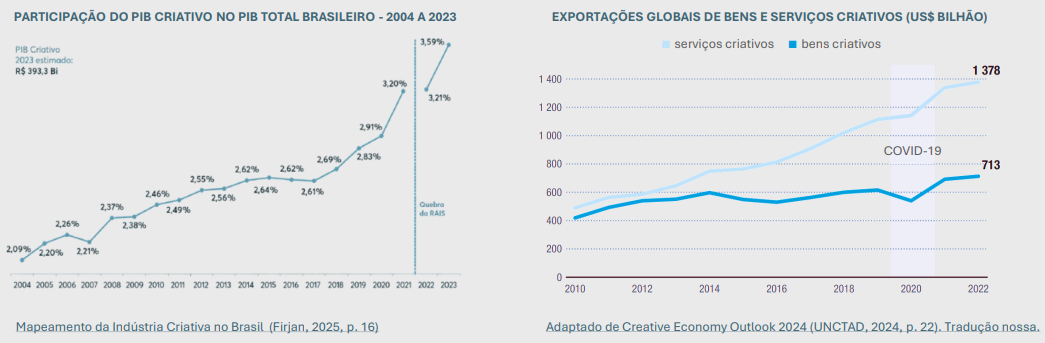
In Brazil, in 2023, the Creative Industry moved R$ 393.3 billion — equivalent to 3.6% of the national GDP, and employed more than 1.26 million formal professionals.
And all this growth occurs at a moment of unprecedented technological transformation.
The advancement of Generative Artificial Intelligence (GAI) technologies, which gained momentum from 2022 onwards, has become part of the daily lives of creators, companies and cultural institutions, altering the way ideas are produced, distributed and consumed.
In sectors such as design, fashion, audiovisual, advertising and music, these tools have been integrated into content creation, editing and circulation processes, expanding productivity, but also raising new ethical, economic and cultural questions.
The Creative Futures Report stems from this context of expansion and, at the same time, uncertainty. We want to investigate how the adoption of Generative Artificial Intelligence is transforming the production, circulation and added value of the creative industry in Brazil, gathering national and international empirical references to qualify the debate on the future of the creative sector.
The report seeks to measure impacts and understand how human creativity reinvents itself in the face of a new technological scenario, and which paths open up for a sector that combines culture, ideas and economics as drivers of development.
Sources: Mapeamento da Indústria Criativa no Brasil (Firjan, 2025); O futuro da economia criativa: área vai criar um milhão de vagas até 2030 no Brasil (CNI, 2023).
Sample Data
What is the creative industry?
The creative industry is a sector that transforms ideas into economic, social and cultural value, bringing together activities based on creativity and intellectual knowledge. In addition to generating products and services, the industry drives economic and social development, strengthens cultural identity and expands Brazil’s soft power in the world. Creative professionals are at the forefront of experimentation and the application of new technologies, business models and production formats. They act as agents of change, capable of anticipating trends and generating value for companies and society.
The areas of the creative industry include:
- Consumption: advertising and marketing; architecture; design; fashion
- Culture: music; performing arts; cultural expressions
- Media: publishing; audiovisual
- Technology: information and communication technology (ICT); biotechnology; research & development (R&D)
Given the broad scope of the creative industry, the research focused on the ten subsectors with the highest formal employment generation in Brazil1:
- Advertising and Marketing
- R&D
- ICT
- Architecture
- Design
- Publishing
- Biotechnology
- Cultural Expressions
- Audiovisual
- Fashion
Source: 1. Mapeamento da Indústria Criativa no Brasil (Firjan, 2025).
The importance of AI in these sectors
AI, especially generative AI, has been consolidating itself as a transformative element in the creative industry, and its use has been expanding rapidly among sector professionals. AI has been used as a tool to support and expand creative capabilities, automating repetitive tasks and allowing creators to spend more time on higher artistic-value activities. At the same time, ethical and cultural discussions arise about authenticity, authorship and trust, as well as perceptions about the possible replacement of human functions, reflecting the complexity of the creative role in an increasingly digital ecosystem.
- Influencers and content creators use AI to edit content, generate images and videos. Writers use AI for grammar review and brainstorming;
- in music and audiovisual, GAI has been applied in editing and automatic translation of content, which can expand the global reach of works and cultural experiences;
- in marketing, the use of data-driven models and campaign automation accelerates processes and favors the personalization of messages;
- in the area of design and architecture, AI has been incorporated to support prototyping and visual reference generation.
These transformations require continuous training and professional adaptation to achieve the positive potential of technology, since mastery of AI tools becomes an essential competence of contemporary creative work.
Sources: The Sky is Rising (The Copia Institute & CCIA, 2024); The Ipsos AI Monitor (Ipsos, 2025); The economic potential of generative AI (McKinsey&Company, 2023); A Realidade do Marketing no Brasil (HubSpot, 2025); A.I. and Creators: The Future of Tech and Creativity (Youtube; Radius, 2025); The Effects of Generative AI on Productivity, Innovation and Entrepreneurship (OCDE, 2025); Jobs of Tomorrow: Large Language Models and Jobs (World Economic Forum, 2023).
Methodology: the knowledge synthesis
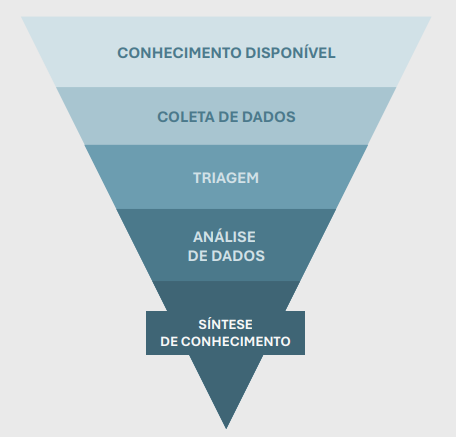
A knowledge synthesis is a systematic process of collecting, analyzing and integrating existing research and evidence on a specific topic. Its objective is to identify findings, reveal patterns, highlight gaps and generate conclusions or recommendations based on a rigorous review of multiple studies — what we usually call a literature review.
But how to provide transparency and reproducibility in this case? We chose to adopt a systematic review, a technique that uses a rigorous, transparent and pre-defined methodology to minimize bias. The process involves a comprehensive and reproducible search strategy to find all relevant studies, independent screening by multiple reviewers, and quality assessment of the included studies.
Furthermore, Reglab sought new references and methodological innovations for this research. On a topic where there are important opposing narratives and a difficulty in ensuring the analysis of all studies in the field (especially due to the breadth of the topic), we sought to adapt a bias-reduction method known in the exact sciences: the red/blue teams method.
Sources: ANDERSON, C.; REYNOLDS, Travis. Conducting a Literature Review. Washington, DC: University of Washington (Evans School of Public Policy and Governance), 2020. FERRIS, T.; CAMELIA, F; MATTSSON, T; MACHADO, R. Red-teaming as a research validation method for systems engineering thesis students. INCOSE International Symposium, v. 32, n. 1, p. 529-544, 2022. Disponível em: https://doi.org/10.1002/iis2.12947. TORRACO, Richard J. Writing Integrative Literature Reviews: Guidelines and Examples. Human Resource Development Review, v. 4, n. 3, p. 356–367, 2005.
The Blue/Red Team Approach
The methodology was designed to test opposing interpretations observed in the use of GAI in the creative industry, with the goal of reducing bias in the selection of evidence. To this end, we divided our team into two groups:
| Blue Team |
Red Team |
| Sought evidence of positive impacts of GAI in the sector, such as economic growth, job creation, market diversification and expanding the reach of creative audiences. |
Sought evidence of negative impacts of GAI in the sector, including job losses, reduced compensation, precariousness of creative functions and risks to the authenticity of work. |
After collection and screening, we arrived at 51 documents, including institutional reports, scientific articles, public policy documents and market studies. Public and empirical sources were considered, with a geographic scope covering global, national, Latin American and upper-middle-income country research over a 3-year period, from August 2022 to August 2025.
The complete methodology is attached to this report.
Furthermore, we encourage other organizations and researchers to contribute to data collection — whether by updating with new research or by covering points we did not identify — so that we can publish periodic updates of this report.
Results
Main results
From the data collected, it was possible to assemble an exploratory overview of how Generative Artificial Intelligence is being incorporated into the creative industry. The findings were organized into four axes:
| Axis |
Description |
| 1. Uses |
Applications of generative AI in tasks and workflows in the creative industry. |
| 2. Revenue |
Estimates and evidence on the economic impact and potential added value in creative sectors. |
| 3. Employment |
Transformations in professional roles and profiles. |
| 4. Perceptions |
Impressions of creative industry professionals regarding the risks, opportunities and implications of AI. |
Uses
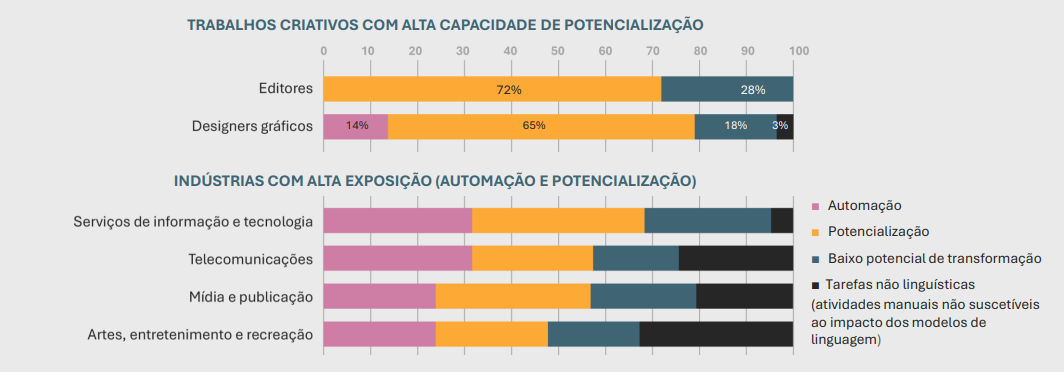
In general, there is greater use for augmenting existing activities than for automation
Creative sectors show greater capacity for augmentation — that is, when AI increases productivity — than for automation, which involves replacing tasks with automated systems. This dynamic may suggest greater net gains in the sector, with increased productivity and the emergence of new roles.
Even so, this potential depends on institutional, infrastructure and technology access conditions, linked to factors such as technical training, connectivity, innovation policies and distribution of economic benefits.
Source: Adapted from Jobs of Tomorrow: Large Language Models and Jobs (World Economic Forum, 2023, p. 11 and 15).
Digital creators stand to benefit greatly from the uses
Generative AI has consolidated itself as a strategic ally for content creators and digital influencers, expanding productivity, creative diversity and new monetization opportunities.
92% of creators say they use generative AI. The main uses and benefits mentioned are:
| Use / Benefit |
Percentage |
| Creative support (optimizing editing, accelerating production or as a stimulus for new ideas) |
96% |
| Reduces production costs |
87% |
| Faster and more efficient work |
55% |
| Idea generation |
58% |
| Content research and brainstorming |
45% |
| Video and image generation |
33% |
| More engaging content |
46% |
| Time savings |
29% |
| Creative ideas |
28% |
Sources: 1. A.I. and Creators: The Future of Tech and Creativity (YouTube; Radius, 2024); 2. Creator Economy 2024: Insights, Achievements, and the Road Ahead (Schwarzwald Capital, 2025); 3. AI in Influencer Marketing: 2023 Study (SocialPubli, 2023); The Socioeconomic Impact of Digital Businesses in the Creator Economy in Brazil (FGV ECMI; Hotmart, 2024).
Audiovisual: films and music have different AI uses, and adoption is expanding
The use of GAI in the sector combines diversity in creative form and ethical concerns. While challenges arise around authorship, concerns about voice rights, cultural identity and transparency about data in model training, evidence also points to a scenario of growing cooperation between technology and creativity. Main uses include:
- Technical and operational use: AI tools are applied to editing, mixing and finishing works, optimizing processes and reducing costs. Automation of repetitive tasks allows for greater efficiency and independent production.
- Creative cooperation: Record labels and artists use AI to expand artistic possibilities and recreate fan experiences. Cases such as the recreation of Brenda Lee’s voice (performer of the classic “Rockin’ Around the Christmas Tree”, in a Spanish version) and the restoration of Beatles recordings show how AI is redefining artistic creation.
- Engagement and personalization: AI expands the personalization and global reach of content, including better entertainment options, including films and music, creating more immersive experiences.
Sources: 1. Inteligência Artificial e Cultura: perspectivas para a diversidade cultural na era digital (Cetic.br, 2022, p.131); 2. Global Music Report 2025, (IFPI, 2025); 3. The IPSOS AI Monitor 2025 (Ipsos, 2025); Global Music Revenues Are Forecast to Double to $200 Billion in 2035 (Goldman Sachs, 2025); Efectos de la Inteligencia Artificial en Derechos Laborales y Creativos en la Industria Audiovisual (2020 a 2024) (Ortiz, 2025).
Marketing and advertising: high technological absorption and a positive professional outlook
The advertising sector has stood out as one of the most dynamic in AI adoption, and marketing professionals are among those who use Generative AI the most. Studies show gains in productivity and operational efficiency, while other studies also point to caution regarding risks of creative homogenization and loss of critical thinking.
How is AI being used in advertising?
| Application |
Description |
| Campaign personalization and optimization |
AI allows adapting messages and formats according to consumer behavior, offering more individualized communication and enabling audience loyalty. |
| Process automation |
AI tools streamline operational tasks such as text generation, ads and reports, freeing up time for strategic activities. |
| Predictive analysis and segmentation |
AI processes large volumes of data and identifies consumption patterns, making marketing more analytical and data-driven. |
- 61% of Brazilian marketing professionals see AI working alongside their teams to accelerate results.
- 71% of digital advertising respondents believe that the benefits of artificial intelligence outweigh the drawbacks.
- 27% point to the learning curve as an obstacle to AI adoption in marketing, a low rate compared to other professions.
Sources: 1. IBM Global AI Adoption Index – Enterprise Report (IBM; Morning Consult, 2023, p. 38); 2. The economic potential of generative AI (McKinsey&Company, 2023); 3. A Realidade do Marketing no Brasil 2025 (Hubspot; Canva; Hypeauditor, 2025); 4. Decodificando os desafios da IA no mercado de publicidade Digital (IAB Brasil; Nielsen, 2025); Marketing Digital: contribuições da Inteligência Artificial na Criação de Conteúdo Estratégico Personalizado (Kanezaki; Oliveira; Canella, 2024).
In the visual arts, augmentation potential is much higher than automation, creating new expressions
The visual arts encompass a wide range of generative AI applications. Due to their market characteristics, it is one of the creative subsectors most exposed to “augmentation”, rather than automation.
Uses and Trends — Visual Arts
| Area |
Application |
| Image creation |
Designers use text-to-image generation models to test ideas and visual compositions. Works created with AI tend to have greater engagement, being more “favorited”. |
| Digital exhibitions |
AI is used to create digital galleries and immersive exhibitions, globally accessible, expanding access to art and connecting artists and audiences in virtual environments. |
| Architecture |
Algorithms help architects test forms, predict lighting and optimize structures. |
| Crafts |
AI assists in the production and design of handcrafted pieces, automating repetitive tasks and allowing professionals to migrate to creation, maintenance and programming roles. |
| Digital art |
African artists use AI in multimedia installations and digital portraits, combining algorithms with traditional painting techniques to explore identity and cultural representation. |
Sources: 1. Barômetro de empregos de inteligência artificial 2025 (PwC, 2025, p. 25); 2. The effects of generative AI on productivity, innovation and entrepreneurship (OCDE, 2025, p. 21); 3. Creative Economy Outlook, (UNCTAD, 2024).
In journalism and the publishing market, use is more diversified and expanding more slowly
Generative AI has been incorporated in various ways into journalism and the publishing sector, enhancing activities involving analysis, curation and content production. The Publishing area is among those most exposed to capacity-augmenting activities.
- Data analysis: GAI tools are used to map discourses, detect and analyze sentiments on social networks, supporting journalistic investigation and online behavior analysis.
- Content automation and personalization: newsrooms integrate AI into personalization, automation and news synthesis processes, expanding productive efficiency and format diversity.
- Production and editing support: AI tools assist journalists in transcription, research, headline creation and summaries.
- Human oversight: applying AI requires contextual mastery and editorial oversight to avoid biases and ensure the accuracy of analyses. The journalist remains essential for interpreting results and directing complex investigations.
Sources: 1. O potencial da Inteligência Artificial Generativa no Jornalismo: Novas perspectivas para análise de dados nas plataformas de mídias sociais (Paulino; Cabral, 2025); 2. Reuters Institute Digital News Report 2025 (Reuters Institute; University of Oxford, 2025); 3. Artificial Intelligence (AI) in Brazilian Digital Journalism: Historical Context and Innovative Processes (Pinto; Barbosa, 2024); 4. Jobs of Tomorrow: Large Language Models and Jobs (World Economic Forum, 2023).
In fashion, there is a high level of experimentation with uses and applications
The fashion industry has demonstrated various types of GAI use, both in creative and operational processes.
| Area |
Examples of Uses |
| Creative processes |
AI converts sketches into detailed designs, generates product variations and accelerates collection development. |
| Marketing |
AI generates personalized content and identifies behavioral and consumption trends. |
| Personalization |
AI enables virtual fitting rooms, recommendations and interactive shopping experiences. |
| Operational efficiency |
AI for inventory and logistics optimization, reducing costs and product launch time. |
Generative AI use cases with the greatest potential in 2025, according to fashion executives (%)
| Use case |
% |
| Curated product recommendations |
50 |
| Product discovery and customer search |
50 |
| Marketing (e.g.: personalized communications) |
45 |
| Product design and other creative processes |
41 |
| Operational efficiency |
39 |
Consumer perception in luxury fashion: in tests, consumers showed a preference for designs created by AI, which was even greater when the origin was not revealed.
Adapted from The State of Fashion 2024 (McKinsey&Company; The Business of Fashion, 2025, p. 42). Sources: The effects of generative AI on productivity, innovation and entrepreneurship (OCDE, 2025, p. 21); Generative AI: Unlocking the future of fashion (McKinsey&Company, 2023); The State of Fashion 2024 (McKinsey&Company; The Business of Fashion, 2025).
In the games industry, AI is being integrated at different stages of production
AI adoption in the games sector has proven strategic at different stages of the creative process, from design to the player experience. The main uses and applications are:
- Learning personalization and adaptation: the Egyptian company Warrd develops AI-based educational games capable of automatically adjusting the difficulty level according to each student’s performance. The platform has already reached more than 30,000 students in countries such as Egypt, France, Nigeria and Senegal.
- Creative workflow automation: Indonesia’s Iota Kreatif Media, specializing in games and digital entertainment, uses AI to optimize creative workflows in design.
- Dynamic experiences and interactive narratives: AI has been used to automatically generate levels, environments and game rules, as well as scripts that adapt to the player’s choices, creating personalized experiences.
Source: Creative Economy Outlook 2024 (UNCTAD, 2024, pp. 57-58).
But there are problems and challenges in implementing these uses efficiently and broadly
Evidence and perceptions also point to problems and challenges in implementing GAI in the creative industry: the challenges include preparing the workforce for the efficient use of GAI and dealing with inequalities in access to digital resources.
- Lack of workforce qualification can prevent the efficient adoption of generative AI.
- Inequality in access to digital tools and education hinders complementarity between tasks and generative AI.
- Team training as an obstacle in AI implementation: marketing professionals point out that team training is an obstacle to integrating AI in a more strategic way.
- Concerns about inaccuracies and biases generate caution among leaders and reduce confidence in AI-produced results.
- Lack of quality of training data is identified as a critical factor that compromises the performance and reliability of AI systems.
Productivity gains and augmentation brought by GAI will only be sustainable if institutional, formative and technological conditions are strengthened. Without this infrastructure, the benefits tend to concentrate in a few agents, reproducing asymmetries rather than promoting inclusion and creative development.
Sources: 1. Buffer or Bottleneck? Employment Exposure to Generative AI and the Digital Divide in Latin America (Gmyrek, Winkler & Garganta, 2024); 2. A Realidade do Marketing no Brasil (Hubspot, Canva & HypeAuditor, 2025); 3. The State Of GenAI In Media And Entertainment (Forrester; AWS, 2024, p. 10); 4. Jobs of Tomorrow: Large Language Models and Jobs (World Economic Forum, 2023, p. 19).
Revenue
Creative sectors have shown uninterrupted growth over the past 5 years
Both in Brazil and globally, overall data on the creative industry show growth, even post-Covid-19 pandemic. The economic and social transformations of the early 2020s had a direct impact on the Creative Industry, marked by the acceleration of digitization and the expansion of social and sectoral policies, which stimulated sector growth. At least for now, there appear to be no signs that GAI has negatively affected sector revenues.
Sources: 1. Mapeamento da Indústria Criativa no Brasil (Firjan, 2025); Creative Economy Outlook 2024 (UNCTAD, 2024).
Total media and entertainment industry revenue may increase with the use of GAI
With the accelerated digitization of content consumption, the media and entertainment (M&E) sector tends to capture a large share of GAI gains. PwC’s 2023–2027 Global Entertainment and Media Research projects growth over five years. In this scenario, GAI emerges as a new engine of productivity and creative innovation, expanding the added value of the M&E sector.
Generative AI use cases will have different impacts on business functions across sectors
| Sector |
Total, % of Industry Revenue |
| Administrative and professional services |
0.9–1.4 |
| Agriculture |
0.6–1.0 |
| High technology |
4.8–9.3 |
| Media and Entertainment |
1.8–3.1 |
| Telecommunications |
2.3–3.7 |
GAI can generate between US$ 80 and 130 billion per year, representing 1.8% to 3.1% of global Media and Entertainment sector revenue.
Projected growth of the Media & Entertainment (M&E) industry through 2027
| Market |
M&E Sector |
Economy (general sectors) |
| Brazil |
+3.4% (above average) |
+2.0% |
| Global |
+2.8% (slightly below) |
+3.1% |
Source: 1. Elaborated from The economic potential of generative AI (McKinsey, 2023, p. 25). Source: 2. Elaborated from Pesquisa Global de Entretenimento e Mídia 2023-2027 (PwC, 2023, p. 5).
In some creative industry sectors, the economic impact of GAI is much greater, especially fashion and digital creation
In the fashion, apparel and luxury sector, generative AI can add between US$ 150 billion and US$ 275 billion to operating profit in the next 3 to 5 years. The projected growth stems from the use of generative models in design, personalization and supply chain processes. The potential for efficiency and creativity gains explains the projected value leap, especially in companies that manage to integrate GAI into sustainable and consumer-centric practices.
The digital creation sector is also going through a period of expansion, estimated at US$ 300 billion in 2024, potentially doubling by 2030, driven by factors such as increased fan engagement, new monetization tools and shifts in consumer behavior toward more personalized content. Among these transformations, the role of artificial intelligence stands out, as it has been redefining how creators produce, distribute and monetize their content.
Sources: 1. Generative AI: Unlocking the future of fashion (McKinsey, 2023); 2. Creator Economy 2024: Insights, Achievements, and the Road Ahead (Schwarzwald Capital, 2024).
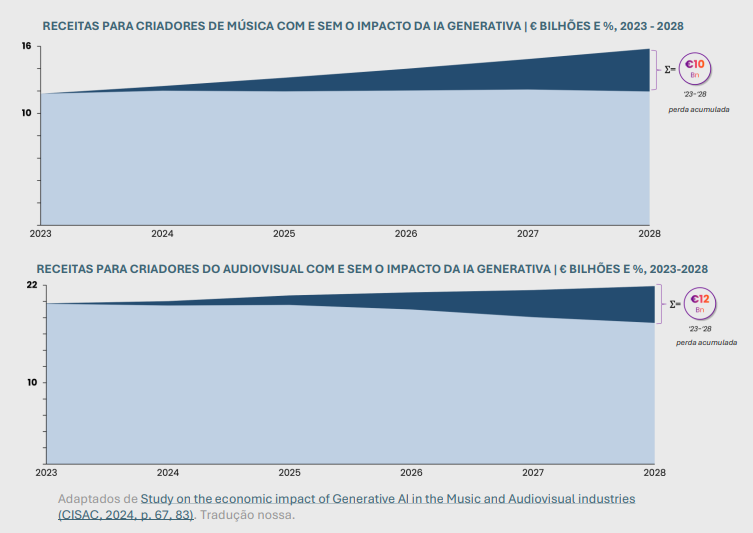
Music and audiovisual sectors will continue to grow, but companies may concentrate revenues more than individual creators
AI-driven music sector revenues are expected to increase, with expansion sustained by “prompt-to-output” tools and AI-assisted creation software.
However, individual creators may see their revenues reduced, potentially losing up to 24% (music) and 21% (audiovisual) of their earnings by 2028.
Sources: Study on the economic impact of Generative AI in the Music and Audiovisual industries (Cisac, 2024).
Sector Employment
Evidence and projections point both to the end of current jobs and to the emergence of new occupations in the creative sector
On one hand, a reduction in position supply and demand for vacancies with mechanical and freelance functions:
- Between eight months and a year after the launch of ChatGPT and AI tools for image generation, a 21% reduction in writing and programming vacancies was observed, and a 17% reduction in 3D modeling and graphic design.
- A 2% drop in freelance jobs on the Upwork platform, with similar results for the design area, related to the launch of ChatGPT.
- Creative freelancers have faced AI substitution in jobs such as video editing, content writing and graphic design.
On the other hand, the sector continues with demand for labor:
- 389,000 vacancies in the creative industry were announced on the Hotmart Platform in 2024, an increase of 30% compared to the previous year.
- Information and communication technology professionals are among those most exposed to AI, but continue with a positive level of job demand.
- The graphic design sector shows a high potential, of around 75%, for increased complementarity with AI use.
Sources: 1. Who Is AI Replacing? The Impact of Generative AI on Online Freelancing Platforms (Demirci, Hannane & Zhu, 2023), 2. The Short-Term Effects of Generative Artificial Intelligence on Employment: Evidence from an Online Labor Market (Hui, Reshef & Zhou, 2023), 3. Artificial intelligence and technological unemployment (Nigar et al. 2025); 4. The Socioeconomic Impact of Digital Businesses in the Brazilian Creator Economy (FGV ECMI & Hotmart, 2024), 5. Barômetro de Empregos de Inteligência Artificial 2025 (PwC Brasil, 2025), 6. Jobs of Tomorrow: Large Language Models and Jobs (World Economic Forum & Accenture, 2023).
New occupations can also be driven by language models and generative artificial intelligence
According to the Jobs of Tomorrow study, the expansion of language models and GAI has driven new models of collaboration between humans and AI, giving rise to occupations that require creativity, technological mastery and critical thinking. Among the new occupations are:
- AI Content Creators: Professionals who use language models (LLMs) to generate and enhance content in different areas. They master the functioning of AI models to produce original and personalized content.
- Interface and Interaction Designers: Responsible for making AI systems accessible, intuitive and creative. These professionals work on creating personalized assistants, immersive environments and creative tools, ensuring usability, aesthetics and inclusion in AI interaction.
Sources: Jobs of Tomorrow: Large Language Models and Jobs (World Economic Forum, 2023, p. 13).
In Brazil, there is a prospect of job growth in the cultural sector above the average of other sectors
By 2030, the creative industry is expected to generate around one million new jobs in Brazil, equivalent to one in every four created in the period, reaching a total of 8.4 million employed workers.
- 13.5% is the projected growth of the Brazilian creative industry through 2030
- 4.2% is the projected growth of other sectors of the Brazilian economy through 2030
This increase fits into a larger trend. In Brazil, jobs requiring AI skills grew 30% in 2024, while the global average was 7.5%, even in a scenario of an 11% drop in total job postings worldwide.
Sources: 1. Observatório Nacional da Indústria (CNI, 2023), 2. Barômetro de Empregos de Inteligência Artificial 2025 (PwC Brasil, 2025).
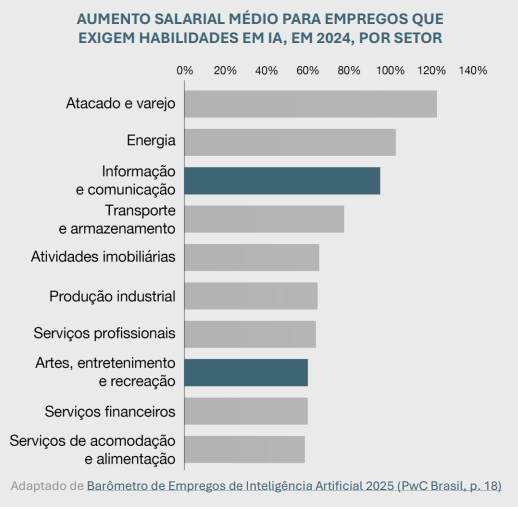
AI skills have enabled salary increases for workers with these qualifications
According to PwC research, salaries of professionals with AI skills are, on average, 56% higher. This difference is observed across all analyzed sectors, including arts, entertainment, recreation, information and communication, indicating a broad trend of digital skills valorization.
*Higher salaries also reflect the scarcity of these talents. However, rarity alone does not explain the increase: to pay more, organizations need to recognize the strategic value that these competencies represent.
Source: Barômetro de Empregos de Inteligência Artificial 2025 (PwC Brasil, 2025).
Lack of human training remains a significant barrier to AI adoption
Education and human skills are determining factors for workers, especially in occupations with potential for productivity gains, to be able to reap the benefits of GAI. The lack of training is a critical barrier, especially in developing economies such as Latin America and the Caribbean, where there is a shortage of foundational skills needed to absorb the productivity and innovation gains brought by technology.
This trend is confirmed in the marketing sector:
- For 34% of marketing professionals, the lack of team training is a barrier to implementing AI in operations.
This means that AI adoption can combine efficiency gains with human and operational challenges, requiring continuous training and adaptation.
Sources: 1. Buffer or Bottleneck? Employment Exposure to Generative AI and the Digital Divide in Latin America (Gmyrek, Winkler & Garganta, 2024); 2. A Realidade do Marketing no Brasil (Hubspot, Canva & HypeAuditor, 2025).
Lack of legal clarity and regulatory gaps weaken the protection of creative work in the context of GAI
Evidence collected in sectoral studies indicates that the absence of clear legal frameworks on GAI use may have impacts on creative work. These gaps may compromise authorship protection and job security for those working in creative sectors.
- In Colombia, for example, vacuums in labor legislation and copyright law regarding AI use leave authors without protection regarding the use of their voices and previous works, without defining the relationship between the dignity of work and the use of AI.
- In Brazil, there are no objective legal definitions of what “Artificial Intelligence” is, nor regarding authorship and ownership of works created with the assistance of generative systems — which creates legal uncertainty and the risk of devaluing human work.
Source: 1. Efectos de la Inteligencia Artificial en Derechos Laborales y Creativos en la Industria Audiovisual (2020 a 2024) (Ortiz, 2025), 2. A INTELIGÊNCIA ARTIFICIAL COMO AMEAÇA OU OPORTUNIDADE? UMA ANÁLISE DO IMPACTO NO TRABALHO DOS ROTEIRISTAS (Müller, 2025).
Perceptions
Perceptions about GAI are generally negative, but concerns focus more on creative effects, market concentration and regulation than on substitution
Among Brazilian screenwriters, concerns prevail about the impact of GAI on creativity and about the concentration of market power in technology companies, even though there is confidence in existing intellectual property rules as a means of protecting authorial work.
- In general, a skeptical view predominates regarding the potential of AI to replace human screenwriters.
- There is growing demand for GAI regulation in the film industry.
These perceptions resonate with the international context: In 2023, the Hollywood writers’ strike in the US highlighted similar tensions: the search for authorship guarantees and fair remuneration in the face of GAI advancement. The agreement that ended the strike established clauses preventing AI systems from being credited as authors and ensuring that human screenwriters maintain their credits and payment, even when AI is used partially in the creative process.
Source: Direito do autor e inteligência artificial generativa: a perspectiva do roteirista na indústria cinematográfica (Veloso, 2023).
The general public believes that AI will increase entertainment options
In the field of the creative industry, approximately 2/3 of respondents believe that the use of AI will improve their entertainment options (films, music, books) over the next 3–5 years.
67% of respondents believe that AI will improve their entertainment options.
Despite concerns about misinformation and brand trust, the research indicates a mixed but predominantly positive impact, especially in media, entertainment and advertising.
Source: The Ipsos AI Monitor (Ipsos, 2025).
Perceptions and usage reports among digital creators are generally positive
- 87% believe that AI will allow expanding the global reach of content through automatic translations.
- 89% see the technology as indispensable support for adding value to their work in the coming years.
- 9 out of 10 believe they are not using AI to its full potential.
- Brazil is the 2nd largest creator market in the world.
However:
- 71% of creators fear loss of originality from AI use, demonstrating the dilemma between efficiency and creative authenticity.
Sources: 1. A.I. and Creators: The Future of Tech and Creativity (YouTube & Radius, 2024), 2. Creator Economy 2024: Insights, Achievements, and the Road Ahead (Schwarzwald Capital, 2024).
In advertising and marketing areas, impressions are of productivity gains and increased ROI with AI adoption
By including AI in their work:
- 95.4% of marketing professionals observed a positive impact on ROI.
- 72.3% of marketing professionals surveyed report significant improvements in quality.
- Among the main benefits obtained from AI use, respondents cited: increased efficiency (80%) and increased speed (68%).
- 97.9% of marketing professionals surveyed plan to increase AI use in the next 12 months.
Source: 1. A Realidade do Marketing no Brasil. Hubspot, Canva & HypeAuditor, 2025), 2. Decodificando os desafios da IA no mercado de publicidade digital (IAB e Nielsen Brasil (2024)).
Analysis and Commentary
This section analyzes the research data through the lens of the authors of this work.
There is a gap between data and perception — and this may indicate pre-existing structural issues in the sector
Although revenues of companies that make up the Creative Industry continue on an expansion trajectory, both in Brazil and globally, the diffusion of AI technologies is not generating equally positive perceptions among some sector professionals. The scenario may suggest, as a hypothesis, that this difference between macroeconomic data and individual perceptions relates to historical dynamics, such as concentration of production infrastructure and intellectual property catalogs — processes that predate AI.
This inference is reinforced when we compare the uninterrupted growth of sector revenues, the negative perceptions of some creators and the projections of stagnant individual income in traditional sectors, against the advance of company revenues. This mismatch may reflect a dynamic already known in the cultural market: productivity gains tend, in certain contexts, to be appropriated by actors who already control means of production, infrastructure or proprietary rights. The regulatory challenge, therefore, would be to ensure that the digital transition of creative sectors, including AI adoption, does not amplify structural asymmetries between those who produce, those who distribute and those who hold control of proprietary rights and means of production.
AI can accelerate creative democratization, reducing the distance between production and consumption
The research data reveals that the group of digital creators — precisely where there are lower barriers to entry — is one of the most enthusiastic and active in the use of generative AI, not only to increase productivity, but to expand their aesthetic language. This adoption is reconfiguring the symbolic structure of cultural production. Cases such as the character Marisa Maió, created entirely by AI by screenwriter Raony Phillips, illustrate how image and video generation tools are making accessible a type of production previously restricted to large studios and budgets. The character’s virality demonstrates AI’s capacity to reduce barriers to creation, enabling the construction of new audiovisual narratives.
This “creative democratization” is not without risks: the abundance of content may reinforce new forms of aesthetic homogenization, dependence on digital platforms and make it more difficult to combat illegal activities.
AI literacy is an enormous barrier for sectors with lower technological absorption
The appropriation among digital creators contrasts with the resistance observed in sectors with lower technological absorption capacity, such as traditional audiovisual and the publishing market. This becomes evident when we perceive the negative impressions of some professionals even in the face of sophisticated editing, scripting and design tools.
This finding suggests the urgent need to address public policies on AI digital literacy, not only for technical training, but also for critical analysis of its use and of the existing political economy between creators, entertainment companies and technology companies.
There is no evidence of massive job losses due to AI, but there are important signs regarding the revaluation of roles and professions
The research data indicates that, in Brazil, the creative sector shows growth above the national average in job creation and compensation, even amid increasing adoption of AI technologies — that is, the use of this technology has not, until now, translated into widespread elimination of jobs. However there are signs of structural reconfiguration of functions and competencies — in other words: what changes is not the supply of vacancies, but the type of competency required and who is prepared.
This transition favors those who already have cultural and educational capital and affects less qualified workers. These findings seem to reinforce the importance of cultural and educational policies incorporating the dimension of work as a structural priority in AI governance, identifying how to create conditions for new professional profiles to emerge, ensuring that AI productivity gains are socially distributed.
The regulatory agenda has not yet kept pace with the economic and symbolic sophistication of the phenomenon
The research results reveal that the public and regulatory debate on the use of Artificial Intelligence in the creative industry, especially in the context of Bill 2338/23, is still marked by a limited understanding of the phenomenon. While public opinion demonstrates growing familiarity and openness to AI use, institutional debates continue to be centered on more moralistic views less connected to economic data and opinion research.
This asymmetry between the public’s perspective and the regulatory perspective needs to be deepened in future studies. Even though it is not a problem unique to technology debates, the legislative process on AI and culture runs the risk of producing regulation without social adherence, unable to understand how people interact, consume and reinterpret technologies in their daily lives.
Conclusion and Directions
- GAI is already an integral part of the creative industry, in Brazil and worldwide. It was possible to observe that its adoption is concentrated in areas such as marketing, design and digital content creation. The advancement of these tools redefines processes, expands creation possibilities and alters the dynamics of cultural production and circulation.
- Even the cases of positive evidence include caveats by suggesting that the augmentation of creative sector activities through GAI use only materializes when accompanied by technical training, ethical policies and inclusion mechanisms, ensuring that AI is treated as a support tool for human work.
- The scenario is marked by ambiguous perceptions and uncertainties. Among companies and professionals in the creative industry, enthusiasm and apprehension coexist in the face of possible losses of control, authorship and authenticity. There are also expected changes in the profile of occupations, with the emergence of new roles and the reconfiguration of others, which imposes qualification and equitable technology access challenges.
- As this is a recent and rapidly changing phenomenon, this study intended to explore and does not seek to exhaust the topic or offer definitive answers about the impact of GAI, but to map emerging evidence and trends that help understand the direction of this change.
- The evidence suggests that the impact of generative AI depends on the context of adoption, which includes public policies, infrastructure and business practices that shape economic and cultural effects.
The study covered materials published through August 2025, reflecting a rapidly changing socioeconomic landscape and evidence of impacts still being consolidated. Therefore, the results should be interpreted as a snapshot of a scenario in motion, and not as definitive conclusions.
Directions for future studies
- Temporal expansion and evidence updates: future research can conduct longitudinal studies and periodic data updates, tracking the evolution of AI adoption in creative subsectors after August 2025. As the growth of GAI adoption is recent, this will allow more consolidated trends to be observed.
- Exploration of the hypothesis on individual perceptions and gains distribution: future research can systematically investigate the hypothesis about the disconnect between macroeconomic indicators of the creative industry and the perceptions of some professionals. This deepening would allow examining how existing structural asymmetries in the cultural ecosystem relate to AI adoption, helping to clarify possible distributive effects in the sector.
- Qualitative deepening of cultural and ethical effects: since the research focused on secondary data, it is recommended to develop qualitative studies (such as structured interviews, netnographies and reception studies with creative industry professionals) to understand perceptions about authorship, authenticity and trust in AI-mediated creations.
- Professional training initiatives: the consolidation of technologies in the creative industry requires policies that combine digital literacy and technological inclusion. Future studies can map educational programs and private sector initiatives focused on professional training and AI adoption in the creative industry.
- Geographic expansion: the scope, centered on upper-middle-income countries, Brazil and Latin America, can be expanded to include benchmarks from other countries, to compare regulation strategies, development incentives and technology adoption models.
Methodology Annex
General information
Reglab’s research adheres to rigorous methodological standards to ensure objectivity and transparency. All data and findings are available for independent verification, reinforcing the credibility of our studies.
Data collection and analysis took place from September 18 to October 30, 2025, with double validation for bias reduction, and the use of software to organize results.
- 1. Data Collection
- 2. Data Analysis
- 3. Bias Reduction Procedures
- 4. Other information
- 5. Ethical Guidelines
| Item |
Details |
| Work Title |
Creative Futures: how Artificial Intelligence is reshaping the creative industry in Brazil |
| Research Question |
How is the adoption of generative artificial intelligence technologies transforming, in terms of production, circulation and added value, the creative industry in Brazil? |
| Methodology Summary |
The study investigates how the adoption of generative artificial intelligence (GAI) is transforming the production, circulation and added value of the creative industry in Brazil. The methodology is inductive and exploratory, combining documentary and secondary data analysis with qualitative content analysis. Data collection followed criteria focused on empirical materials, covering global, Brazilian and comparable market contexts, with an evidence validation model based on a search for positive and negative impacts of GAI in the sector. Inferences derived from the database were categorized into thematic axes allowing the identification of trends and transformations in creative subsectors. |
1. Data collection
Data collection was carried out through documentary analysis of secondary data (desk research), with a systematic review of empirical sources. The process involved the identification and selection of materials on the creative industry and the adoption of generative AI. Pre-defined criteria were applied to guide the inclusion of documents in the research.
| Criterion |
Description |
| General Criterion |
Covers publicly accessible materials, focusing on empirical data. Includes articles, sectoral reports, databases, search engine results and AI research tools, using pre-defined entry criteria. The geographic scope of the data covers global, national and comparable markets — defined as Latin American countries and/or other upper-middle-income economies, as classified by the World Bank (2025-2026). |
| Search sources |
General search engines (Google, Google Scholar); Databases such as Statista and AI tools (ChatGPT – deep research, Perplexity, DeepSeek). |
| Data publication period |
August 2022 to August 2025 |
| Collection period |
September 18 to October 3, 2025 |
The entry criteria used in the source search were based on the blue team and red team methodological approach, with the objective of testing opposing interpretations about the impacts of GAI in the sector and minimizing biases in research results.
Entry criteria — Blue Team (searches for evidence of positive impacts)
PT:
- “inteligência artificial generativa” + “crescimento econômico” ou “impacto positivo” + “indústria criativa” ou “economia criativa”
- “IA generativa” + “novas oportunidades” ou “inovação” + “mídia e entretenimento”
- “Inteligência Artificial” + “engajamento” ou “expansão de público” + “setores criativos”
- “Inteligência Artificial” + “produção cultural” ou “produção criativa” + “benefícios” ou “vantagens”
- “Indústria criativa” + “IA generativa” + “Crescimento de receita” ou “geração de empregos”
EN:
- “Generative Artificial Intelligence” + “economic growth” or “positive impact” + “creative industry” or “creative economy”
- “Generative AI” + “new opportunities” or “innovation” + “media and entertainment”
- “Artificial Intelligence” + “engagement” or “audience expansion” + “creative sectors”
- “Artificial Intelligence” + “cultural production” or “creative production” + “benefits” or “advantages”
- “Creative industry” + “Generative AI” + “revenue growth” or “job creation”
ES:
- “Inteligencia Artificial Generativa” + “crecimiento económico” ou “impacto positivo” + “industria creativa” ou “economía creativa”
- “IA generativa” + “nuevas oportunidades” ou “innovación” + “medios y entretenimiento”
- “Inteligencia Artificial” + “compromiso” ou “expansión de público” + “sectores creativos”
- “Inteligencia Artificial” + “producción cultural” ou “producción creativa” + “beneficios” ou “ventajas”
- “Industria creativa” + “IA generativa” + “crecimiento de ingresos” ou “creación de empleo”
Entry criteria — Red Team (searches for evidence of negative impacts)
PT:
- “desemprego” ou “redução de empregos” + “IA generativa” + “indústria criativa” ou “economia criativa” ou “mídia e entretenimento”
- “perdas” + “IA generativa” + “indústria criativa” ou “economia criativa” ou “mídia e entretenimento”
- “impactos negativos” + “IA generativa” + “indústria criativa” ou “economia criativa” ou “mídia e entretenimento”
- “disrupção” + “IA generativa” + “indústria criativa” ou “economia criativa” ou “mídia e entretenimento”
- “efeitos adversos” + “IA generativa” + “indústria criativa” ou “economia criativa” ou “mídia e entretenimento”
EN:
- “Disruption” + “generative AI” + “creative industries” or “media and entertainment” or “creative economy”
- “Employment loss” or “job reduction” + “generative AI” + “creative industries” or “media and entertainment” or “creative economy”
- “negative impacts” + “generative AI” + “creative industries” or “media and entertainment” or “creative economy”
- “adverse effects” + “generative AI” + “creative industries” or “media and entertainment” or “creative economy”
- “loss of authorship” + “generative AI” + “creative industries” or “media and entertainment” or “creative economy”
ES:
- “disrupción” + “IA generativa” + “midia e entretenimiento” ou “economía creativa” ou “indústria creativa”
- “desempleo” ou “pierda de empleo(s)” + “IA generativa” + “midia e entretenimiento” ou “economía creativa” ou “indústria creativa”
- “impactos negativos” + “IA generativa” + “midia e entretenimiento” ou “economía creativa” ou “indústria creativa”
- “efectos adversos” + “IA generativa” + “midia e entretenimiento” ou “economía creativa” ou “indústria creativa”
- “perdidas” + “IA generativa” + “midia e entretenimiento” ou “economía creativa” ou “indústria creativa”
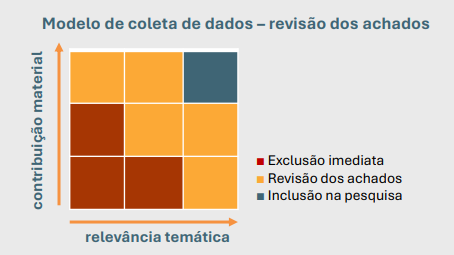
Material contribution
To ensure replicability and methodological transparency, an evaluation matrix based on two axes was used:
Thematic relevance — relationship of the material with the central concepts of the research and the pre-defined criteria. The criteria include: (i) Geographic scope: data from global, national, Latin American or upper-middle-income country contexts; (ii) Temporal scope: materials published between Aug/2022 and Aug/2025; (iii) sources presenting empirical data.
- Low: contain keywords but are not central to the study; and/or do not meet entry criteria;
- Medium: addresses related concepts, but tangentially and/or partially aligns with the criteria;
- High: meets all entry criteria and directly connects to the research concepts.
Material contribution — potential of the document to answer the research question.
- Low: does not contribute to answering the research question;
- Medium: provides limited or partial contribution;
- High: contributes directly to the formulation of the research analyses and inferences.
51 documents were included in the research: 9 collected by the Red Team | 37 collected by the Blue Team | 5 collected by snowballing and referral.
2. Data analysis
After selecting materials according to the defined inclusion and exclusion criteria, the references included in the research were organized in a consolidated spreadsheet for systematic analysis. Records were structured in columns:
- document reference (title, authorship, date and link);
- collection origin — Blue Team, Red Team or snowballing (researcher referral);
- document methodology;
- main inferences extracted*; and
- document region of origin.
*From these references, analytical inferences were produced in paragraph format, synthesizing the main findings of each document. A single reference could generate more than one inference. For example: even among sources collected by the Blue Team, aimed at identifying positive impacts, inferences about risks and challenges of GAI in the sector were also recorded.
2.1 Content analysis
With the consolidated table, the inferences were classified into four main themes, defined inductively after material analysis. They are: (i) employment, (ii) sector revenues, (iii) types of artificial intelligence uses in the creative industry, and (iv) perceptions.
2.1.1 Thematic classification of inferences
- Employment: includes inferences related to the labor market of the creative industry, covering the emergence of new roles, the transformation of existing positions and the reduction or substitution of jobs in certain subsectors.
- Sector revenues: groups inferences about economic and financial data of the creative industry, such as GDP share, revenues, subsector growth and future revenue projections, both globally and in Brazil.
- Uses of artificial intelligence in the creative industry: gathers inferences about practical application forms of generative AI, identifying tasks, workflows and processes in which the technology is used by creative professionals, such as production, editing, creation and automation of work stages.
- Perceptions: comprises inferences about the perceptions and attitudes of different agents in the creative industry, such as executives, creators, artists, marketing professionals, among others, regarding the impacts, opportunities and risks associated with the use of generative AI.
These themes served as the basis for the report’s structure, guiding the organization of analyses and results by thematic axis.
3. Bias reduction procedures
We recognize that all research, especially of a qualitative and exploratory nature, is subject to inherent biases. In Creative Futures, we sought to exercise continuous reflexivity throughout all stages of the study, adopting practices aimed at mitigating subjectivities and balancing interpretations.
- Adoption of pre-defined criteria: From the data collection phase, pre-established search and inclusion criteria were applied, such as the geographic scope (Brazil, Latin America and upper-middle-income countries) to search for data that can be comparable to Brazilian reality, avoiding projections based on developed countries; the temporal scope and the prioritization of empirical materials.
- Search for evidence with opposing impacts: The research used the Blue Team / Red Team evidence validation model, in which different researchers independently searched for positive and negative impacts of generative AI in the creative industry. This division allowed reducing the influence of individual perspectives.
- Collaborative validation of findings: The results of the searches were stored in a shared database, allowing the exchange of observations and interpretations among researchers. The inferences and classifications were subsequently reviewed by a third researcher, ensuring an additional perspective for the analysis.
- Registration and transparency: All collection, classification and analysis steps were documented in a spreadsheet and on the research page, ensuring traceability and transparency of the methodological process.
4. Other information
4.1 Methodological limitations
Temporal scope: the study covered data published between August 2022 and August 2025. Materials released after August 2025 were not included. As this is a recent and rapidly evolving topic, the research has an exploratory character, reflecting the current stage of available evidence. Only publicly accessible materials were included, which may restrict the reach of proprietary data or internal market studies. Furthermore, during collection, relevant reports and evidence from high-income countries were identified, especially the United States and European countries, which presented robust data on GAI use in the creative industry. However, these materials were not incorporated into the database, following the defined geographic inclusion criteria.
4.2 Personal data protection
For this research, personal data and publicly available information contained in reports, statistical databases and open access documents were accessed. Access to this data was restricted to analysis and extraction of inferences linked to the studied references, without direct use of personal data. The processing of publicly accessible personal data observed the principles of purpose, good faith and public interest that justify their availability. No data was used for identification, commercialization or individual monitoring.
4.3 Software use
| Software |
Use in Research |
| MS Office Suite |
Text editing, spreadsheets and charts |
| ChatGPT 4o |
Brainstorming, information systematization, data structuring, chart editing, organization of pre-textual elements, ABNT review, adaptation to the Reglab Writing Manual |
| Notion and Notion AI |
Text editing, data and file organization, chart editing |
| NotebookLM |
Review of secondary data findings |
| Perplexity |
Search tool for finding secondary data |
| Deep Seek |
Search tool for finding secondary data |
5. Ethical Guidelines
This research was funded by Google Brasil internet Ltda. To ensure the integrity of this work, the authors developed, conducted and analyzed the study independently, without any contribution or interference from the company, which also did not influence or interfere in the interpretation of results. The authors maintain full professional independence and responsibility for the content and conclusions of this work.
- Respect for Privacy and Confidentiality: The data used is in the public domain and was obtained from accessible sources, without violating the privacy or confidentiality of any individual or institution.
- Responsible Use of Public Data: Although the analyzed data is public, its use was carried out in a responsible and ethical manner, with the exclusive purpose of independent research.
- Methodological Transparency: The research methodology was detailed to ensure transparency and replicability, contributing to scientific integrity and allowing independent validation of results.
- Non-discrimination and Respect for Diversity: The research was conducted in a manner that respects diversity and avoids any form of discrimination.